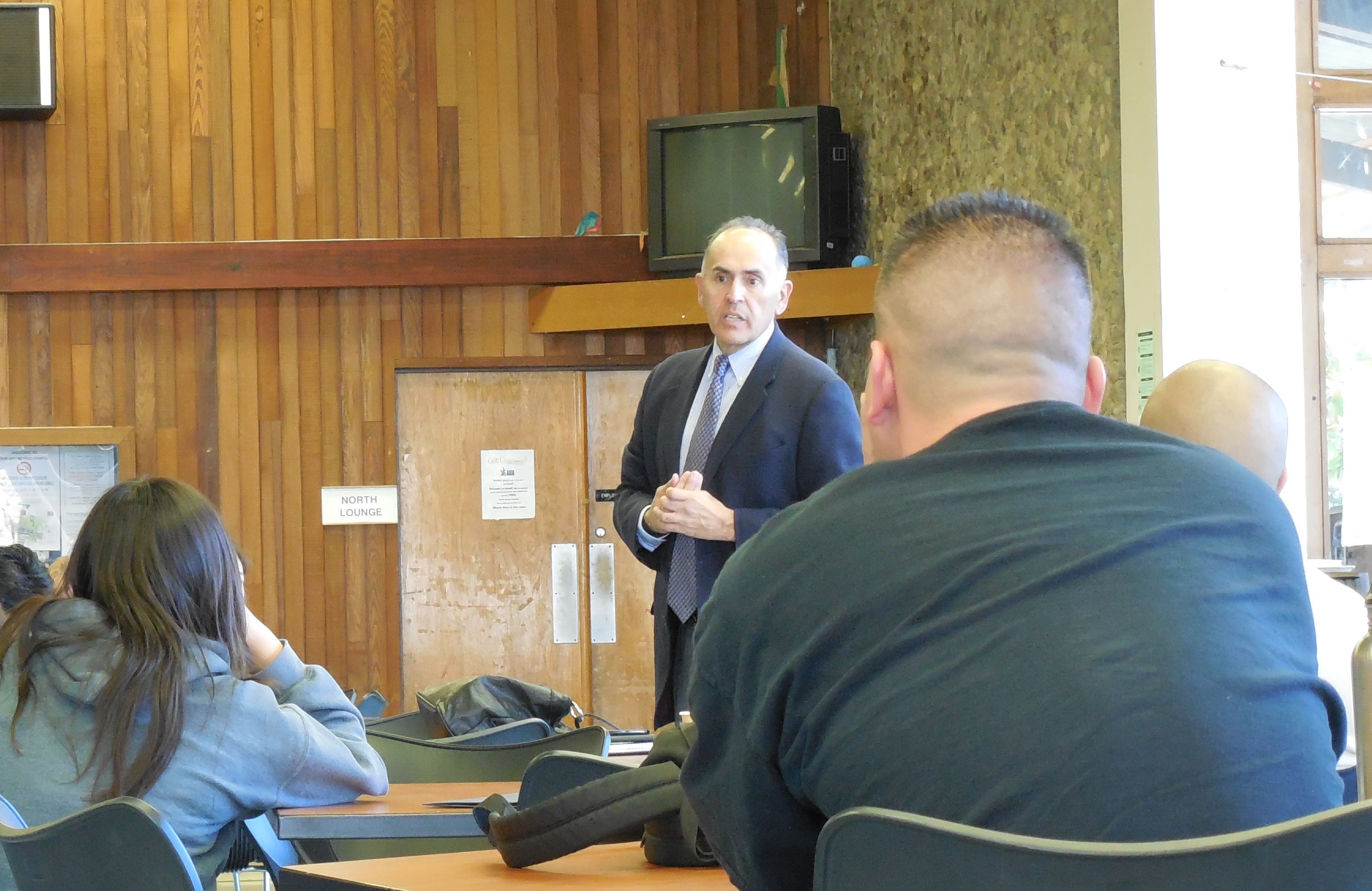
I’ve written about failing at my first try at college and suffering a health crisis that nearly took my life 25 years later. Both episodes resulted in life-changing transformations. I eventually earned a degree and had a dynamic career in executive management and public service, and after that awful summer in the hospital, I got the gift of time to reflect on my experiences. In the reflection process, I found purpose in life.
Growing up in a working-class family, coaching basketball at my high school alma mater, serving as board president of a large school district, working as a vice president of a major U.S. company, and serving as senior staff to public officials have provided me with a treasure trove of stories and anecdotes. These stories are my inspiration for writing East Side Eddie Report.com.
Along the way, I’ve learned a few life lessons about failure, despair, hope and the power of perseverance. The purpose behind creating East Side Eddie Report.com and writing Summer in the Waiting Room is to share these stories to inspire others to achieve their dreams and aspirations. With that in mind, I’m now available as a motivational speaker at conferences, corporate meetings, school activities, and community events.
For my talks, I draw from a broad set of experiences to engage audiences with inspiring, amusing, and colorful stories. My signature keynote address is called, “From Working-Class Family to Corporate Executive, Life in the ICU, and Beyond.” In this speech, I share the inspiring story of persevering through failure, a life-threatening illness, and hopelessness to find success and redemption. I’ve also developed a series of talks on the following topics:
How to Navigate the Executive Office and Achieve Success in the Corporate World
Creating Educational Equity to Provide Leadership for Diverse School Systems
Organizing and Empowering People for the Good of the Community
Be Your Own Advocate: Managing Personal Healthcare in the 21st Century
In addition to being an engaging keynote speaker for any breakfast, luncheon, dinner, or fundraising event, I’m available for presentations as a panelist, seminar presenter, or moderator specializing in corporate, non-profit, and education conferences. My areas of expertise include:
Education Policy and Leadership
Executive Leadership
Healthcare from a Patient Perspective
Coaching Athletics
Organizational Development
Speaking fees are reasonable and negotiable in order fit any budget. I’m also available to speak to middle and high school students at no cost.
To learn more about speaking services and to schedule a speaking engagement for your next event or conference, click on the “Speaking Engagement” tab at the top of the East Side Eddie Report.com page, e-mail eddie.m.garcia@comcast.net, or call 408-426-7698.
President Obama and Cuban Leader Raul Castro shaking hands at Nelson Mandela’s funeral. (file photo)
When President Obama reached out and shook hands with Cuban dictator Raul Castro last week at Nelson Mandela’s funeral the Republican leadership in Congress rushed to the television cameras to criticize the president. The GOP’s shameful response to the president‘s display of graciousness during a solemn ceremony in honor of someone who epitomized forgiveness is exactly why Congress lacks the leadership skills to get anything done in Washington.
Had President Ronald Reagan declined a working relationship with Soviet Premier Mikhail Gorbachev, the world could have been consumed by nuclear holocaust. Perhaps the most famous example of leadership by reaching out to rivals is President Abraham Lincoln. He appointed campaign opponents to cabinet posts; then extended his hand in peace to Confederate rebels promising a post-Civil War America, “with malice toward none, with charity for all.”
One of the most difficult challenges for effective leaders is to be able to bury the hatchet with opponents to benefit those they serve. True leadership embraces conflict and bridges differences for the common good. When I served as a trustee on the East Side Union High School District, overcoming differences with a rival led to the approval of two of the most important district initiatives during the past half dozen years.
The district’s board of trustees appointed me in 2006 on a 3-1 vote. Trustee Frank Biehl was the lone dissenter who vigorously argued against my appointment, so our relationship started off on the wrong foot. Adding to that dynamic, he and I are from different worlds. Frank is white, I’m Latino. He’s the oldest son from a successful family business. I’m the youngest son from an east side working-class family. He’s pragmatic, I’m passionate. On the board, we rarely found common ground.
Two years later, Frank was again the sole “no” vote on my reappointment to the board. That term we started off on two wrong feet. I broke the cardinal rule of leadership; I took Frank’s opposition personally. Instead of looking for common ground, I sought out conflict with him. The result was a lack of productivity on my part.
When the board took a preliminary vote to eliminate after-school sports, we again were on opposite sides of the fence. As a former student-athlete I understood the value of athletics and proposed a plan that would restore funding to the programs. After Frank’s initial vote to eliminate sports programs, he reconsidered and unveiled his own plan to save sports. I didn’t like his ideas and prepared myself for a long fight.
My personal issues with Frank had trumped doing what was right. Rather than fighting for student-athletes and their families, I realized I was opposing Frank’s plan because he had opposed me. It was a valuable on-the-job lesson. I learned that leadership shouldn’t be about me, it should be about those I serve. I reached out to Frank and expressed my concerns about his ideas, and he did the same. With his pragmatic approach and my passion for student athletics, we compromised and saved sports programs.
He supported my candidacy for president of the board a year later. When I announced an initiative to make college entrance requirements the default curriculum for all students, Frank and I shared ideas and worked together for the good of students. I spent that summer in the hospital and he came to visit me. A personal rivalry had turned into friendship. That fall, Frank and I joined a unanimous board in passing a historic policy that ensured that every East Side graduate can to go to college.
I learned a valuable lesson. Leaders must overcome personal differences in order to make decisions that benefit those they lead. Whether you’re PTA president, on the Little League board, a supervisor at work, or President of the United States, these three simple rules can help you avoid the pitfalls caused by personal problems:
It’s not about you. Your role as a leader is to serve others, not the other way around. Your decisions will impact, negatively or positively, those you lead. So make decisions with them in mind.
Keep Your Eye on the Prize. Why did you seek out a leadership role in the first place? Probably to make things better or to make a change. Don’t let personal issues get in the way of accomplishing what you set out to do.
Find Common Ground. Rival leaders may share your vision to make improvements or change, but have different notions on how to get there. Listen to what they have to say. You may find that you have more in common than you think.
Leaders are like the rest of us replete with biases, emotions, fears, and dislikes. Yet unlike the rest of us, they must overcome those personal barriers to ensure the common good. Just imagine what kind of world we would be living in if President Lincoln didn’t have the courage to embrace his rivals to keep our nation united or President Reagan and Premier Gorbachev let personal philosophies keep them from the Cold War peace table.
Hon. Carlos Ponce Martínez, Consul General of Mexico, (pictured with Directora Sandra García) visits Adelante Academy to plant a ceremonial friendship tree on Mexican Independence Day
Blogger’s Note: The following post is about my wife Sandra García. I was initially reluctant to post it because Sandra is uncomfortable with the spotlight. I post it at my own risk.
************************
Sandra García was always a good student. She was 6th grade class president and student body president in high school. Her mom once told me that she has always known what she wanted. She wanted to be a teacher, then a principal; and she accomplished both. Throughout her life, this east side girl has quietly exemplified what it is to be a leader. On December 5th, she will be honored by the San Jose Silicon Valley Chamber of Commerce as the Outstanding Principal of the Year in the Silicon Valley
Sandra comes from a family with strong Latina role models. Her maternal grandmother was a young widow who raised nine children teaching them the values of hard work and perseverance. Sandra’s mom taught her daughters the value of education by participating in their school life during an era when the place for a Latina mother was in the home. These two resilient women forged the foundation of Sandra’s leadership journey that complements her skill, talent, and experience.
I’ve written about how Bob Williams built a team of east side kids into a shoe selling machine at Kinney Shoes during the late 70s and early 80s. I’ve shared with you how Chris Boyd provides the tools his team at Kaiser Santa Clara Medical Center needs to save lives. Raised in a hard-working family with strong Latina role models, Sandra is a genuine leader who brings her own brand of compassion and determination to the leadership table.
A little more than a decade ago, Sandra, several colleagues, and a group of parents dreamed of building a Spanish-English dual language school on the east side. After putting together a design team and getting approval from the school board, Adelante Dual Language Academy opened a year later with three teachers, and 60 kindergarten and first grade students. Sandra has served as principal for all but the first year. Her leadership style comes from the fortitude and nurturing handed down by her grandmother and mother.
Sandra is a stickler for high standards (how she ended up with me begs that question and is fodder for another post). From the smallest household project to gigantic dreams like creating and building a school, she expects the best from herself and those around her. Anything less is just unacceptable. Her passion for Adelante and its success is displayed on a daily basis whether she is coaching a teacher to reach higher, encouraging a student to achieve, or picking up an errant wad of paper littered on the ground.
For her, getting the job done is simply a function of good old-fashioned hard work. I joke with friends that I didn’t realize how much Sandra worked until I stopped working. If the girls and I really need her, we know where to find her. On any given night, Adelante is teeming with students and parents on campus for a book fair, “Reading Under the Stars,” a sporting event, or a Dia de los Muertos student exhibit. The Directora, as her students and parents affectionately call her, is on campus as well supporting her school community.
Like all leaders of a complex organization with many stakeholders, Sandra has had her share of problems and challenges at Adelante. To overcome these challenges, business guru Patrick Lencioni says that leaders must have a “rallying cry” that keeps organizations focused on what really matters. Adelante’s rallying cry is centered on student success, parent participation, and community cohesion. With dignity and grace, Sandra ensures that all involved stay on course on a daily basis.
She’ll be the first to say that the honor bestowed by the chamber of commerce belongs to the students, parents, and faculty at Adelante. And, she would be right. Just walking around campus, you can see that students come to school every day ready to learn. The level of parent support is unequaled for a public school and the teachers are passionate about their students. Under her leadership, Adelante has become a bona fide east side institution.
All of this is reflected in the school’s academic performance. Adelante is among the highest performing schools in the district as its standardized test scores have increased phenomenally during the past several years. Its students have reached the finals in the state Mathematics, Engineering, Science and Achievement competition and the National Spanish Spelling Bee. What started as a school of 60 students housed on another campus, now serves nearly 600 students on a campus of its own.
With the rise of charter schools and the launch of a new national curriculum for public schools called Common Core, education policymakers are once again grappling with the Latino academic achievement gap. They could look at the Adelante formula of high standards, good teachers, and engaged parents. At the helm is a genuine Latina leader who, like her grandmother and mother before her, expects excellence, isn’t afraid to toil tirelessly, and maintains her laser-focused eye on the prize.
Last week’s post about the Latino student expectation gap struck a few chords with readers. Most commentators voiced support for raising student expectations through equity policy and culturally relevant training for educators. They ihttps://esereport.wordpress.com/wp-admin/index.phpncluded college professors, education administrators, and parents of school-aged children. Others shared their own stories of how they overcame the barriers created by the inherent bias of the Mr. Jones Effect.
One reader especially caught my attention by challenging the notion that inherent bias in individuals and school systems result in low expectations of Latino students. The reader concludes that the Mr. Jones Effect isn’t caused by bias, so “cultural relevancy is not as important as the ability to spot individual attributes.” If this is a debate about the ideology of rugged individualism vs. institutional intervention, the reader’s argument would be cogent and sound.
However, this isn’t an issue that can afford to be caught up in the quagmire of ideological debate. One just needs to look at the current paralysis of the federal government to see that ideological sparring isn’t productive. This issue is about raising expectations and accountability, allocating resources, and providing access so Latino students have an opportunity to achieve academically in our increasingly competitive world.
Let me explain.
The reader stated that individual student success is “still about [the school system] providing equal opportunity, plain and simple.” Makes sense, right? With equality, every student receives the same resources and access. The problem is that not all students are born equal. The child of a Beverley Hills heart surgeon has a dramatic advantage in resources and access to quality education compared to the child of an East Los Angeles landscaper. So, providing equal opportunity in the school system actually widens the resource and access gap.
With that said, the school system should provide an equitable opportunity to all students. Equity is the concept of allocating resources and providing access to where they’re needed, not equally, or the same, across the board. Governor Jerry Brown’s recent schools funding mechanism is an example of assigning resources equitably. Local school districts should allocate their newly gained resources in the same equitable manner to level the playing field for Latino students.
This brings us to culturally relevant training. The reader raised valid issues when he asked the following questions about Mr. Jones: “Did he not care?” “Was he being racist?” “Was he culturally biased? “ “Was he even trained to assess human potential?” Of course, only Mr. Jones himself can accurately answer those questions, but I’ll take a stab at answers: I believe he cared, I don’t think he was being intentionally racist or culturally biased, and he probably wasn’t trained to assess human potential. There’s a good chance, however, that his unintentional inherent bias was trained to pre-judge a student’s potential based on race and socio-economic background.
That’s why culturally relevant training for school board members, administrators, counselors, teachers, and staff is so important. Conservative critics will dismiss this as another minority as victim feel-good program. They’re wrong. Culturally relevant training is about individuals and school systems coming to terms with their own inherent biases to view Latino students as distinct human beings that should be expected to achieve in a rigorous academic environment like everyone else. In short, educators will be “trained to assess human potential,” and not assess students on their own perception of Latino potential.
In the final analysis, the reader and I are on the same page with respect to Latino student academic achievement. We both want high standards, accountability, and personal responsibility. He stated it perfectly by saying that public education is “also about making sure that educators know that they are in the human potential business.” As the Latino population continues to grow at an exponential rate, the future of California and, in the long view, the future of our nation depends on Latinos to be successful.
Latinos, like all human beings, have the capacity to learn and achieve. Individuals need to capitalize on that fact and institutions need to allocate the resources and provide the access to provide a level playing field so that individuals can achieve their potential. Engaging in ideological debate over whether the individual or institution is responsible for one’s success is fruitless. As another reader eloquently commented, “I’m for action…No talking; let’s do.” I agree. So, let’s get on with it.
The school year is in full swing and once again the education community will engage in the age-old question, “Why can’t Latino students close the academic achievement gap?” A parade of education experts and sociologists will tell us that poverty, language barriers, gangs, drug and alcohol use, and indifference are the root causes. Of course, these challenges do exist. Most Latino students, however, come from hard-working families that want a better life for their children.
The simple analysis that all Latinos are mired in poverty, substance abuse, and a culture that does not value education is part of the problem itself. Former California State Superintendent of Schools Jack O’Connell calls this phenomenon the “expectation gap.” In his 2007 report, “Closing the Achievement Gap,” Superintendent O’Connell was one of the first high-profile statewide education leaders to acknowledge that school systems “do not always reflect and are [not] responsive to the diverse racial, cultural backgrounds, and needs of its student populations.”
San Jose State University adjunct professor of education Glenn Singleton puts it more bluntly in his book, Courageous Conversations About Race, where he says that students of color are “viewed by the school system and the larger society as a problem,” which results in the common belief in “their inability to thrive in ‘mainstream’ society.” I’ll share a few of stories that illustrate Professor Singleton’s point.
The first story is about my high school guidance counselor. I don’t want to use his real name, so let’s call him Mr. Jones. I wasn’t a stellar student, but I passed college prep courses and did well on the SAT, so I was eligible to apply to San Jose State University. During senior year, Mr. Jones advised that I consider learning a trade as he did not believe that I could meet the rigor of college. He provided no further explanation. Lucky for me, my parents had higher expectations. Those not so lucky were certainly negatively impacted by the counselor’s guidance. I call this the Mr. Jones Effect.
Almost 30 years later when I was a school board member at the East Side Union High School District, Latino students shared their versions of the Mr. Jones Effect with me. Some counselors and teachers were discouraging them from eventaking college prep classes, essentially institutionalizing their inability to be eligible for college. When I was elected president of the school board I proposed the “A-G Initiative,” at the urging of a group of students called Californians for Justice, to make college entrance requirements the basic curriculum, thereby eliminating the school system’s ability to discourage students from pursuing a college education.
This brings us to the third story. Shortly after proposing the “A-G Initiative,” I began meeting with teachers to garner their support. I was met with skepticism and doubt. Teachers explained that the initiative was setting up students to fail because many of them came from poor households with language barriers and an indifference to school. One math teacher, who happened to be Latina and an East Side grad, summed it up by telling me with sincere conviction, that “these kids just can’t do Algebra II.” I was stunned!
Despite this opposition, the school board unanimously approved the “A-G Initiative” in 2010 with the leadership of the Silicon Valley Education Foundation and strong support from students, parents, and the community. The Class of 2015 will be the first class in East Side’s history that every graduate is eligible for college. Unfortunately, that alone won’t close the achievement gap so long as the institutional expectation gap persists.
My Mr. Jones story, similar stories three decades later, and some teachers’ low expectations of Latino students proved Singleton’s contention that school systems do not believe that certain kids can thrive. Critics call the Mr. Jones Effect racial profiling at best and institutional racism at worst. I don’t believe it’s either. The problem is systematic and individual unintentional bias. Regrettably, it doesn’t matter what the intent is, the result for Latino kids is the same.
There’s hope. Superintendent O’Connell’s bold statements about race and education in 2007 have opened the door, however slightly, to the notion that education leaders and front-line educators need to have the courageous conversation about how inherent bias plays a vital role in how school systems educate Latino students. Educational institutions must find a way to look past the poverty, language barriers, etc, etc. to develop strategies and solutions to help “these” students achieve.
There has been a simmering discussion about how to do this in academic circles from education thinkers. Understanding that teachers need the resources to overcome the challenges they face on a daily basis, thought leaders like Dr. Linda Darling-Hammond, Dr. Edwin Lou Javius, and Singleton have long advocated for educational equity and culturally relevant teacher training. Equity policy will move the resources to where they’re needed to support teachers and culturally relevant teacher development could help in the elimination of the expectation gap.
So, can Latino students achieve? The short answer is “yes.” First, education policy makers and administrators must have the courage to acknowledge that race plays a role in educating our kids. Second, our leaders need to allocate resources equitably to ensure that teachers and administrators have the tools to help students succeed. Third, school systems (school board members, administrators, teachers, staff, students, parents, community members) need to look deeply into how their own inherent biases affect our kids and how they could change their thinking so Latino students can thrive.
There is no silver bullet here. It will take commitment and hard work. We just need education leaders to take that first step by acknowledging the existence of the expectation gap and making equity policy/culturally relevant teacher development an integral part of their plans to close the academic achievement gap for Latino students. Okay…let’s get started. Who wants to be first?