Tag Archives: Education

Latino Thursdays: Do We Care About School?

extra-extra

NEWS FLASH: Latinos DO Value Education

As the old saying goes, if I had a dollar for every time someone told me that Latino families don’t value education, I’d be a rich man.

During my four years serving on the high school board of trustees, the immediate response to any innovative idea on how to improve Latino educational achievement and attainment started with the “fact” that getting a higher education just wasn’t Latinos’ cup of tea.

These comments came from credible sources like school administrators, teachers and counselors, usually non-Latinos and a sprinkling of their Latino colleagues. The latter group’s worldview is puzzling to me and opens the door to an entirely different blog subject. We’ll leave that for another time.

I checked with the experts to make sure that I wasn’t imagining things. A pair of researchers from the University of New Mexico and the University of Massachusetts has studied these issues extensively. In their 2004 book on the topic, Professors Nancy Lopez and Raul Ybarra wrote, “non-Latino academics often refer to traditional family values as serious barriers that prevent access into higher education.”

According to Lopez and Ybarra, non-Latino academics claim that the rate of college attainment is “unlikely to change as Latino families value 2-year career-only degrees over a higher (four-year university) education.” The Latino professors rightly question the validity of this perception. I’d also like to know where the data is to support these broad statements. I couldn’t find anything.

To answer the question, the nationally-renowned Pew Hispanic Center went out and surveyed Latino families in 2009. Here’s what the survey said: 89% of Latinos agree that a college degree is important for getting ahead in life, 77% of Latino students ages 16-25 say their parents think going to college is the most important thing to do after high school, and just 11% say their parents think getting a full-time job after high school is important.

So there it is, straight from the caballo’s mouth. We do value education. So, what gives? Why does the data show that Latinos care about education, yet test scores and college attainment and completion rates continue to lag behind non-Latino counterparts?

The answers are no doubt complex. Academia and education policymakers will surely debate the merits of competing strategies on how to solve this problem for decades to come. In the meantime, education leaders need to find the courage to confront the misguided stereotypes and assumptions that create barriers for 89% of Latino students and 77% of their parents who want to take the college route. That way, we can get past assumptions and get to solutions.

Latino parents also have to get off the sidelines and participate in their children’s education. I know that could be intimidating. As long as the stereotypes and the obstacles they create persist, parents will continue to feel unwelcome. But we have to do it for our kids. Get to know teachers, go to back-to-school nights, attend after-school activities, volunteer, join the PTA. If we show the school system that educating our children is important to us, it will become important to them.

The good news is that that there’s solid evidence that the myth of Latinos not valuing education is just that, a myth. Once educators acknowledge and erase the negative images and parents get into the game, Latino students will be able to fully participate and benefit from the education system. The bad news is that I won’t become rich anytime soon. But that’s okay with me.


Quotes & Quips: Speaking from the Heart

Delivering the keynote address at the annual Mathematics, Engineering, Science, Achievement Awards Dinner at San Jose State University (photo courtesy of SJSU)
Delivering the keynote address at the annual Mathematics, Engineering, Science, Achievement Awards Dinner at San Jose State University
(photo courtesy of SJSU)

“Eloquent speech is not from lip to ear, but rather from heart to heart.”  ~ William Jennings Bryan

From the late 19th century through the early 20th century, William Jennings Bryan was the driving force behind the populist wing of the Democratic Party.  He was the Democrats’ candidate for President of the United States in 1896, 1900, and 1908. Although he lost all three times (that’s something I can relate to), Bryan spoke from the heart and captured the soul of the modern Democratic Party.

Over the last several months, I’ve had the privilege to speak at community gatherings, corporate partnership meetings, San Jose State University, Gavilan Community College, and local high schools.  Each one of these opportunities has been a humbling experience as audiences have inspired me to speak from the heart about my passions: leadership, education, and second chances.

If your organization or event planners are looking for a speaker who inspires audiences with heartfelt, amusing, and compelling stories, check out my speaking services.

I tailor each talk to engage your audience by drawing on stories about life growing up in a working-class neighborhood and sharing insights from over 25-years as a corporate executive, school board president, community leader, and high school and junior college basketball coach.

To learn more about speaking services, click on the following link: https://esereport.com/speaking-engagements/

To schedule me for your next event or conference, send an e-mail to eddie.m.garcia@comcast.net or call 408-426-7698.

Winning the Fight for Higher Standards on the East Side

(Stock Photo)
(Stock Photo)

Sitting in the back of the multi-purpose room at Mt. Pleasant High School in east San Jose on Friday, I reflected on the untapped potential of this dynamic community. The occasion was the annual MESA (Mathematics Engineering Science & Achievement) College Poster Contest.  MESA is a non-profit organization that helps prepare educationally underrepresented students to graduate from college with an engineering, science, business or mathematics degree.

The college poster contest, one of many MESA programs, challenges students to research a college of their choice, make a poster, and present their findings to a panel of judges. For the past two years, I’ve had the honor to serve as a judge in the high school division. To my delight, the entire afternoon was an east side affair. MESA’s executive director at San Jose State University is a James Lick High School alum like me, the contest coordinator is an Evergreen High School grad, and the students represented east side schools.

I was impressed by the meticulous research, creativity and oral presentation skills demonstrated by the students. Two junior girls from Silver Creek High School, who chose to highlight UCLA, made my day. When I asked if they took the A-G class schedule needed to apply to UCLA, one of the girls said, “everyone takes A-G classes,” while the other smiled and nodded in agreement. A rush of emotion washed over me as I remembered the 2010 “A-G” fight at the East Side Union High School District.

In California, the A-G curriculum is the checklist of classes students need to take to be eligible to apply for college in the University of California (UC) and California State University (CSU) systems. Most school districts don’t require an A-G curriculum for all students. According to a 2009 California Post Secondary Education Commission report, “the college-going rate for students in California to UC schools was 7.2% and the rate to CSU schools was 10.5%.”

In 2008, just six of the state’s over 400 school districts that issued high school diplomas required an A-G curriculum. The East Side was like the vast majority of school districts where 90% of the graduates weren’t even eligible to apply to a UC or CSU. During my term serving on the school board at the East Side from 2006-2010, a group of students from the district’s chapter of Californians for Justice (CFJ) were campaigning the school board to make A-G the required curriculum for all students.

When I was elected board president in 2009, I joined the CFJ students, their families, and community supporters to fight for A-G at East Side schools by announcing at the annual State of the District Address that I would ask the board to approve an A-G curriculum for all students by the end of the year. The standing room-only crowd in James Lick’s multi-purpose room that night expressed full support for what would be called the A-G Initiative.

I thought the proposal was a no-brainer that would easily pass the board by mid-summer. The day after the State of the District Address, I quickly learned that it would be anything but easy. I met with opponents who were concerned and angry that I made such a bold statement without consulting the broader education community. They warned that the rigorous curriculum would “set up students to fail” as “these students weren’t prepared to pass Algebra II.”

Together with students, parents, and community supporters, we moved forward nonetheless. The Silicon Valley Education Foundation joined the fight by providing critical resources to educate the public and my board colleagues on the values of A-G. Later that spring, I had a massive heart attack with complications that kept me in the hospital for over 100 days. As I fought for my life in the ICU, the community fought for A-G and higher standards on the east side.

The A-G vote was scheduled for the October board meeting and the initiative’s opponents had asked the board to delay the vote and convene a study session to better understand the impacts. Although I was home from the hospital, I was in no condition to participate in the board meeting, so my four board colleagues would determine the fate of A-G. The board ended up deadlocked so both proposals failed to get the required three votes for move forward. A-G was dead.

The next day, I confirmed with district officials that I was still board president and could vote by teleconference, so I asked the administration to once again place the issue on November’s board agenda. Student, parents, and community supporters rallied their troops to attend the November board meeting to show solidarity for the initiative. I planned to by on telephone standby until the issue came to a vote.

By the night of meeting, I was strong enough to attend and persuaded Sandra to let me participate in the A-G vote. An overflow crowd came to the board chambers on November 18, 2010, to enthusiastically urge the board to vote for the A-G Initiative. After brief comments by each board member, we unanimously voted to require the A-G checklist to be the default curriculum for all students beginning with the Class of 2015.

After casting my last vote as a school board member, I turned toward the door behind the dais and walked out of the board chambers for the last time as students and families celebrated their hard-fought victory. That was, and always will be, my proudest moment as an eastsider . We showed everyone that our community valued high standards that night. Last Friday, when the young woman from the Silver Creek High Class of 2015 matter-of-factly told me that, “everyone takes A-G classes,” I smiled, assured that 2010 was worth the fight.

Summer in the Waiting Room: Chapter 2 (excerpt #17)

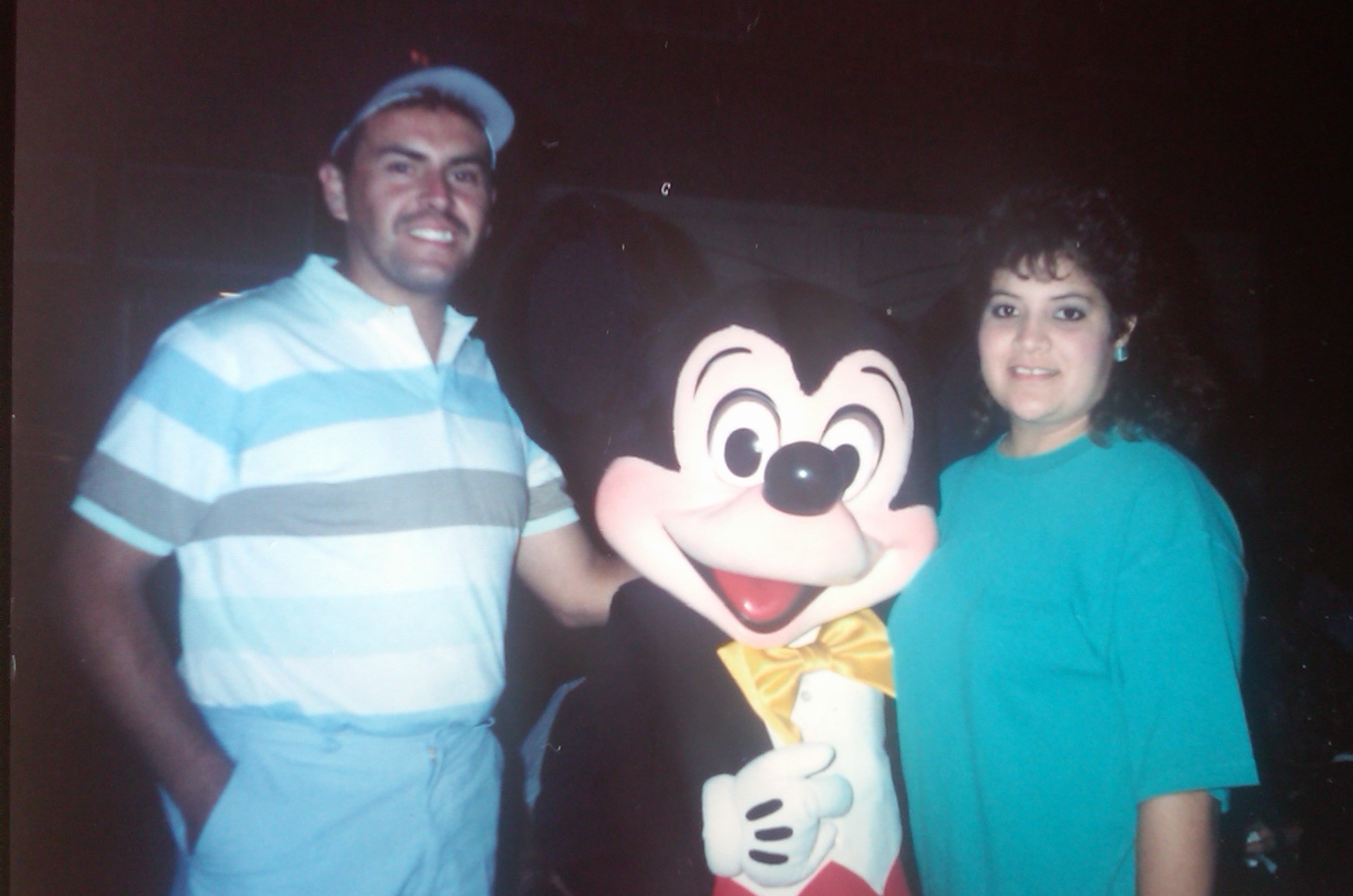
The newlyweds hanging out with Mickey during the summer of 1991 (Eddie & Sandra García Family photo)
The newlyweds hanging out with Mickey during the summer of 1991
(Eddie & Sandra García Family photo)

Sandra and I rented a small one bedroom apartment in the east foothills, not far from Alum Rock Park and the expensive houses up the hill.  She was in her first year as an elementary school teacher and I taught Spanish to pre-school kids at a private elementary school/day care center.  It was a job that didn’t require a college degree and paid next to nothing.  I also coached basketball at City College and made extra money tutoring the basketball players.  We were able to scrape by financially and married life was treating me well.

For the first time since I was a teenager I felt a sense of accomplishment and stability, this time without the brashness and bravado of one of the big men on campus.  Soon after the basketball season ended, Sandra and I made the decision that I should return to San Jose State on a full-time basis and put my career as a basketball coach on hold until I earned my bachelor’s degree and teaching credential.

I had been taking courses at State here and there for a couple of years to meet reinstatement eligibility to the university and to remove the academic disqualification from my record, so I was ready to submit an application for acceptance.  When a letter from San Jose State arrived in the mail, I anxiously opened the envelope, read the letter, and let out a huge sigh of relief.  My failed academic record had been cleared, and I was officially a college student once again.

The next day, a Saturday, Eddie Velez and I were working on a side job with Mr. Peralta replacing sidewalks at an apartment complex, but I wasn’t participating in the usual banter about sports, politics, the weather, and the aches and pains that come with construction work.  My mind was spinning with thoughts about my past failures, my new opportunity, and my second, and perhaps, last chance to redeem myself by earning a college degree and pursuing my dream of being a teacher and a coach.  Right then and there, I decided that I would work harder than ever in college to stay focused on the prize.

Because the acceptance letter arrived just days before classes were to begin, I had to sit in on the classes I wanted to secure a space before I could actually register.  It would be a tedious process that required patience and perseverance.  With a determination I never had before, I sat in class after class, cajoled professors to allow me to stay, and registered for a full load of classes to qualify as a full-time student.  I threw myself into my schoolwork, finishing projects, writing papers, and completing reading assignments ahead of schedule.

Early that first semester, I ran into a mental roadblock that could have compromised the entire effort; I realized that I was almost ten years older than my classmates in first year general education courses.  I started to doubt myself, I questioned my decision to drop everything to return to school, and I felt out of place as a weathered twenty-seven year old man among bright, young, and eager college students.

I shared these sentiments with a professor, Dr. Randall Jimenez, with whom I had developed a good relationship in his freshman communications course.  He told me that I had a natural talent for public speaking and using words to persuade and lead others.  Then he asked me how old I was and when did I anticipate on finishing my degree, and I responded that I hoped to graduate by my thirtieth birthday.  He said with good health and God’s will I would be thirty years old, so I had to decide whether I wanted to be thirty years old with a college degree or thirty years old without one; the choice was mine and mine alone.

From that day on I had a laser focus toward achieving success at the highest level possible, as a student and in my future career as an educator and basketball coach.  To help Sandra with living expenses, I spent the next three years tutoring freshman for the professor’s public speaking courses.  I ran into Dr. Jimenez two decades later, and with a bear hug and heartfelt smile, he mentioned how happy he was to see me, and that he had followed my career and medical problems in the newspaper.

I reminded him of and thanked him for the wise words he imparted on me that day early in my return to college.  He thanked me for listening because he knew that I would use my gift for public speaking to make an impact in people’s lives.  His wise advice twenty-one years before sent my college career and the professional life that was to follow into high gear.

For the next three years, I was a full-time student and part-time homemaker.  After that first semester, I met with an advisor on campus, selected history as my major, and mapped out the schedule of classes I would need to graduate by the time I was thirty years old.  At home, in between reading and writing assignments, I washed clothes, kept our little apartment clean, and experimented making different meals so dinner would be ready when Sandra got home from a long day with her students.

More often than not, my experiments would go badly and we would end up at one of the mom and pop restaurants or fast food joints that dotted our new neighborhood.  In addition to my studies and tutoring for the professor’s public speaking courses, I worked as a referee for intramural sports at San Jose State and tutored a neighborhood kid to further supplement Sandra’s teaching salary.  I was absolutely dedicated to my studies, devouring books faster than professors could assign them; reading in the laundry room at our apartment complex or at the kitchen counter while preparing another disastrous meal.

Let’s Start a “Courageous Conversation”

Book cover for "Courageous Conversations About Race" (courtesy of Google Books)
Book cover for “Courageous Conversations About Race”
(courtesy of Google Books)

Recently, I had the opportunity to visit a kindergarten classroom at a school on the east side. I was able to see an excellent teacher at work. Just holding the attention of energetic five-year-olds seemed like a tall order. The teacher was engaging and positive as she led the students through a math exercise. Some kids were attentive, others were restless, and most were somewhere in between. What impressed me most was that the teacher worked hard to involve each student.

I witnessed the teacher practicing what educational equity experts call “meeting students where they are.” In other words, the teacher didn’t expect every student to be the same and she made adjustments for each student’s strengths and weaknesses. On the other hand, as an education blogger and former school trustee, I’ve heard many other teachers express frustration that students don’t come to school ready to learn.

So what does “ready to learn” mean? Essentially, it describes the model student: conscientious, organized, and prepared to learn every day. This must start at home, the argument goes. With that reasoning, some educators believe that high academic achievement could become a reality because the school system would be able to do what it is designed to do: teach.

Unfortunately, that’s just not real life. Wouldn’t it be wonderful if everyone was conscientious, organized, and prepared? That would eliminate most of the world’s problems for sure. The reality is that students, like all people, come in all colors, cultures, sizes, intellectual abilities, and social classes. Despite this diversity, every student can succeed if school systems truly understood and accepted that everyone is different.

In their insightful book about equity in education, Courageous Conversations About Race, Glenn E. Singleton and Curtis Linton use meticulous research to demonstrate that society, school systems, education leaders, and classroom teachers more times than not prejudge students based on race, cultural background, and socio-economic status. This results in practices that marginalize students of color and sets them on a course that discourages a future college education.

All too often the school system and educators dismiss kids of color with the cop-out that “college isn’t for everyone.” In response to my post last week, several readers shared with me their own experiences with this discouraging phrase (click on https://esereport.com/2014/03/17/college-can-change-your-life/ to read last week’s blog). One reader recounted how her son’s high school counselor encouraged him to be a truck driver because he could make good money without a college education.

In his 2009 report on closing the achievement gap, former California State Superintendent of Schools Jack O’Connell recognized this problem and recommended culturally relevant professional development as a solution (click on http://svefoundation.org/svefoundation/files/p16_ctag_report.pdf to read Superintendent O’Connell’s report). Unfortunately, few school districts have attempted to develop a comprehensive and systematic approach to implement this recommendation.

Why is this? To even start thinking about implementing a culturally relevant professional development program, school systems must first acknowledge that racial and cultural bias actually exists.  Singleton and Linton write that talking about these biases is “a difficult conversation, one that clearly troubles educators and can make everyone downright uncomfortable.” It’s hard for good people to believe that they hold such biases.

One would think that in a place as diverse as Silicon Valley, having this conversation would be easy. But it’s not. I’ve discussed this issue with several superintendents who have implemented equity and culturally relevant professional development programs in their districts. In those initiatives, teachers, staff, and the school communities were skeptical and resistant to even begin the conversation. Although long-term relationships were tested and challenged, the end results for students were good.

School leaders may be reluctant to venture into the wilderness of starting that difficult conversation.  It will take conviction, courage, and commitment. Nevertheless, we need to have these discussions as a community for us to ensure that all students have an opportunity to achieve and succeed.

So, I suggest that we support our education leaders and start a “courageous conversation” right here on East Side Eddie Report.com. I want to hear about your experiences with racial and cultural bias as a student, parent, teacher, school administrator and how it impacted your decision to continue (or not continue) a higher education? If you don’t feel comfortable posting publicly, but want to share your story, please feel free to e-mail me confidentially at eddie.m.garcia@comcast.net.

Let’s be bold and start talking!

********************

Eddie is available to speak at your next event or conference.  To learn more about speaking services click on the “Speaking Engagement” tab under the banner on this page.

To schedule Eddie for your next breakfast, luncheon, or dinner event, e-mail eddie.m.garcia@comcast.net, or call 408-426-7698.

Summer in the Waiting Room: Chapter 2 (excerpt #14)

Written on the back of the photo is, "Sandy 5th Grade" (Peralta Family Photo)
Written on the back of this photo is, “Sandy 5th Grade”
(Peralta Family Photo)

It was during those long phone calls between our first and second date that I got to know Sandra very well.  She was born Sandra Faustina Peralta on September 30, 1966, at Doctors Hospital just west of downtown San Jose, the second of four daughters born to Fausto and Connie Peralta, a construction worker and cannery worker.  She was a cute baby with big brown eyes, chubby cheeks, and puffy arms and legs that looked like they were tapered at the joints with rubber bands like a cute Michelin Man from the tire company’s commercials.

As she grew up, Sandra was obedient, studious, and cheerful.  In elementary school, she helped in the school library, cafeteria, and could always be found at recess time helping a teacher with some odd job in the classroom. Beneath the exterior of the model student and obedient daughter was a girl who had tremendous strength of character and unflinching determination.  According to her mom, even as a toddler, “Sandra knew what she wanted to do and was confident she could do it.”

The family next door had a daughter the same age that constantly competed with Sandra in the classroom and with extracurricular activities.  Only once did Sandra let the pressure of that competition get the best of her when in a fit of anger she called the other little girl a bitch, and abruptly went home to confess to her mom, express remorse, and return to apologize.  This incident accurately describes Sandra’s dual qualities of toughness and compassion.

Sandra went on to excel in school earning good grades, playing clarinet in the award winning high school marching band, participating in after school activities, and eventually getting elected student body president her senior year at Silver Creek High School in east San Jose.  After two years of community college she enrolled at San Jose State University to begin a journey that would lead to her career as an educational administrator.

Sandra’s success can be attributed to her spirit, personality, and the unconditional support from her family.  Her parents, Fausto and Connie Peralta, are the personification of the American Dream.  Born in the village of Cumpas, Sonora, Mexico in 1938, Fausto was raised by aunts and uncles because his father Mariano died as a young man; and his mother Concepción left him, and his sister and brothers in the care of relatives to go to the United States in search of work and a chance to send for her children so they could have a better life than the one they had in Mexico.

He came to the United States at the age of sixteen and settled with his mother in the small California farming town of Mendota; his brothers followed later.  In Mendota, Fausto quickly established himself as a hard working young man who provided much value to the farmers who employed him in the cotton fields of central California.  When not doing the back-breaking work required in the hot and dusty fields, he could be seen around town neatly dressed in clean and pressed clothes, polished shoes, and hair combed just right.

Sandra’s mom, Connie Rosales, was born in 1941 just a few miles up the road from Mendota on the Hotchkiss Ranch just outside of Firebaugh, California, the ninth child of Jesus and Encarnación Rosales.  Like Fausto, she was raised by a single mother as her father passed away when she was just three years old.  Connie, a strong-willed, hard-working, and compassionate woman, grew up dreaming of one day living in a nice house and raising a successful family just like the Americanas who lived in town.

Connie and Fausto met in 1958 when Connie’s presumably match-making aunt invited Fausto to a New Year’s Eve party at the home of Connie’s sister.  Two years later they were married, then moved to San Jose looking for work where Fausto made his way as a cement mason and Connie supplemented their income working in the canneries of Santa Clara Valley, and where they built a family with their four daughters: Valerie, Sandra, Kimberley, and Shelley.  They worked hard and did whatever it took to ensure that their daughters had a chance to succeed.

Raising four daughters was a challenge for Fausto and Connie as each woman has her own distinct personality.  Collectively, the Peralta girls made an impression at Silver Creek High School and proudly call San Jose State University their alma mater.  A large photo of the sisters standing together resplendent in college cap and gown under the shadow of the university’s ivy-covered Tower Hall hangs in the entryway of the Peralta house.

College Can Change Your Life

Tower Hall, San Jose State University (SJSU file photo)

“College isn’t for everybody.” The first time I heard this was from my high school counselor who discouraged me from applying to San Jose State University. I heard it over and over again from teachers and other school leaders when, as president of the school board, I proposed making high school graduation requirements the same as college eligibility requirements.

That statement has some truth to it, but you have to make that determination on your own. Teachers, counselors, the school system, parents, family, friends, and society don’t have any business telling you if college is the right path for you. Unless your heart is set on a career that requires no education, I highly recommend that you give college a try.

Let’s get a couple of things straight first. College isn’t easy. It’s an exercise in determination, discipline, and hard work. It doesn’t guarantee a job and a high-paying career after graduation. That’s up to you.  What college does is open your mind and opens the door to limitless opportunities. During the past few months, I’ve had the privilege to speak to high school and college students about the value of my college education in a talk I call, “How College Changed My Life.”

I failed at my first try at college, so I went out into the world and tried to make a living without an education. I drove a forklift at a sheet metal company and worked in construction to quickly learn that I was miserable. I tried selling shoes, toys, and sporting goods to find out that the fastest path to management was a college degree. I coached middle and high school kids, but that didn’t provide a living.

So, in my mid-20s, I went back to college. This time I put my heart and soul into it. My goal was to be a high school history teacher and basketball coach. A funny thing happened on the way to that goal: I never got there. Studying history at San Jose State University blew my mind wide open. I became fascinated about how business, politics, education, and ideas changed the course of history. This fascination led to a career that has been a wild, but fulfilling, ride.

When I walked into Spartan Stadium on graduation day, I wasn’t sure what I wanted to do anymore. I loved kids and coaching basketball, but the college experience taught me that there was so much more out there than I could even imagine. I took a position as legislative assistant to a city councilwoman, not knowing what that meant. The research, writing, and public-speaking skills I learned in college were a perfect fit for the job.

My fondest memory of that first job as a college graduate was when the councilwoman led the effort to rename the central city park in honor of Latino icon César Chávez. I suggested that the organizing committee, which included Chávez family members, honor César by engraving his name on the face of the park’s marble stage. They agreed. I got goose bumps the day that city leaders and the Chávez family unveiled the engraving. I still get goose bumps every time I see it.

Since that experience, I’ve worked in business, served on the school board, and returned to local government. Instead of teaching history, I’ve been a witness to history. I was in Denver’s Mile High Stadium as a corporate executive when President Obama accepted the Democratic nomination for president in2008. As a school board member, I saw parents and students save high school sports and win the fight for graduation requirements to mirror college eligibility standards.

There’s an old saying that goes something like this: “No one can ever take away your education.” A few years ago, I had a massive heart attack that nearly took my life. With a damaged heart, my ability to work 18 hours a day, play basketball, and ride roller coasters has been taken away. But, I can still read, write, research, speak, and share stories with anyone who’s willing to listen. I couldn’t do any of that without my San Jose State University education.

I understand that college might not be for everyone. Our world depends on people who work in the trades, drive goods to market, and provide services. These are honorable professions that deserve our appreciation. My parents worked hard without a college education, raised a family, and encouraged their children to reach for the stars. Even though they didn’t have a university degree, they knew we needed one to achieve our dreams.

Cultural and socio-economic conditions seven decades ago made it difficult for my parents to get a higher education. We live in a different age today. There are so many more opportunities than a generation ago, especially for Latinos. Society may be telling you that you’re destined to be a truck driver, receptionist, construction worker, or landscaper. That may be true. That may be your destiny.  But you ought to give college a try first. You never know what could happen.

********************

Eddie is available to speak at your next event or conference.  To learn more about speaking services click on the “Speaking Engagement” tab under the banner on this page.

To schedule Eddie for your next breakfast, luncheon, or dinner event, e-mail eddie.m.garcia@comcast.net, or call 408-426-7698.

Leadership Lessons from a Hall of Fame Coach

carrphoto
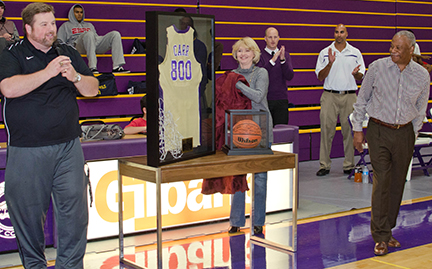
Coach Percy Carr (right) on the night of his 800th victory at San Jose City College.
(photo courtesy of City College Times)

When walking into the basketball gym at San Jose City College, the first impression is that the place is literally spotless. If you show up around 3:00 PM, you’ll likely see Coach Percy Carr sweeping the floor, as he has for the past 38 years. It doesn’t matter that custodians probably just swept it; Coach Carr wants to make sure that the floor is in perfect condition for practice.

In 38 years at SJCC, Coach Carr has won over 800 games, the most in California history, and led his Jaguars to 34 playoff appearances, 12 conference championships, and 8 state championship games. Despite this success, there are no banners hanging in the gym trumpeting his accomplishments.  That’s just Coach’s style.

In addition to his success on the floor, Coach Carr founded the Creative Athlete Retention Response (CARR) program at San Jose City College. The CARR Program offers athletic and academic advice to all SJCC athletes. Ninety-seven percent of SJCC basketball players go on to a four-year university. In 1998, Coach Carr was inducted into the California Community College Basketball Hall of Fame. I was fortunate to sweep the floor right next to him as one of his assistant coaches from 1989-1991

Throughout my career, I’ve been around some amazing leaders, and Coach Carr tops that list.  Working for Coach was one of the most inspiring experiences of my life. The lessons I learned from him have helped form the core of my own leadership journey. This season, Coach welcomed me back to the Jaguar family as the public address announcer for home games. Watching him working up close again has reminded me of those lessons.  I call them the “Four Be’s of Leadership.”

  1. Be Excellent

Many of the players that come to play for Coach Carr are from inner-city neighborhoods with few positive role models. Coach provides these young men with the highest quality of equipment and facilities. The locker room resembles a facility usually seen only at top-notch Division I universities. He’s a stickler about personal grooming, good manners, and study habits. He gives and expects excellence from his players outside and inside the gym, 24/7.

  1. Be Prepared

Early one Sunday morning, Coach called me from the airport after visiting legendary UNLV Coach Jerry Tarkanian and watching his team play. Coach Carr learned a new technique to help players on defense stay a step ahead against speedy opponents. He asked me to meet him at the gym when he arrived in San Jose to demonstrate the move and prepare for the next day’s practice. Monday’s practice was seamless, and the Jags defense led the team to 28 victories that year.

  1. Be a Teacher

When young men first arrive on campus at SJCC, they have little experience managing life on their own. During my two years there, I watched Coach teach them how to navigate the financial aid bureaucracy, shop for groceries, and conduct themselves in public as respectable young men. He taught them how work effectively in a team environment.  And for a couple of hours a day, he taught them how to play basketball.

  1. Be a Winner

This year’s team is a classic SJCC Jaguar squad. They’re big, fast, and very talented. The team is also young, which resulted in a rocky start to the season. The team would take early leads in many games only to succumb at the end. They couldn’t find a way to win. Coach didn’t give up. He made adjustments, tried different line-ups, and convinced the young players that they could win. The Jags started to play like a well-oiled machine and sent Coach to the playoffs for the 34th time in his career.

Although it hasn’t helped my March Madness brackets, I learned a whole lot about coaching basketball from Coach Carr. Like his players, I spent only two years at SJCC, but left with a lifetime of leadership lessons. Working to be excellent, preparing for each assignment and project, being a teacher to those under my care, and striving to be a winner have guided me as a father, husband, community leader, and executive.

At the end of the day, Coach Carr’s leadership isn’t about basketball; it’s about inspiring young men and giving them the tools to be successful. His former players are now lawyers, doctors, teachers, coaches, and businessmen.  I’m sure this year has been an incredible experience for the players and the young coaching staff. They went to the playoffs, Coach is a step closer to 900 wins, and most important, the young men he leads are headed for a successful life.

California Can Have World-Class Schools Again

480657_10201656783314932_1180923346_n

The other night I was relaxing and listening to The Beatles Magical Mystery Tour album when I heard the familiar sound of a recorder, a flute-like woodwind instrument, on the song A Fool on the Hill (hear Paul McCartney on the recorder at 1:25 – http://www.youtube.com/watch?v=D-8gd1jD0oM). The high-pitched melodic sound of the recorder brought back memories of elementary school. Readers from my generation will remember the recorder as the public school system’s introduction to music education.

Every student was issued a basic plastic recorder that taught us how to read music by belting out old standards like Twinkle Twinkle Little Star and Mary Had a Little Lamb. Some students were inspired to take their musical interests to the next level by joining the school band. I tried the saxophone and quickly learned that there was no way I could ever earn a living as a musician.

I was lucky to grow up during a time when California had the best public school system in the nation. With voter approval of Proposition 13 in 1978, everything changed. The anti-tax law slashed school budgets to provide only the basics. The result has been three and a half decades of limited resources and opportunities for working-class kids. With courageous local leadership, the state’s new Local Control Funding Formula (LCFF) could change that.

From the 1950s to the late 70s, California’s stellar public school system was a symbol of the state’s role as an economic juggernaut during our country’s longest period of prosperity. In 1968, the year The Beatles released A Fool on the Hill, 58% of the state’s funding went to education. According to the California Department of Education website, public school funding is only “40% of the state’s General Fund for 2013-14.”

So what did working-class families get for that extra 18%? In addition to the plastic recorders, there were regular field trips, art, music, and physical education. Today, music, art, and P.E. are considered “enrichment,” not basic education, and parents have to dig deeper into their pockets for fields trips and other “extras” like pencils, paper, and crayons. With the heavy emphasis on science, technology, engineering, and math (STEM), we’re no longer educating our kids; we’re putting them through basic job training.

That’s not necessarily a bad thing, especially in Silicon Valley. Our tech industry badly needs a trained pool of workers, and students need job skills that help them compete in today’s economy. But let’s call it what it is, and not call it a well-rounded education. Putting all our public school resources in the STEM basket leaves few options for students from working-class families with leadership qualities and an aptitude for written and verbal communication or the humanities and arts.

State education policy analysts estimate that the LCFF will add $2,700 per student to local school district budgets for the next five years and even more in the future. At the East Side Union High School District, that means an additional $5.5 million next year. School boards should resist the temptation to use all of the new dollars on technology and STEM-related applications.

I’ve written in previous posts that education leaders need to allocate some of those extra dollars on developing systematic and comprehensive educational equity. Resources also need to be earmarked for student readiness projects and a gradual return of arts and humanities education. Unlike affluent families that are able to fund their children’s “enrichment,” the public school system is the only place that kids from working-class families can get a shot at a well-rounded education.

California schools have been in a perpetual state of budget-cutting for over 35 years. With the annual economizing, school leaders have been on an obsessive quest to run schools like a business. Treating kids like widgets in a factory has resulted in a system that prepares students to merely take standardized tests; rather than educating them.  That’s a shame.

I’m not saying that STEM and standardized tests aren’t important elements of the school system.  I’m saying that they shouldn’t be the ONLY elements of public education. As the Information Age continues to expand, we’ll need people who can read, write, and think critically; as well as people who can program a computer and write code.

During the 1950s and 1960s, California Governor Pat Brown created and funded a well-rounded, word-class public school system.  A half-century later, his son Governor Jerry Brown has developed an education funding mechanism to provide more funding than local school districts have seen in decades.  Let’s hope our local leaders use that extra funding to inspire another era of word-class education in the Golden State.

Educating Latino Students is a Team Effort

(Stock Photo - www.csusb.edu)
(Stock Photo – http://www.csusb.edu)

Since my tenure on the school board, I’ve been an advocate of investing in raising expectations for Latino students.  With my ongoing blog discussion about this issue, I’ve heard from many readers, especially teachers.  One educator wrote, “It all starts with the priorities in the home.”  Another commented that, “Latino parents need to know that their involvement is critical and necessary.”

A parent responded to the teacher comments by asking, “Can you educate parents on district policies for enrolling our kids and what to do?” That’s an important question.  Another teacher agreed with that parent and described how she and her colleagues invest time in families because “parents want to help their kids but they don’t have the tools to do it.”  So who’s right?

They’re all correct.  Every study about student success identifies strong parent support as an essential factor.  This component makes up one of the four legs of the stool that holds up high achievement in school.  The other three legs are high academic standards, sufficient resources, and high student expectations.  California schools are addressing standards and resources, but haven’t invested in engaging Latino parents or raising student expectations.  Why is this?

Raising academic standards and allocating sufficient resources are concepts that are easy to understand.  Test score goals and a college-prep curriculum are measurable, so policymakers just need to adjust the benchmarks to raise those standards, which is starting to happen around the state.  Governor Jerry Brown’s Local Control Funding Formula provides school districts with funding based on the demographic profile of their students, so financially underprivileged students will have more access to resources.

Increasing parent engagement and raising student expectations are harder to understand.  Immigrant Latino parents know little or nothing about our school system and American-born Latino parents are products of the very same system of low expectations that is hampering their kids.  Our school systems can’t expect parents to set academic priorities for their children if they don’t even have the means to understanding those priorities.

The misconception within education circles is that Latino parents don’t care about academic success and don’t make school a priority at home.  When I served on the school board in east San Jose, a predominately Latino community, I found the opposite to be true.  Latino parents were constantly asking me for advice about how to access district administration to share their concerns and seek counsel for their children.

Many school districts have active Latino parent groups that advocate for their students with few resources allocated by the district.  With the new funding formula, school leaders now have an opportunity to invest in parent groups that want to be more engaged with their students’ education.  For those who say ALL parent organizations, not just Latino parents, should have access to more district resources, my answer is “absolutely yes.”

Raising expectations for Latino students is a little trickier.  This is an issue I’ve discussed in past posts.  Proponents of educational equity and culturally relevant teacher development have argued with solid evidence that school systems have been historically biased along racial lines, thus creating an environment of low expectations for students of color.  In fact, educational equity experts call this the “missing link” in academic achievement.  I call it the fourth leg on the stool.

Despite recommendations from the state superintendent of schools and a Silicon Valley Education Foundation report, investing in a comprehensive program to address these real issues has been non-existent.  During the last decade of school budget-cutting, policymakers haven’t even considered addressing the fourth leg of the stool.  Local control funding provides a historic opportunity to change this.

Academic standards are rising and new school funding formulas are increasing resources.  With a growing Latino population, our education leaders can no longer accept the argument that the foundation of academic achievement can only be started “with priorities in the home,” especially when parents are asking for the tools to build that foundation.   Educators play a major role in the foundation of academic success and it must start with high student expectations.

By the same token, Latino parents can no longer relinquish the role of setting the foundation of academic success solely on the school system.  If school systems provide tools for parents and welcome them to engage in their children’s education, then Latino parents must meet their obligations and responsibilities to guide students toward a successful academic career.

Ensuring a robust economic future for California will hinge on the success of today’s Latino students, who will make up a majority of the state’s breadwinners within a generation.   We can no longer put all of the responsibility on the school system, nor can the school system merely rely on the home to achieve this.  California’s future rests on a team effort.  Schools need to provide all four legs of the stool to achieve success, and Latino parents and students need to answer the call.

********************

Eddie is available to speak at your next event or conference.  To learn more about speaking services click on the “Speaking Engagement” tab under the banner on this page.

To schedule Eddie for your next breakfast, luncheon, or dinner event, e-mail eddie.m.garcia@comcast.net, or call 408-426-7698.