After more than 10,000 clicks on this blog, look what readers are saying about East Side Eddie Report.com and Summer in the Waiting Room: How Faith, Family, and Friends Saved My Life!!
“I invited a ton of friends [to follow East Side Eddie Report.com] and I think it’s wonderful what you’re doing. What I really like best is your candor. Thank you, thank you my friend.” – Debra Stephens
“I highly recommend reading the East Side Eddie Report. I encourage you to “like” the East Side Eddie Report Facebook page and to enjoy his posts and his incredible story.” – David Neighbors
“I just caught up on reading all your excerpts…WOW…what a great story…now I can’t wait for the next segment”. – David Duarte
“Wow! I am in suspense and now I can’t wait to read the rest of your story.” – Michele Melnyk
“A darn good read.” – Jim Cunneen
“Eddie, I keep enjoying your weekly reports!!” – Alice Rodriguez
I hope you enjoy reading the posts as much as I enjoy writing them. Encourage your friends to try East Side Eddie Report.com, and “Follow” the blog by clicking on the button on the upper right and “Like” East Side Eddie Report.com Facebook page by clicking on the icon on the lower left of this page.
East Side Eddie.com is off today in honor of Presidents’ Day. On Wednesday, look out for the 10th installment of Summer in the Waiting Room: How Faith, Family, and Friends Saved My Life. Thanks for reading!!
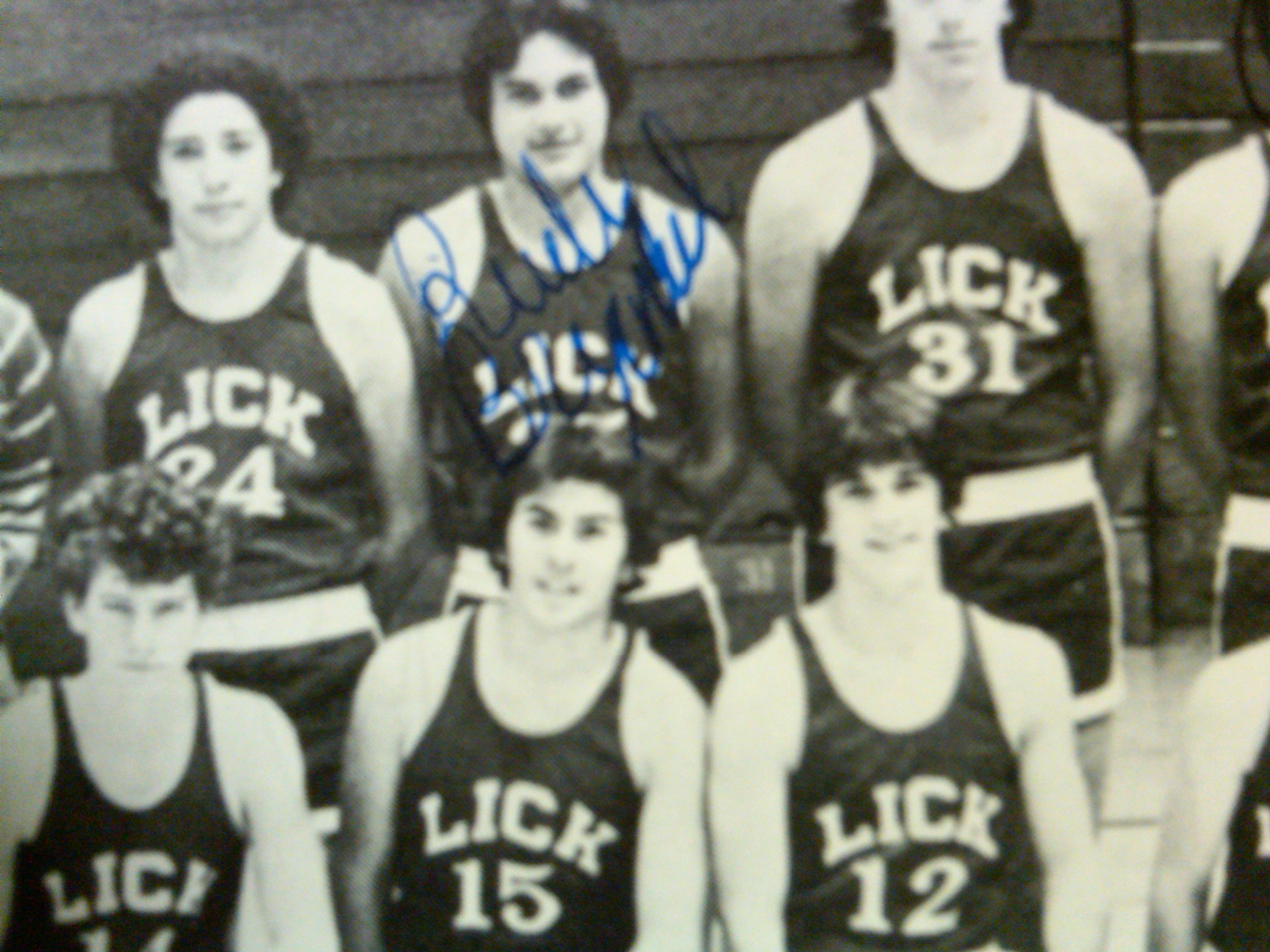
1978 James Lick High School frosh-soph basketball team photo with me (kneeling #15) and my best friend Rudy Bryand (standing directly behind me). (JLHS Yearbook Photo)
Blogger’s note: The following passage is the from my manuscript of Summer in the Waiting Room: How Faith, Family, and Friends Saved my Life. It’s the 7th excerpt from Chapter 1: “48 Viewmont Avenue.” I will post weekly excerpts every Wednesday morning. To read previous installments, go to the Categories link and click on “Summer in the Waiting Room.”
********************
When I started at Joseph George Middle School in the 6th grade, I realized, for the first time in my life, that the world outside of Viewmont Avenue wasn’t very safe. I became the target of an eighth-grade bully who would hide behind a post or a wall at school and jump in front of me to keep me from getting to class on time. After being marked tardy a few times, I figured that I had better do something about it or I would be in trouble with the school and with my parents.
Although my parents taught us that conflicts should be resolved by talking, and using our fists was the last resort, the older kid wasn’t interested in negotiations, so there wasn’t much chance of avoiding a fight. When I explained that to my dad, he as usual counseled against fighting as that would just cause another set of problems for me in school, but he understood if I needed to fight to protect myself.
Preparing for my confrontation, I rallied the neighborhood kids to be at my side so my chances of surviving would be better if I ended up on the losing end of the battle. The next day at school, as expected, the bully jumped out from behind a wall and started toward me. I was scared and nervous, but preparing myself for the first scuffle of my life outside of the rough housing I took from my brother Stevie from time to time.
When the bully had seen that my defenses had suddenly multiplied, he backed off quickly and ran the other way. Learning from that venture outside of the cocoon, I got into the habit of walking to school and class with a few friends every day. I had dodged a bullet, but my days in the protective cocoon of Viewmont Avenue would be coming to an end sooner or later.
When I started high school, my strong academic performance in junior high filled my high school schedule with college prep courses and my classrooms with students I hadn’t been in class with before. These students lived in the foothills up Alum Rock Avenue with their professional fathers and stay at home moms, and went to private Catholic school at St. John Vianney or the elementary school in the hills that the “rich” kids attended.
At first, I felt academically intimidated, but quickly settled down and discovered that I could intellectually compete with these kids in the tough college prep classes. Outside the classroom, I still hung out with my friends from the neighborhood where I felt safe and comfortable. I met the closest of these friends, Rudy Bryand, in junior high school where we spent free periods playing baseball.
Rudy lived right around the corner on Alum Rock Avenue about nine houses away from me. We got to know each other better in high school. I talked him into trying out for the frosh/sophomore basketball squad, and of course, we both played on the James Lick baseball team for four years. Rudy and I quickly became best friends. He was tall and handsome, a born comedian with a charismatic personality that attracted friends and girls with ease.
Together, we had our first beer, went to football and baseball games, talked about girls, and caroused around town as rambunctious young men. He was the best man at my wedding and I was the best man in his. As we got older, we started having our own families, had chosen different career paths and social circles, and drifted apart.
His street smarts complemented my book smarts, so we made a likable team that would cause mischief everywhere we went. He would say that our friendship was analogous to walking a tightrope; he would walk out as far as he could urging me to follow, while I stayed closer to safety beckoning him to come back in. A high school friend and baseball teammate who I still stay in contact with, once said that, “Rudy was crazy and Eddie could talk his way in and out of anything.”
A few years after high school, an incident perfectly captured that observation when Rudy, a couple of friends, and I were confronted by police after a fight broke out in a fast-food joint parking lot on the west side of town where one of our friends worked. While the three of us were waiting in the car for our food at the end of a night of bar-hopping, Rudy got into a verbal altercation with a couple of guys in the car parked next to us because he was flirting with one of their girlfriends.
One thing led to another and soon Rudy was in a fist fight with the offended boyfriend. A car full of guys, presumably friends of Rudy’s opponent, showed up and entered into the fracas. In the chaos and confusion that ensued, I took out a baseball bat from the trunk of the car to protect myself, and within minutes, police sirens were wailing as the other combatants scattered into the night.
When the police arrived, the bat was safely stored in the fast-food place. The police said that they were called to the location because a group of young men were fighting with baseball bats. As the spokesman of the group, I assured the officers that we didn’t see an altercation and had no knowledge of bats that were said to have been used in a brawl. After a few more questions, and despite a deep gash over Rudy’s left eye, the cops let us go without explanation. With Rudy, there was never a dull moment during a night (or day) on the town.
********************
Next Wednesday: Life at James Lick High School
Eddie is available to speak at your next event or conference. To learn more about speaking services click on the “Speaking Engagement” tab under the banner on this page.
To schedule Eddie for your next breakfast, luncheon, or dinner event, e-mail eddie.m.garcia@comcast.net, or call 408-426-7698.
I am happy to join with you today in what will go down in history as the greatest demonstration for freedom in the history of our nation.
Five score years ago, a great American, in whose symbolic shadow we stand today, signed the Emancipation Proclamation. This momentous decree came as a great beacon light of hope to millions of Negro slaves who had been seared in the flames of withering injustice. It came as a joyous daybreak to end the long night of their captivity.
But one hundred years later, the Negro still is not free. One hundred years later, the life of the Negro is still sadly crippled by the manacles of segregation and the chains of discrimination. One hundred years later, the Negro lives on a lonely island of poverty in the midst of a vast ocean of material prosperity. One hundred years later, the Negro is still languished in the corners of American society and finds himself an exile in his own land. And so we’ve come here today to dramatize a shameful condition.
In a sense we’ve come to our nation’s capital to cash a check. When the architects of our republic wrote the magnificent words of the Constitution and the Declaration of Independence, they were signing a promissory note to which every American was to fall heir. This note was a promise that all men, yes, black men as well as white men, would be guaranteed the “unalienable Rights” of “Life, Liberty and the pursuit of Happiness.” It is obvious today that America has defaulted on this promissory note, insofar as her citizens of color are concerned. Instead of honoring this sacred obligation, America has given the Negro people a bad check, a check which has come back marked “insufficient funds.”
But we refuse to believe that the bank of justice is bankrupt. We refuse to believe that there are insufficient funds in the great vaults of opportunity of this nation. And so, we’ve come to cash this check, a check that will give us upon demand the riches of freedom and the security of justice.
We have also come to this hallowed spot to remind America of the fierce urgency of Now. This is no time to engage in the luxury of cooling off or to take the tranquilizing drug of gradualism. Now is the time to make real the promises of democracy. Now is the time to rise from the dark and desolate valley of segregation to the sunlit path of racial justice. Now is the time to lift our nation from the quicksands of racial injustice to the solid rock of brotherhood. Now is the time to make justice a reality for all of God’s children.
It would be fatal for the nation to overlook the urgency of the moment. This sweltering summer of the Negro’s legitimate discontent will not pass until there is an invigorating autumn of freedom and equality. Nineteen sixty-three is not an end, but a beginning. And those who hope that the Negro needed to blow off steam and will now be content will have a rude awakening if the nation returns to business as usual. And there will be neither rest nor tranquility in America until the Negro is granted his citizenship rights. The whirlwinds of revolt will continue to shake the foundations of our nation until the bright day of justice emerges.
But there is something that I must say to my people, who stand on the warm threshold which leads into the palace of justice: In the process of gaining our rightful place, we must not be guilty of wrongful deeds. Let us not seek to satisfy our thirst for freedom by drinking from the cup of bitterness and hatred. We must forever conduct our struggle on the high plane of dignity and discipline. We must not allow our creative protest to degenerate into physical violence. Again and again, we must rise to the majestic heights of meeting physical force with soul force.
The marvelous new militancy which has engulfed the Negro community must not lead us to a distrust of all white people, for many of our white brothers, as evidenced by their presence here today, have come to realize that their destiny is tied up with our destiny. And they have come to realize that their freedom is inextricably bound to our freedom.
We cannot walk alone.
And as we walk, we must make the pledge that we shall always march ahead.
There are those who are asking the devotees of civil rights, “When will you be satisfied?” We can never be satisfied as long as the Negro is the victim of the unspeakable horrors of police brutality. We can never be satisfied as long as our bodies, heavy with the fatigue of travel, cannot gain lodging in the motels of the highways and the hotels of the cities. We cannot be satisfied as long as the negro’s basic mobility is from a smaller ghetto to a larger one. We can never be satisfied as long as our children are stripped of their self-hood and robbed of their dignity by signs stating: “For Whites Only.” We cannot be satisfied as long as a Negro in Mississippi cannot vote and a Negro in New York believes he has nothing for which to vote. No, no, we are not satisfied, and we will not be satisfied until “justice rolls down like waters, and righteousness like a mighty stream.”¹
I am not unmindful that some of you have come here out of great trials and tribulations. Some of you have come fresh from narrow jail cells. And some of you have come from areas where your quest — quest for freedom left you battered by the storms of persecution and staggered by the winds of police brutality. You have been the veterans of creative suffering.Continue to work with the faith that unearned suffering is redemptive. Go back to Mississippi, go back to Alabama, go back to South Carolina, go back to Georgia, go back to Louisiana, go back to the slums and ghettos of our northern cities, knowing that somehow this situation can and will be changed.
Let us not wallow in the valley of despair, I say to you today, my friends.
And so even though we face the difficulties of today and tomorrow, I still have a dream. It is a dream deeply rooted in the American dream.
I have a dream that one day this nation will rise up and live out the true meaning of its creed: “We hold these truths to be self-evident, that all men are created equal.”
I have a dream that one day on the red hills of Georgia, the sons of former slaves and the sons of former slave owners will be able to sit down together at the table of brotherhood.
I have a dream that one day even the state of Mississippi, a state sweltering with the heat of injustice, sweltering with the heat of oppression, will be transformed into an oasis of freedom and justice.
I have a dream that my four little children will one day live in a nation where they will not be judged by the color of their skin but by the content of their character.
I have a dream today!
I have a dream that one day, down in Alabama, with its vicious racists, with its governor having his lips dripping with the words of “interposition” and “nullification” — one day right there in Alabama little black boys and black girls will be able to join hands with little white boys and white girls as sisters and brothers.
I have a dream today!
I have a dream that one day every valley shall be exalted, and every hill and mountain shall be made low, the rough places will be made plain, and the crooked places will be made straight; “and the glory of the Lord shall be revealed and all flesh shall see it together.”2
This is our hope, and this is the faith that I go back to the South with.
With this faith, we will be able to hew out of the mountain of despair a stone of hope. With this faith, we will be able to transform the jangling discords of our nation into a beautiful symphony of brotherhood. With this faith, we will be able to work together, to pray together, to struggle together, to go to jail together, to stand up for freedom together, knowing that we will be free one day.
And this will be the day — this will be the day when all of God’s children will be able to sing with new meaning:
My country ’tis of thee, sweet land of liberty, of thee I sing.
Land where my fathers died, land of the Pilgrim’s pride,
From every mountainside, let freedom ring!
And if America is to be a great nation, this must become true.
And so let freedom ring from the prodigious hilltops of New Hampshire.
Let freedom ring from the mighty mountains of New York.
Let freedom ring from the heightening Alleghenies of Pennsylvania.
Let freedom ring from the snow-capped Rockies of Colorado.
Let freedom ring from the curvaceous slopes of California.
But not only that:
Let freedom ring from Stone Mountain of Georgia.
Let freedom ring from Lookout Mountain of Tennessee.
Let freedom ring from every hill and molehill of Mississippi.
From every mountainside, let freedom ring.
And when this happens, and when we allow freedom ring, when we let it ring from every village and every hamlet, from every state and every city, we will be able to speed up that day when all of God’s children, black men and white men, Jews and Gentiles, Protestants and Catholics, will be able to join hands and sing in the words of the old Negro spiritual:
García Team #1: clockwise from top, David, Patty, Steve, Barbara – Team #2: Me and Sisi (García Family photos)
Blogger’s note: The following passage is the from my manuscript of Summer in the Waiting Room: How Faith, Family, and Friends Saved my Life. It’s the fifth excerpt from Chapter 1: “48 Viewmont Avenue.” I will post weekly excerpts every Wednesday morning. To read previous installments, go to the Categories link and click on “Summer in the Waiting Room.”
********************
The protective shell my parents built kept the bad influences out by keeping us away from people or situations that could be harmful. At home, when my parents hosted family parties, a long night of hard-drinking would inevitably lead to tense conditions that could end up in a fight, and my mom would quietly usher us away from the party to our bedrooms.
When I was in elementary school, on my walk home, I would see some of the cool kids hanging out under the trees at the back fence of campus, and they would sometimes wave me over. I told my parents and they warned that under no circumstance should I ever venture out to the fence. As I got older, I realized that the boys were sniffing glue and paint to get high. Many of those kids joined gangs, dropped out of high school, and either died violently or found a permanent home in prison.
Not only did 48 Viewmont provide a cocoon for us, it served as a safe haven for relatives down on their luck or just hiding away from the miseries of the world. It would not be unusual for me to sleep on the couch in the living room so my bed could be used by a cousin, uncle, or aunt who needed a place to stay for a few days while they worked out whatever brought them to our house.
In true American fashion, my dad taught us to be independent, to think for ourselves, and to control our own destinies. We should be good people, he would say, and be there for others in need, but don’t count on others to be there for you, he counseled. Most of all, we should know that they, my parents, would always be there for us. They worked tirelessly to paste together a family budget, and we always had a hot breakfast in the morning, bag lunch to take to school, and dinner on the table when my dad came home from work.
The meals weren’t very healthy, but they filled our stomachs: any combination of chorizo or bacon, potatoes, and eggs for breakfast; bologna sandwiches slathered with mayonnaise on white bread, cookies, and an occasional piece of fruit for lunch; and tortillas, beans, and something fried with the bacon drippings or chorizo grease from the morning for dinner. On payday Fridays, we could count on a piece of chuck steak, fried chicken, or something exotic like spaghetti with hamburger meat sauce.
We could also count on our parents being at school and extracurricular activities. I can’t think of one back to school night or athletic event that wouldn’t include my parents’ attendance, even when there were competing activities like the 1972 World Series between Oakland A’s and Cincinnati Reds. That night, during the school’s open house, my dad found his way to the school office to watch the game with the principal and other dads.
My brothers and sisters all recount similar stories even though we were part of two families from the same parents. My four older siblings – David, Barbara, Patty, Steve – were born in the early 1950s, and my little sister Sisi and I came a decade later; I was born in 1963 and Sisi five years after me in 1968. Together with the true baby of the family, my little sister Sisi and I make up my parents’ “second” family. According to our older siblings, she and I had it easy. I guess that’s the luck of the draw.
At 48 Viewmont Avenue, we had a clear code of conduct and value system from which we were expected to manage our lives. My dad was no nonsense and no frills, who taught us, through counsel and by way of example, to work hard, play by the rules, and have respect for ourselves and others. There was no variation from this formula. Any lack of respect and decorum, especially in public, would immediately lead to a non-verbal response, a stern look with a furrowed brow followed by pursed lips, closed eyes, and a slow shake of the head in disapproval.
He also gave us the lifelong love of reading, learning, and music. The tight shelf space in my parents’ bedroom was stacked with paperbacks and periodicals, every edition of National Geographic Magazine published since the mid-1950s was displayed on a homemade shelf for all to see. My dad would get home from work every day shortly after 5:00 o’clock with the evening edition of the San Jose Mercury News tucked under his arm, and we had to be prepared at dinner to be peppered with questions about the day’s world and local events.
Even as adults when we gathered around the same kitchen table for the holidays, he would sit at the counter looking into the kitchen with his whiskey and water and make a controversial philosophical or political statement and watch his educated kids flare up in a heated debate. In the dining room, he had the record player and later cassette player in a place of prominence surrounded by albums that included Tex-Mex, mariachi, other genres of Mexican music, and the standards – Frank Sinatra, Dean Martin, and Nat King Cole.
********************
Next Wednesday: Chapter 1 continues with life at 48 Viewmont Avenue in east San Jose.
Eddie is available to speak at your next event or conference. To learn more about speaking services click on the “Speaking Engagement” tab under the banner on this page.
To schedule Eddie for your next breakfast, luncheon, or dinner event, e-mail eddie.m.garcia@comcast.net, or call 408-426-7698.
Five years ago, I helped create the Latino Leadership Alliance (LLA) Leadership Academy in collaboration with Stanford’s Center for the Comparative Studies in Race and Ethnicity to identify, develop, and support emerging leaders that work with Latino communities. Last week, the group introduced Cohort 5 of the LLA Leadership Academy and Stanford Leadership Institute, and continued to strengthen its role as a respected institution of leadership training and learning in the Silicon Valley.
The LLA Leadership Academy developed a model of servant leadership based on bringing together the business, community, education, and public sectors for the common good of the community. In addition to the intensive eight-month program, one of my favorite dynamics of the academy is the ongoing dialogue the cohorts have about the practical practice of leadership after graduation.
At last Thursday’s announcement event, one of the academy alumni posed a fascinating question. She was deliberating on an issue as a leader of a community group that appeared to be in conflict with her role at work and her personal values. Her thought-provoking description of the situation reminded me that leadership is a complex and tough business.
Although there have been leaders since the dawn of humankind, leadership as an academic discipline has only been around for about 50 years. The academic research has resulted in many schools of thought on business, organizational, educational, and political leadership. There are common threads like trust, integrity, and the common good. Unfortunately, however, there’s no silver-bullet to help resolve complicated questions around conflicting considerations.
As a corporate executive, I faced many decisions when company goals, a community group’s objective, and my personal beliefs were seemingly in conflict. Adding to that soupy recipe are personal relationships and political considerations. Once you stir it all up, it’s a thick stew that requires balanced deliberation to get to the right decision. So how do you do that? One question serves as a solid starting point when confronting these sticky situations: What’s the goal?
The question sounds so simple, but making difficult decisions is usually fraught with a complex web of potential winners and losers, advocates on all sides of the issue, and negative impacts if the decision isn’t sound. If your goal is to save your own skin, then get out of leadership business. However, if your goal is to take the best course of action, you must eliminate the noise that could cloud your decision.
Executive management deals with thorny choices on a daily basis. One such decision I made in my corporate career stands out for me. When I had secured a coordinator position for my department, the job description was going to be a dynamic on-the-job process because the position was new to the organization. Therefore, the qualities needed for the role weren’t cut and dry, which made the decision even more complex.
After an initial round of interviews, two candidates stood out from a long list applicants. They had distinctive personalities, unique relationships within the company, and different skill sets. Since I’ve never made a secret about my passion for providing opportunities to qualified and talented Latinos, the fact that one candidate was Latina and the other wasn’t complicated matters.
The lobbying for both applicants was spirited to say the least. At the local office, managers and employees vouched for the Latina who worked there while higher-ups and department colleagues advocated for the other candidate who had previous experience in the department. I had to consider how the decision would impact my personal relationships with the local team and my department colleagues, not to mention trying to keep my bosses happy.
It was a perfect storm where upper management and local office wants, and my personal beliefs seemed to swirl in conflict with each other. The whole purpose for creating the job posting in the first place disappeared in the cacophony of issues not related to the position. Since the pressure from upstairs and my department was stronger than that of the local team, I leaned toward hiring the applicant with department experience.
When I shared my thoughts with Sandra, which I always do before making a decision on complicated work matters, she counseled that I may be hiring someone for the wrong reasons. A sleepless night of tossing and turning ended when I finally cut through the noise and asked myself what I advise others to do in that situation.
With one simple question, I started a deliberation process that addressed the needs of my department, not the personalities or external desires of others. I had created the new position to coordinate employees in the field from the local office to better meet department needs and achieve company goals. Out of that simple question came a simple answer.
I ultimately selected the person who met the company’s needs and reflected my personal values, the Latina from the local office. At first, the decision was met with skepticism from upper management and my colleagues. But the new coordinator turned out to be an excellent choice and erased any doubts. I also learned a valuable leadership lesson: When confronted with a complex decision, cut to the chase and ask yourself, “What’s the goal?”
********************
Eddie is available to speak at your next event or conference. To learn more about speaking services click on the “Speaking Engagement” tab under the banner on this page.
To schedule Eddie for your next breakfast, luncheon, or dinner event, e-mail eddie.m.garcia@comcast.net, or call 408-426-7698.
García siblings posing in front of the kitchen window at 48 Viewmont Avenue – L to R: Patty, Sisi, Barbara, David, me, Steve (García Family photo, mid-1980s)
Blogger’s note: The following passage is the from my manuscript of Summer in the Waiting Room: How Faith, Family, and Friends Saved my Life. It’s the fourth excerpt from Chapter 1: “48 Viewmont Avenue.” I will post weekly excerpts every Wednesday morning. To read previous installments, go to the Categories link and click on “Summer in the Waiting Room.”
********************
The first 27 years of my life were marked and influenced by events in and around my parents’ modest house on 48 Viewmont Avenue in east San Jose. The neighborhood was a typical working-class community of small houses on small lots with neatly mowed lawns and little flower gardens on the edge of the east side of town that once thrived with orchards. Just a short walk a few blocks away, was the Alum Rock Village, a row of mom and pop markets, a liquor store, a bakery, a hair salon, a barbershop, and assorted small businesses that included a feed and fuel that served the remnants of a bygone agricultural community.
The area included a county branch library, a couple of elementary schools, a middle school, a high school, and of course, a Catholic church. Next to the high school was a small fire station. Viewmont Avenue itself was a short block of about forty houses. On one end sat an elementary school and on the other the two-lane Alum Rock Avenue that led to downtown San Jose to the west and several miles up the east foothills to large expensive houses and Alum Rock Park which sunk grandly into a deep canyon.
Viewmont Avenue was narrow with rounded curbs, no sidewalks, and wooden telephone poles carrying heavy electrical and telephone wires placed about 50 yards apart running down one side of the street. The poles and wires played an important role during two-hand touch football games – the poles marked the end zones and the wires could be an extra defensive player if the quarterback threw a pass too high.
Our neighbors were working-class families like ours in pursuit of the American Dream. Across the street from our house lived the Ornelas family. My godfather Tony was a sheet metal worker and his wife Marty worked in the canneries. Next door on each side of our house lived widows, Mrs. Wood on one side and Mildred on the other. Viewmont Avenue was ethnically diverse well before the term became popular in our society. A few houses away were the Moreno, Romero, Dutra, Marino, Olague, Vasquez, and Zigenhart families.
Mr. Helgeson, a retired widower, could always be seen outside wearing neatly pressed work clothes to care for his meticulous yard and garden. On national holidays, I watched in admiration as he carefully hung the American flag over the porch to show pride for his adopted country. The breadwinners provided for their families working as electricians, landscapers, construction workers, and machine shop operators.
The women worked mostly at the canneries and supplemented the family income by cleaning houses, providing child care, or caring for seniors. The neighborhood around Viewmont Avenue was like a small town on the fringes of a growing city. For me, it had everything I needed and wanted. I felt happy, safe, and comfortable there. It was home.
The house I grew up in was a cozy three bedroom, one bathroom tract home built in the late 1940s. The indoor living space measured about 900 square feet and sat on a 1,800 square foot lot that included a front yard and backyard. In the front yard, was a patch of grass and a magnolia tree surrounded by the plants and flowers that flourished under the tender care of my mom’s green thumb. Above the wooden one-car garage door hung a basketball hoop and a backboard made from a piece of scrap plywood. From the kitchen window, one could see the entire scene.
Inside, the house was a standard mid-20th century tract home with low ceilings and distinct living spaces. It seemed as though key family events always occurred at the kitchen table or at the narrow linoleum countertop, dotted with several cigarette burns, which separated the kitchen from a snug dining room. On the kitchen side of the counter sat my dad’s signature restaurant booth tightly curved around a round table and on the dining room side of the counter stood three barstools.
My oldest sister Barbara would say later in life that we had an “idyllic” upbringing on Viewmont Avenue. My parents made sure that school was a priority and provided me and my siblings with the opportunity to participate in extracurricular activities; girl scouts, cheerleading, and color guard for the girls and little league, boy scouts, and Pop Warner football for the boys.
It was the life of the 1950s and 1960s television genre that dad yearned for after listening to the stories about growing up “American” from his friends in the Navy. At mom’s funeral in 2003, my cousin Tutie Sanchez reminisced that “Tía Mary was like the Mexican Donna Reed” from the 1950s sitcom of the same name. Barbara said years later that “mom and dad created a cocoon that protected us from all of the bad things in the world.”
********************
Next Wednesday: Chapter 1 continues with stories about growing up on 48 Viewmont Avenue.
Eddie is available to speak at your next event or conference. To learn more about speaking services click on the “Speaking Engagement” tab at the top of the East Side Eddie Report.com page.
To schedule Eddie for your next breakfast, luncheon, or dinner event, e-mail eddie.m.garcia@comcast.net, or call 408-426-7698.
East Side Eddie.com is taking the week off to celebrate the Christmas holiday. Look for a new blogpost next Monday. Thanks for reading!! My family wishes yours a Merry Christmas and Happy Holiday!
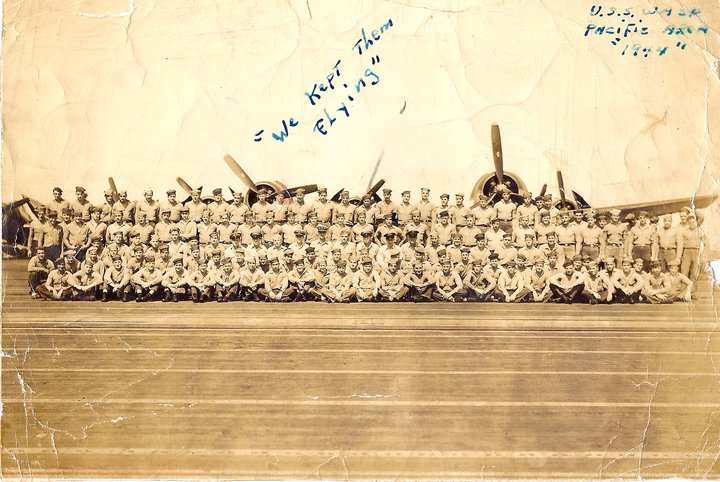
My dad is somewhere in the first row of this photo taken aboard the USS Wasp in 1944. The handwritten notes are my dad’s (Garcia family photo)
I’ve been a history junkie ever since I was a kid. I would ride my bike to the county library and go straight to the stacks that told heroic tales of Americans revolting against King George III, struggling on the battlefields of Gettysburg and Vicksburg, and defending the world against tyranny. I loved the American History course taught by the legendary Mr. Duus and Mr. Hefelfinger at James Lick High School, and I went on to earn a bachelor’s degree in History from San Jose State University.
As a kid, I was most interested in World War II probably because my dad served on the aircraft carrier U.S.S. Wasp in the Pacific Ocean. Like most in his generation, he didn’t talk about the war unless he had a few whiskey and waters under his belt, and even then he wouldn’t say much. With the tidbits of information he shared, I would scour the books from the library trying to piece together my dad’s experience on the Wasp.
To this day, I could spend hours watching the History Channel and Military Channel gathering more data about our collective past. Many episodes include stories about the courageous Black Buffalo Soldiers fighting for freedom during the Civil War and the valiant Japanese-American 442nd Regiment defending our flag in WWII. American-born Latinos have also fought with courage and valor to defend our country, yet they’re nowhere to be found in mainstream accounts. Why is this?
Several years ago, the award-winning PBS documentarian Ken Burns completed a 14 ½ hour series about WWII. I had watched with admiration his comprehensive masterpieces on topics like the Civil War, baseball, the Statue of Liberty and more. I looked forward to the series with anxious anticipation, especially how Burns’ genius might portray the half million Latinos who fought in WWII and the 13 Latino Medal of Honor recipients. It turns out that Burns didn’t include one story about them.
Prior to the airing of the series, national Latino leaders requested that Burns find a way to tell the important stories of these forgotten Americans. Burns initially refused to bend to “political correctness” citing artistic freedom, but he ultimately compromised by adding a few interviews with Latino veterans. I didn’t watch. When Burns came to SJSU for a lecture with public radio last week, I didn’t go.
In some ways, I understand why Ken Burns couldn’t comprehend what the fuss was all about. The land that is now California, Texas, Arizona, and New Mexico formed the northern border of Mexico until they became the spoils of war when the Unites States won the War with Mexico of 1846-1848. Mexicans living in those territories didn’t cross the border, the border crossed them. Since then, American-born citizens of Latino descent have been treated like foreigners in their own land.
Less than a century later, nearly 1.2 million American-born Latinos were evicted from the U.S. to Mexico during the Mexican Repatriation Program of 1929 to 1939 to open up agricultural and factory jobs for Okies fleeing the Depression Era Dust Bowl. More recently, Arizona’s notorious Senate Bill 1070 allows law enforcement to detain anyone when there’s “a reasonable suspicion of being an illegal immigrant.” So in our country, the rule is you must’ve been born somewhere else if you have a Latino surname.
Although those of us born in the United States represent the majority of Latinos in our country, most Americans don’t even know who we are. I didn’t have to look far to find the answer. My dad was born in Las Cruces, New Mexico in 1926. His parents were born near the same place during the 1880s when New Mexico was an American territory. I’m not sure how far back the family tree goes, but I’m willing to guess that the Garcías were living near Las Cruces when the Pilgrims hit Plymouth Rock in 1620.
When he was 11 years old, my dad, his siblings, and my widowed grandmother moved to Phoenix, Arizona where my dad went to grammar school and high school. In 1942, at the age of 16, he enlisted in the Navy by forging my grandmother’s signature so he could fight for his country. One of my most prized possessions is a log he kept during the last days of the war and the victorious trip home on the U.S.S. Wasp.
Back at home, he was refused entrance into a Phoenix dancehall despite wearing his navy uniform because he was “Mexican.” He took a few classes on the G.I. Bill, married my mom, moved to San Jose looking for the American Dream, and got a job at the Post Office. Together my mom and dad had six kids (I’m number 5), bought a house in east San Jose, and struggled to give us a better life. We have become businessmen, school administrators, bank executives, university librarians, and public servants.
That’s my dad’s story. He’s an All-American hero to me. I know there are millions of others just like him. That’s why Latinos can’t wait for Kens Burns or anyone else to understand who we are so our stories can be told. Until we tell our own stories, our fellow Americans will continue to be confused. One just needs to look at the recent Twitter-sphere condemnation of the American Music Awards for showcasing American-born Latinos citing that Mark Antony, Jennifer Lopez, et al, weren’t American.
A few fellow Latino SJSU alums and I traded barbs about Ken Burns on Facebook when we learned he was scheduled to appear at our alma mater. One college friend, Xavier Soriano, reminded us that we should tell our own stories. He’s right. We’re proud Americans who honor and cherish our ancestry. Our generation is educated and has access to resources. So let’s get on with it. Let’s tell our story.
My parents sitting at their kitchen table around 1990
On a rainy Wednesday afternoon last week I attended a funeral for a man named Chuck Gibson, my friend Laurie Mesa’s dad. Like most people, attending funerals isn’t one of my favorite things to do, especially after burying my mom and dad more than a decade ago. Since then, I’ve been to many memorial services to support friends and family, and I’m always inspired by the stories. In just a brief time, those in attendance learn something special about the person being honored.
Chuck’s service was no different. Other than being Laurie’s dad, I didn’t know him. Nevertheless, I joined his friends and family by laughing, choking up, and feeling warm inside while listening to the anecdotes. He was a family man, a good friend, and good neighbor. He was a tinkerer and a handyman who could fix anything no matter how complex. In that one hour, I came to admire Chuck for being a man who was selfless and always available to give a helping hand.
After the service, I went to visit my parents’ grave site at the same cemetery. Standing for just a few minutes in the rain, I said a prayer and reflected at their grave markers, and thought about them on my drive home. Although tales about my parents and people like Chuck won’t be told in history books, their small acts of kindness impacted people in ways they’ll never know. One Thanksgiving, my parents did something that left an indelible mark on my life.
My dad was old-school and taught us, through counsel and by way of example, to work hard, play by the rules, and have respect for ourselves and others. There was no variation from this formula. My mom was the epitome of the warm and loving maternal parent. She taught us unconditional love, faith, compassion, and perseverance. Even during the last days before in her death in 2003, she remained strong in her faith and convictions.
While any indiscretion on our part would be met with my dad’s scowls and rebukes, my mom would react with gentle counsel and loving support urging us to do better the next time. She was our biggest cheerleader encouraging us to be the best we could be. Each morning she would remind us that every day was good because God gave us another day, after each meal she insisted that we say “thank you God,” and she encouraged us to pray the “Our Father” before bedtime.
Although my mom never had much herself, she would share what she had with others to make their lives just a bit better. One evening, right after Thanksgiving, when I was about eight or nine years old, I remember a family calling at our front door. A young couple, with a little girl sitting in a rickety stroller and a baby boy sleeping in his father’s arms, stood at the porch. The man, in a whispered southern accent, explained to my mom that they were hungry and looking for something to eat.
It looked like they had been walking around for some time as the man was unshaven wearing dirty pants and shirt, and the woman looked tired with hollow eyes wearing a dress she may have made herself. My parents invited them into the kitchen and shared the few leftovers from our Thanksgiving meal from the night before, which I’m sure my mom was going to use to make some fried concoction for dinner. The couple gratefully ate at the small kitchen table like they were having a meal in a fancy restaurant.
After they finished eating, my mom packed a few more leftovers in a paper bag and wished them luck. I don’t remember what we had for dinner that night, but I’m sure it was something like chopped up weenies scrambled with eggs and potatoes, our usual type of dinner on the days leading up to payday. How that young family came to our door and why they chose our house I’ll never know. I just know that my parents’ generosity that night was an incredible lesson in compassion and giving to others.
We always seem to wait until funeral time to celebrate the neighbor who helps fix the furnace on a cold winter night or a couple who opens their humble home to those less fortunate. In an age of 24-hour news and instant communication, heroes rise and fall in the blink of an eye rarely making a lasting impression on people. For me, it was good for the soul last week to spend an hour at a memorial service and a few minutes standing over my parents’ graves.
As families come together for Thanksgiving this week, I’m sure the dinner table conversations will include the latest about the NFL’s winners and losers, family gossip, and debates about politics. In those exchanges, we’ll be looking for heroes and villains to explain why things are the way they are. I’m sure that I’ll be a full participant in the banter, but I’ll also be sure to take a moment to be thankful for people like my parents and Chuck Gibson, the enduring heroes in our lives.







 ESEReport.com