Thanks to you, 2014 was a great year for East Side Eddie Report.com! Click below to see this year’s highlights. I can’t express enough my appreciation for you taking a few minutes of your day to read what I have to say. I’m also grateful for your comments, as they help me ensure that what I write is meaningful.
What to look forward to in 2015
As you know, since August I’ve only posted excerpts of “Summer in the Waiting Room: How Faith, Family, and Friends Saved My Life,” so that I could complete the entire manuscript. Beginning on Monday, January 5, 2015, East Side Eddie Report.com will resume posting the following features:
Monday: Monday Meanderings – I will post articles on issues I’m passionate about: education, leadership, politics, and current events. My goal is to highlight issues with an insightful and edgy style.
Tuesday: Quotes and Quips – I love quotes, quips, and anecdotes! I will share my favorites every Tuesday.
Wednesday: “Summer in the Waiting Room: How Faith, Family, and Friends Saved My Life.” – The story of my life-changing health crisis will continue.
Thursday: Latino Thursday – Occasionally, I will post about issues that impact the Latino community.
Once again, thank you so much for checking in every week. Your support is my inspiration. As always, I would love to hear from you.
Here’s to a healthy and safe 2015!!
Eddie García
San Jose, CA
December 30, 2014
Here’s an excerpt:
The concert hall at the Sydney Opera House holds 2,700 people. This blog was viewed about 22,000 times in 2014. If it were a concert at Sydney Opera House, it would take about 8 sold-out performances for that many people to see it.
My Quiet Spot (Sandra & Eddie García family photo) Click on image to see all excerpts
Author’s note: The following passage from Summer in the Waiting Room: How Faith, Family, and Friends Saved My Life is the third of nine parts that details June 7, 2010, the day that a massive heart attack forever changed my life.
********************
Miraculously, I got home safely, stepped out of the car, and listlessly walked up the driveway and walkway that led to the porch. Marisa and Erica were at home because school was out for the summer, so I stopped at the front door to take a deep breath before I walked into the house. I didn’t want the girls to notice the strained look on my face and the uneasiness in my gait.
They were in the family room watching television as I walked away from their view to the bedroom. I was sweating and the anxiety was building up inside of me like the volcano my friend metaphorically described. I took off my necktie and suit jacket, and threw myself onto the bed.
Marisa later said that she saw me walk into the house with the usual grimace I had on my face when I was stressed out. She heard me walk down the hallway and slam the bedroom door shut, then silence, then a thud. She rushed to the bedroom door and asked if everything was alright, I curtly answered, “yes.”
Marisa figured that a work or political matter was on my mind because she lifted the phone to call a friend and heard my voice on the other line. She later ironically remarked that I seemed so upset that I was probably figuratively “having a heart attack.” In the bedroom, I wasn’t talking business. I was on the phone with the Kaiser Permanente Health Plan advice nurse.
Positive that I was having a full-fledged panic attack, I explained to the nurse that I had an anxiety and panic episode nearly six years earlier. I was now experiencing the same symptoms, just a little more intense. The advice nurse asked standard questions about age, weight, medical history.
I mentioned that the cause to my anxiety was a result of my mom’s passing and my sister’s premature death at the hands of heart disease. I also confessed that my fear of having a heart attack led to minor symptoms of anxiety, but that I was able to manage though it. This time, the symptoms didn’t want to go away despite my efforts to deal with them. She then asked pointed questions:
Nurse: “Do you feel a heavy weight, like an elephant, on your chest?”
Me: “No.”
Nurse: “Do you feel tingling radiating down your left arm to your hand?”
Me: “No.”
Nurse: “Do you feel short of breath?”
Me: “Sometimes, until the breathing exercises settle it down for a while.”
Nurse: “Do you feel light headed or dizzy?”
Me: “No.”
Based on my answers, the nurse said that the symptoms I described sounded like a panic attack and recommended I take a warm shower and rest. Heart attack was the furthest thing from my mind. I was so convinced of my self-diagnosis, I persuaded the nurse as well. If the symptoms persisted, she continued, I should call back immediately.
I called Sandra to update her on my conversation with the advice nurse and got ready to get in the shower. Erica told me a couple of years later that she caught me walking between the bedroom and shower to ask if she could go the movies with some friends, and I answered “yeah, sure” in a “grumpy way.” Like Marisa, she too thought I was just stressing over one of the many things on my mind.
I started a steamy shower, sat down on the shower floor, and closed my eyes to clear my mind of the multitude of thoughts that raced through it. Once out of the shower, I put on a pair of shorts and a t-shirt, and walked out the sliding door from our bedroom to the patio, my favorite place to relax.
The backyard and patio had become a sanctuary for me and Sandra. About five years earlier, Sandra and I designed what we thought was the perfect backyard for our home, a Mexican motif with winding clay-colored sidewalks that lead from a tiled gazebo to a large arbor covered with climbing pink trumpet flowers.
A green lawn separates the two structures and a variety of plants, bushes, and flowers grow behind a four-foot retaining wall topped with bull-nose bricks. Three tall pine trees dominate the far corner of the yard and majestically stand over the property. My favorite part of the yard is a small patio behind the arbor covered by a natural canopy made of the pine tree branches and the intertwining of the neighbor’s willow tree and the climbing trumpets that cover the arbor.
The only sounds that can be heard from this relaxing quiet spot are birds chirping, the wind going through the pine trees, a neighborhood dog occasionally barking, or a jet departing from San Jose International Airport leaving the valley for parts unknown. Sitting in the small patio behind the arbor helps me relax and keep the troubles of the real world from my thoughts. This time I couldn’t relax, I kept thinking about how anxiety and panic were consuming me.
The symptoms weren’t getting any better or any worse. I closed my eyes to take in the soothing sounds of the swaying trees above, but the tightening in my chest, the ever growing heaviness on my shoulders, and the frequent need to catch my breath drowned out everything but the noise of my hectic life reverberating in my head.
Over 20,000 readers have viewed East Side Eddie Report.com since the blog’s first post on September 30, 2013!
With deep gratitude, I thank all of you who take a minute from your day to read my articles and my story, Summer in the Waiting Room: How Faith, Family, and Friends Saved My Life. I also appreciate all of your comments. Keep ’em coming! I always want to hear what you think.
Please take a moment to look back at the five most viewed posts on East Side Eddie Report.com:
“The Coaches” circa mid-1980s (García Family photo)
“Coach ‘em up, and let ‘em play.” ~ Fred O. (Lico) García
Fred O. García is my dad. Even though he passed away almost 20 years ago, I turn to him often for advice. He taught his children how to live a productive life through anecdotes, analogies, and one-liners I call “Licoisms.” His simple philosophy on raising kids is one of my favorites.
He would say that you can’t start teaching values when kids are teenagers, people can learn values from the time they are babies. Together with my mom, they prepared my siblings and me for the tough road called life. He taught us the values of respecting ourselves and others, working hard, taking responsibility for our actions, and owning up to our mistakes. From mom, we learned to trust in God, love unconditionally, and give to others less fortunate.
My dad believed that once children have a strong foundation of values, parents should let them take risks and make mistakes. According to Lico, mom and dad’s role is to be there for more coaching to “help steer them back on track when they wander off.”
Recently, an old friend shared with me that her son was going to start the 8th grade in a few weeks. She commented how it seemed like he went from a little boy to a teenager from one day to the next. I told her that the transition from teenager to young adult happens just as fast. We chuckled and continued sharing stories about our kids.
Then, reality hit me. My daughter Marisa will drive back to Los Angeles soon to start junior year at Loyola Marymount University and Erica is entering senior year in high school. Both are taking big steps in their lives. Marisa and a few friends have rented an apartment off campus. We will move Erica into a college dorm room right around this time next year.
My chuckle quickly turned into concern. I’ve been around enough to know that college isn’t just about term papers, mid-terms, and finals. Alcohol, parties, and other unknown dangers lurk around every corner during down time. Outside the relative safety of campus security gates is a world filled with beauty, wonder, and yes, even bad influences, evil, and darkness.
I thought about how Sandra and I have taught the girls to be independent and confident. We’ve shared with them the values our parents shared with us. On a daily basis, Marisa and Erica make more decisions on their own as their transition to adulthood evolves. It’s easy to worry about external forces that could shape the rest of their lives.
After some more thought, my parents steered me back on track. Concern turned back into a chuckle. My parents were pretty good coaches. God has this figured out, and Sandra and I coach the girls the best we can. As Lico would say, now it’s time to “let ‘em play.”
Celebrating my daughter Erica’s quinceañera – November 3, 2012 (Sandra and Eddie García family photo)
“This is the true joy in life, the being used for a purpose recognized by yourself as a mighty one.” ~ George Bernard Shaw
The great English playwright wrote this sentence in a long letter to a friend about the allure of money and power versus the meaning of purposeful life work. You would think he was commenting about today’s media fascination with the rich and famous. But he wasn’t. He wrote it in 1905.
When I was a kid listening to the grown-ups talk about work, the word purpose was never part of the discussion. Work was a means to put food on the table and pay the mortgage or rent. Any extra money went towards an occasional backyard barbecue and a few beers on the weekend before going back to the grind of the work week.
My parents wanted me and my five siblings to get a college degree so that we could have an important career and earn enough money to live comfortably. When I finally graduated from college, I set out to do just that. I soon became a run-of-the-mill workaholic trying to bring home a good paycheck and make my family and friends proud.
I had never heard about the concept of working with a purpose until I participated in a year-long Fellows Program called the American Leadership Forum. The concept is simple: figure out what gets you up in the morning, find a way to make a living doing it, and give it all you’ve got. I gave these ideas some thought, but the reality of financial commitments and my thirst for success didn’t allow me to do much more than that.
The high-pressure career, and the prestige and perks that came with it drove me to work hard every day. Striving for personal success kept me busy until I had a health crisis that changed my life. Then, in an instant, it all came to a screeching halt. God sent a clear message. An all-consuming quest for personal achievement isn’t in His plan for me.
On a daily basis, I struggle to reconcile what I thought was the definition of success with what I’m destined to do. I still miss the hustle and bustle of working in executive management, not to mention the financial security. But my journey has led me to a deep understanding of passion and purpose.
I’ve come to realize that helping others along their journey and being with people I care about are my passions. I now work with purpose through sharing stories on East Side Eddie Report.com and mentoring others, and I live with purpose when I’m around those I love.
You can find joy in your life. Discover your passion. Work and live with purpose. You’ll be glad you did it.
Frito Bandido (image courtesy of jimhillmedia.com)
Please Note: Latino Thursdays isn’t just for Latinos!
Okay. I’ll get right to the point. I can’t say for sure what comes to mind when non-Latinos think about the Latino community. Given a lifetime of interactions with people from all walks of life, I can say that the image isn’t very good, not to mention grossly inaccurate. A long-ago war framed that faulty impression and the modern media is an ongoing source of the blurred representations.
First, let’s consider a quick history lesson. In 1846, the United States declared war on Mexico. Like the Gulf War of 2003, the official justification for war was different than the actual reason, which was the American ambition to acquire the Mexican lands of modern-day California, Texas, Arizona, New Mexico, and Colorado. As it turned out, the stars and stripes would win the territory as spoils of war.
As in all conflicts, politicians demonized the enemy. A congressional committee in 1845 reasoned that “pure white blood, against a mixed and mongrel race, composed of Indians, negroes and Spaniards, degenerated by the mixture of blood and color” assured victory over Mexico. After the war, California legislators passed the Greaser Act of 1855, which defined vagrants as “all persons who are commonly known as ‘Greaser’ or the issue of Spanish and Indian blood.” A stereotype was born.
The media has been on the front lines of cementing the myth of the lazy, dirty, thieving, simple-minded, drunkard Mexican. Take a minute to watch an old Hollywood western and you’ll see what I mean. My earliest memory of Mexicans on TV was the Frito Bandido advertising campaign from the late 60s and early 70s. I still remember hanging the black cardboard mustaches that came in each bag above my lip so I could look like a marauding bandido. I looked just like my dad, only he wasn’t a bandit.
During the past century, Spanish-speaking people from all over the western hemisphere have come to the United States. Puerto Ricans, Colombians, Dominicans, Salvadorans, others from all points south, and American-born Latinos are all dumped into the same stereotypical bucket. Today, images of Latino drug dealers, gangsters, “illegal” immigrants, and welfare moochers flood the media.
The good news is that in recent years we’ve reversed the” lazy” myth as most Americans believe that Latinos have a strong work ethic. The bad news is that belief applies only to those who toil in menial and back-breaking physical work. The white-collar Latino hasn’t even reached the American consciousness yet.
Despite a growing population and modest inroads in economic and political influence, generalized Latino images still result in unjust misunderstandings. How do I know this? In more than 25 years working at the highest levels of the corporate, local government, and education worlds, I’ve heard non-Latinos say the darnedest things about us. I don’t believe these off-the-cuff comments are made in malice or with racist intent. Rather, the remarks are the result of over 160 years of misinformation started by a war of conquest.
For those who think Latino Thursdays on East Side Eddie Report.com will be a pity party dwelling on past sins and injustices, guess again. A historical review of the distorted picture that is the Latino image provides a foundation to understanding what caused it in the first place. With that knowledge, we can remove some of the barriers and embark on the road to clarification.
So what is a true reflection of Latinos? Some of us are smart and some of us aren’t that smart. There’s a small segment that is bad, evil, and criminal, but a vast majority are people striving to improve their lot in life and make the future better for their families. We come in black, white, and every shade in between. Latinos are short and tall, gloomy and optimistic, funny and serious, festive and boring. In short, we’re human beings.
By writing stories, commenting on news events, and doing profiles of people I admire, I’ll give my take on the dynamic, complex and misunderstood being that is the American Latino. Be assured that I won’t just highlight the positive. I plan to provide commentary on the good, the bad, and the ugly.
I’m a fourth generation Mexican American boy from the east side, so keep in mind that my perspective comes from a small segment of a large and diverse group of people. I hope not be the last word on each post. I want to be challenged by Latinos and non-Latinos alike about what I write so I can learn as much as I can about who we are.
That’s what Latino Thursdays is all about. I hope it will be a vehicle to dispel some of the myths and be a source of understanding a community that will represent one-fourth of our nation’s population by century’s end.
“I don’t live in either my past or my future. I’m interested only in the present. If you can concentrate always on the present, you’ll be a happy man. Life will be a party for you, a grand festival, because life is the moment we’re living now.” ― Paolo Coelho, The Alchemist
If you haven’t read The Alchemist, read it as soon as you get a chance. It’s the story about a boy who has a dream about buried treasure. A wise man tells him to follow his dream, so the boy sets out on the long journey from his home in Spain to the find his fortune. Along the way, he meets good and bad people and experiences success and great loss. Once he arrives at his destination, the boy realizes that the treasure was the journey itself.
What fascinated me about the story was how the boy immersed himself in what was happening to him at any given moment. While his ultimate goal was realizing his dream, he didn’t let that get in the way of experiencing the journey one moment at a time. For most of my life, this concept has been totally foreign to me. I’ve always lived, not in the present, but analyzing past events to create a better future. I was always a few steps ahead of myself.
Unlike the boy in The Alchemist, I spent most of my life preparing and planning for future success and happiness. In the process, I didn’t fully experience the joy and sadness life had to offer. A health crisis four years ago forced me to live one day at a time. Shortly after recovering, a good friend recommended that I read Paolo Coelho’s masterful fable. I found the tale to be profound, yet perplexing.
Although the meaning of the story resonates with me, I still struggle to truly understand the concept of living in the present. Like most people, I worry about the mortgage, paying for my daughters’ education, and funding retirement. Voice-mail, e-mail, texts, and social media are always there to distract me from the present moment. Despite these distractions, I now try to live one day at a time.
Every once I awhile, I’m able live in the here and now. For me, it’s different and kind of strange, but it’s fulfilling. I better understand what it means to be alive. As I write, I hear birds singing outside my window, see trees swaying in the wind, and smell the freshness of morning through an open door. They’ve always been there, I just didn’t know it. I’m reminded that when I concentrate on the present, I appreciate the sights, sounds, and smells of life. I think everyone should give it a try.
As Coelho writes, “life is the moment we’re living now.”
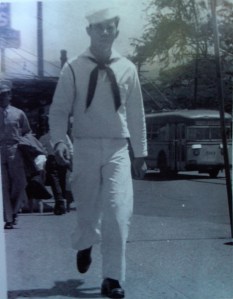
My dad taking a walk in Honolulu after the end of World War II, circa September 1945 (García family photo)
“Now we are engaged in a great civil war, testing whether that nation, or any nation so conceived and so dedicated, can long endure. We are met on a great battlefield of that war. We have come to dedicate a portion of that field, as a final resting place for those who here gave their lives that that nation might live. It is altogether fitting and proper that we should do this.”
~President Abraham Lincoln, “Gettysburg Address”
Memorial Day gives all Americans a chance to reflect on those who gave their lives to ensure our freedom. Many of my relatives and family friends served in combat during World War II, Korea, Vietnam, and Iraq. Although they didn’t make the ultimate sacrifice on the battlefield, I’ve always admired their courage and commitment to our nation. Using President Lincoln’s words, it’s “proper and fitting” today that I honor them and the heroes who gave their lives for our country.
My dad, Fred O. García (1926-1995), served on the U.S.S. Wasp in the Pacific Ocean during World War II. On this Memorial Day, I honor him and his fellow American heroes.
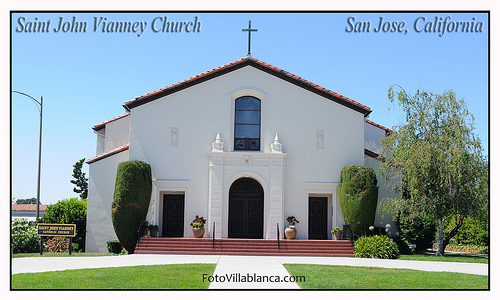
For over five decades, St. John Vianney Catholic Church has been the anchor to my boyhood neighborhood in east San Jose. During three days in May, the annual SJV Fiesta is the gathering place for those who live in the neighborhood and those who grew up there. As my friend Jason Rodriguez puts it, “Fiesta is an east side reunion.” Yesterday, I made my annual pilgrimage.
I’ve always known that people have notions about the east side, and I’m guessing they’re not so positive. I recently heard from a few people who lived in a “better part of town” clearly miffed that East Side Eddie Report.com was posted on Facebook. I could almost hear the disdain in one writer’s voice as he typed, “Why am I getting your east side report? You might as well be from Oakland.” In one sentence, he managed to look down on two communities he probably knows nothing about.
One quick walk around Fiesta demonstrates that writer’s foolish notion. For many of us, this neighborhood is home. Passing the carnival, food booths, and local entertainment stages, Fiesta visitors see generations of families enjoying each other on a beautiful spring day or evening. Teens and pre-teens at the rides, little kids and their parents dancing to the music, and grandparents sitting at tables under the canopies sampling Portuguese linguisa, Philly cheese steaks, and strawberry shortcake.
I always run into old friends and their families. Three friends I saw this year reminded me of the talent the east side has to offer. Two of them, Larry Gonzales and David Rosas, played basketball for me when I coached at James Lick High School. Those talented boys are now men serving as an officer in the United States Navy and a teacher/basketball coach at our alma mater. The third, Jason Rodriguez, grew up one block over from me. Today, he jets around the globe as an executive representing Hewlett Packard.
Like our parents, we east side kids grow up to be resilient men and women who work hard and raise good families. It’s fun to gather once a year at Fiesta to see old friends, share stories, and introduce new family additions. Over the years, I’ve been blessed to share stories about my own growing family and travelling across the country for work. Nevertheless, Dorothy had it right. My pilgrimage to Fiesta every year reminds me that, “there’s no place like home.”
Last week, a Facebook friend posted the following quote:
“Maybe the journey isn’t so much about becoming anything. Maybe it’s about un-becoming everything that isn’t really you so you can be who you were meant to be in the first place.”
These two sentences hit me like a ton of bricks. I scoured the Internet and quotation books to find the source. It showed up on a couple of meditation blogs and Pinterest posts without author attribution. I don’t know who said or penned it, but the more I read the passage the more I reflect on my own life journey.
For the past several years, I’ve been thinking about my journey and writing about it in Summer in the Waiting Room: How Faith, Family, and Friends Saved My Life. I’ve posted 21 excerpts on East Side Eddie Report.com, and plan to complete and publish the manuscript as a book early next year. The powerful two-sentence quote elegantly captures my personal journey and forms the cornerstone of the book.
For readers who have been logging on to the weekly excerpts, thank you!! If you haven’t been reading the story, take a few minutes and check it out by clicking on the Summer in the Waiting Room tag on the right of this page.
Summerin the Waiting Room: How Faith, Family, and Friends Saved My Life is the unique and inspiring story of a boy who grew up in a working-class neighborhood, failed at college and lost hope, met and married the love of his life, returned and finished college, raised a family, and found some success in business and public office. It’s also the story of a man who vowed never to fail again and toiled tirelessly trying to redeem himself, only to find true redemption, while in a state of complete helplessness in the ICU.