Tag Archives: Leadership

Leadership is a Tough Business…What’s the Goal?

1503384_10201538232523722_285040915_n

Five years ago, I helped create the Latino Leadership Alliance (LLA) Leadership Academy in collaboration with Stanford’s Center for the Comparative Studies in Race and Ethnicity to identify, develop, and support emerging leaders that work with Latino communities. Last week, the group introduced Cohort 5 of the LLA Leadership Academy and Stanford Leadership Institute, and continued to strengthen its role as a respected institution of leadership training and learning in the Silicon Valley.

The LLA Leadership Academy developed a model of servant leadership based on bringing together the business, community, education, and public sectors for the common good of the community. In addition to the intensive eight-month program, one of my favorite dynamics of the academy is the ongoing dialogue the cohorts have about the practical practice of leadership after graduation.

At last Thursday’s announcement event, one of the academy alumni posed a fascinating question. She was deliberating on an issue as a leader of a community group that appeared to be in conflict with her role at work and her personal values. Her thought-provoking description of the situation reminded me that leadership is a complex and tough business.

Although there have been leaders since the dawn of humankind, leadership as an academic discipline has only been around for about 50 years. The academic research has resulted in many schools of thought on business, organizational, educational, and political leadership.  There are common threads like trust, integrity, and the common good.  Unfortunately, however, there’s no silver-bullet to help resolve complicated questions around conflicting considerations.

As a corporate executive, I faced many decisions when company goals, a community group’s objective, and my personal beliefs were seemingly in conflict.  Adding to that soupy recipe are personal relationships and political considerations.  Once you stir it all up, it’s a thick stew that requires balanced deliberation to get to the right decision.  So how do you do that?  One question serves as a solid starting point when confronting these sticky situations: What’s the goal?

The question sounds so simple, but making difficult decisions is usually fraught with a complex web of potential winners and losers, advocates on all sides of the issue, and negative impacts if the decision isn’t sound.  If your goal is to save your own skin, then get out of leadership business.  However, if your goal is to take the best course of action, you must eliminate the noise that could cloud your decision.

Executive management deals with thorny choices on a daily basis.  One such decision I made in my corporate career stands out for me.  When I had secured a coordinator position for my department, the job description was going to be a dynamic on-the-job process because the position was new to the organization.  Therefore, the qualities needed for the role weren’t cut and dry, which made the decision even more complex.

After an initial round of interviews, two candidates stood out from a long list applicants. They had distinctive personalities, unique relationships within the company, and different skill sets.  Since I’ve never made a secret about my passion for providing opportunities to qualified and talented Latinos, the fact that one candidate was Latina and the other wasn’t complicated matters.

The lobbying for both applicants was spirited to say the least.  At the local office, managers and employees vouched for the Latina who worked there while higher-ups and department colleagues advocated for the other candidate who had previous experience in the department.  I had to consider how the decision would impact my personal relationships with the local team and my department colleagues, not to mention trying to keep my bosses happy.

It was a perfect storm where upper management and local office wants, and my personal beliefs seemed to swirl in conflict with each other. The whole purpose for creating the job posting in the first place disappeared in the cacophony of issues not related to the position. Since the pressure from upstairs and my department was stronger than that of the local team, I leaned toward hiring the applicant with department experience.

When I shared my thoughts with Sandra, which I always do before making a decision on complicated work matters, she counseled that I may be hiring someone for the wrong reasons. A sleepless night of tossing and turning ended when I finally cut through the noise and asked myself what I advise others to do in that situation.

With one simple question, I started a deliberation process that addressed the needs of my department, not the personalities or external desires of others. I had created the new position to coordinate employees in the field from the local office to better meet department needs and achieve company goals.  Out of that simple question came a simple answer.

I ultimately selected the person who met the company’s needs and reflected my personal values, the Latina from the local office. At first, the decision was met with skepticism from upper management and my colleagues.  But the new coordinator turned out to be an excellent choice and erased any doubts. I also learned a valuable leadership lesson: When confronted with a complex decision, cut to the chase and ask yourself, “What’s the goal?”

********************

Eddie is available to speak at your next event or conference.  To learn more about speaking services click on the “Speaking Engagement” tab under the banner on this page.

To schedule Eddie for your next breakfast, luncheon, or dinner event, e-mail eddie.m.garcia@comcast.net, or call 408-426-7698.

NEW FEATURE: Speaking Engagements

Speaking to a group of community leaders

I’ve written about failing at my first try at college and suffering a health crisis that nearly took my life 25 years later. Both episodes resulted in life-changing transformations. I eventually earned a degree and had a dynamic career in executive management and public service, and after that awful summer in the hospital, I got the gift of time to reflect on my experiences. In the reflection process, I found purpose in life.

Growing up in a working-class family, coaching basketball at my high school alma mater, serving as board president of a large school district, working as a vice president of a major U.S. company, and serving as senior staff to public officials have provided me with a treasure trove of stories and anecdotes. These stories are my inspiration for writing East Side Eddie Report.com.

Along the way, I’ve learned a few life lessons about failure, despair, hope and the power of perseverance. The purpose behind creating East Side Eddie Report.com and writing Summer in the Waiting Room is to share these stories to inspire others to achieve their dreams and aspirations. With that in mind, I’m now available as a motivational speaker at conferences, corporate meetings, school activities, and community events.

For my talks, I draw from a broad set of experiences to engage audiences with inspiring, amusing, and colorful stories. My signature keynote address is called, “From Working-Class Family to Corporate Executive, Life in the ICU, and Beyond.”  In this speech, I share the inspiring story of persevering through failure, a life-threatening illness, and hopelessness to find success and redemption.  I’ve also developed a series of talks on the following topics:

  • How to Navigate the Executive Office and Achieve Success in the Corporate World
  • Creating Educational Equity to Provide Leadership for Diverse School Systems
  • Organizing and Empowering People for the Good of the Community
  • Be Your Own Advocate: Managing Personal Healthcare in the 21st Century

In addition to being an engaging keynote speaker for any breakfast, luncheon, dinner, or fundraising event, I’m available for presentations as a panelist, seminar presenter, or moderator specializing in corporate, non-profit, and education conferences.  My areas of expertise include:

  • Education Policy and Leadership
  • Executive Leadership
  • Healthcare from a Patient Perspective
  •  Coaching Athletics
  • Organizational Development

Speaking fees are reasonable and negotiable in order fit any budget.  I’m also available to speak to middle and high school students at no cost.

To learn more about speaking services and to schedule a speaking engagement for your next event or conference, click on the “Speaking Engagement” tab at the top of the East Side Eddie Report.com page, e-mail eddie.m.garcia@comcast.net, or call 408-426-7698.

Leadership Lessons: Reaching Out to Rivals

President Obama and Cuban Leader Raul Castro Shaking Hand at Nelson Mandela's Funeral (file photo)
President Obama and Cuban Leader Raul Castro shaking hands at Nelson Mandela’s funeral. (file photo)

When President Obama reached out and shook hands with Cuban dictator Raul Castro last week at Nelson Mandela’s funeral the Republican leadership in Congress rushed to the television cameras to criticize the president.  The GOP’s shameful response to the president‘s display of graciousness during a solemn ceremony in honor of someone who epitomized forgiveness is exactly why Congress lacks the leadership skills to get anything done in Washington.

Had President Ronald Reagan declined a working relationship with Soviet Premier Mikhail Gorbachev, the world could have been consumed by nuclear holocaust.  Perhaps the most famous example of leadership by reaching out to rivals is President Abraham Lincoln.  He appointed campaign opponents to cabinet posts; then extended his hand in peace to Confederate rebels promising a post-Civil War America, “with malice toward none, with charity for all.”

One of the most difficult challenges for effective leaders is to be able to bury the hatchet with opponents to benefit those they serve.  True leadership embraces conflict and bridges differences for the common good.  When I served as a trustee on the East Side Union High School District, overcoming differences with a rival led to the approval of two of the most important district initiatives during the past half dozen years.

The district’s board of trustees appointed me in 2006 on a 3-1 vote.  Trustee Frank Biehl was the lone dissenter who vigorously argued against my appointment, so our relationship started off on the wrong foot.  Adding to that dynamic, he and I are from different worlds.  Frank is white, I’m Latino.  He’s the oldest son from a successful family business.  I’m the youngest son from an east side working-class family.  He’s pragmatic, I’m passionate.  On the board, we rarely found common ground.

Two years later, Frank was again the sole “no” vote on my reappointment to the board.  That term we started off on two wrong feet.  I broke the cardinal rule of leadership; I took Frank’s opposition personally.  Instead of looking for common ground, I sought out conflict with him.  The result was a lack of productivity on my part.

When the board took a preliminary vote to eliminate after-school sports, we again were on opposite sides of the fence.  As a former student-athlete I understood the value of athletics and proposed a plan that would restore funding to the programs.  After Frank’s initial vote to eliminate sports programs, he reconsidered and unveiled his own plan to save sports.  I didn’t like his ideas and prepared myself for a long fight.

My personal issues with Frank had trumped doing what was right.  Rather than fighting for student-athletes and their families, I realized I was opposing Frank’s plan because he had opposed me.  It was a valuable on-the-job lesson.  I learned that leadership shouldn’t be about me, it should be about those I serve.  I reached out to Frank and expressed my concerns about his ideas, and he did the same.  With his pragmatic approach and my passion for student athletics, we compromised and saved sports programs.

He supported my candidacy for president of the board a year later.  When I announced an initiative to make college entrance requirements the default curriculum for all students, Frank and I shared ideas and worked together for the good of students.  I spent that summer in the hospital and he came to visit me.  A personal rivalry had turned into friendship.  That fall, Frank and I joined a unanimous board in passing a historic policy that ensured that every East Side graduate can to go to college.

I learned a valuable lesson.  Leaders must overcome personal differences in order to make decisions that benefit those they lead.  Whether you’re PTA president, on the Little League board, a supervisor at work, or President of the United States, these three simple rules can help you avoid the pitfalls caused by personal problems:

  1. It’s not about you.  Your role as a leader is to serve others, not the other way around.  Your decisions will impact, negatively or positively, those you lead.  So make decisions with them in mind.
  2. Keep Your Eye on the Prize.  Why did you seek out a leadership role in the first place?  Probably to make things better or to make a change.  Don’t let personal issues get in the way of accomplishing what you set out to do.
  3.  Find Common Ground.  Rival leaders may share your vision to make improvements or change, but have different notions on how to get there.  Listen to what they have to say.  You may find that you have more in common than you think.

Leaders are like the rest of us replete with biases, emotions, fears, and dislikes.  Yet unlike the rest of us, they must overcome those personal barriers to ensure the common good.  Just imagine what kind of world we would be living in if President Lincoln didn’t have the courage to embrace his rivals to keep our nation united or President Reagan and Premier Gorbachev let personal philosophies keep them from the Cold War peace table.

La Directora: A Genuine Latina Leader

Hon. Carlos Ponce Martínez, Consul General of Mexico, (pictured with Directora Sandra García) visits Adelante Academy to plant a ceremonial friendship tree on Mexican Independence Day

Blogger’s Note: The following post is about my wife Sandra García.  I was initially reluctant to post it because Sandra is uncomfortable with the spotlight.  I post it at my own risk.

************************

Sandra García was always a good student.  She was 6th grade class president and student body president in high school.  Her mom once told me that she has always known what she wanted.  She wanted to be a teacher, then a principal; and she accomplished both.  Throughout her life, this east side girl has quietly exemplified what it is to be a leader.  On December 5th, she will be honored by the San Jose Silicon Valley Chamber of Commerce as the Outstanding Principal of the Year in the Silicon Valley

Sandra comes from a family with strong Latina role models.  Her maternal grandmother was a young widow who raised nine children teaching them the values of hard work and perseverance.  Sandra’s mom taught her daughters the value of education by participating in their school life during an era when the place for a Latina mother was in the home.  These two resilient women forged the foundation of Sandra’s leadership journey that complements her skill, talent, and experience.

I’ve written about how Bob Williams built a team of east side kids into a shoe selling machine at Kinney Shoes during the late 70s and early 80s.  I’ve shared with you how Chris Boyd provides the tools his team at Kaiser Santa Clara Medical Center needs to save lives.  Raised in a hard-working family with strong Latina role models, Sandra is a genuine leader who brings her own brand of compassion and determination to the leadership table.

A little more than a decade ago, Sandra, several colleagues, and a group of parents dreamed of building a Spanish-English dual language school on the east side.  After putting together a design team and getting approval from the school board, Adelante Dual Language Academy opened a year later with three teachers, and 60 kindergarten and first grade students.  Sandra has served as principal for all but the first year.  Her leadership style comes from the fortitude and nurturing handed down by her grandmother and mother.

Sandra is a stickler for high standards (how she ended up with me begs that question and is fodder for another post).  From the smallest household project to gigantic dreams like creating and building a school, she expects the best from herself and those around her.  Anything less is just unacceptable.  Her passion for Adelante and its success is displayed on a daily basis whether she is coaching a teacher to reach higher, encouraging a student to achieve, or picking up an errant wad of paper littered on the ground.

For her, getting the job done is simply a function of good old-fashioned hard work.  I joke with friends that I didn’t realize how much Sandra worked until I stopped working.  If the girls and I really need her, we know where to find her.  On any given night, Adelante is teeming with students and parents on campus for a book fair, “Reading Under the Stars,” a sporting event, or a Dia de los Muertos student exhibit.  The Directora, as her students and parents affectionately call her, is on campus as well supporting her school community.

Like all leaders of a complex organization with many stakeholders, Sandra has had her share of problems and challenges at Adelante.  To overcome these challenges, business guru Patrick Lencioni says that leaders must have a “rallying cry” that keeps organizations focused on what really matters.  Adelante’s rallying cry is centered on student success, parent participation, and community cohesion.  With dignity and grace, Sandra ensures that all involved stay on course on a daily basis.

She’ll be the first to say that the honor bestowed by the chamber of commerce belongs to the students, parents, and faculty at Adelante.  And, she would be right.  Just walking around campus, you can see that students come to school every day ready to learn.  The level of parent support is unequaled for a public school and the teachers are passionate about their students.  Under her leadership, Adelante has become a bona fide east side institution.

All of this is reflected in the school’s academic performance.   Adelante is among the highest performing schools in the district as its standardized test scores have increased phenomenally during the past several years.  Its students have reached the finals in the state Mathematics, Engineering, Science and Achievement competition and the National Spanish Spelling Bee.  What started as a school of 60 students housed on another campus, now serves nearly 600 students on a campus of its own.

With the rise of charter schools and the launch of a new national curriculum for public schools called Common Core, education policymakers are once again grappling with the Latino academic achievement gap.  They could look at the Adelante formula of high standards, good teachers, and engaged parents.  At the helm is a genuine Latina leader who, like her grandmother and mother before her, expects excellence, isn’t afraid to toil tirelessly, and maintains her laser-focused eye on the prize.

Why Leadership Counts: Chris Boyd & the Kaiser Santa Clara Team

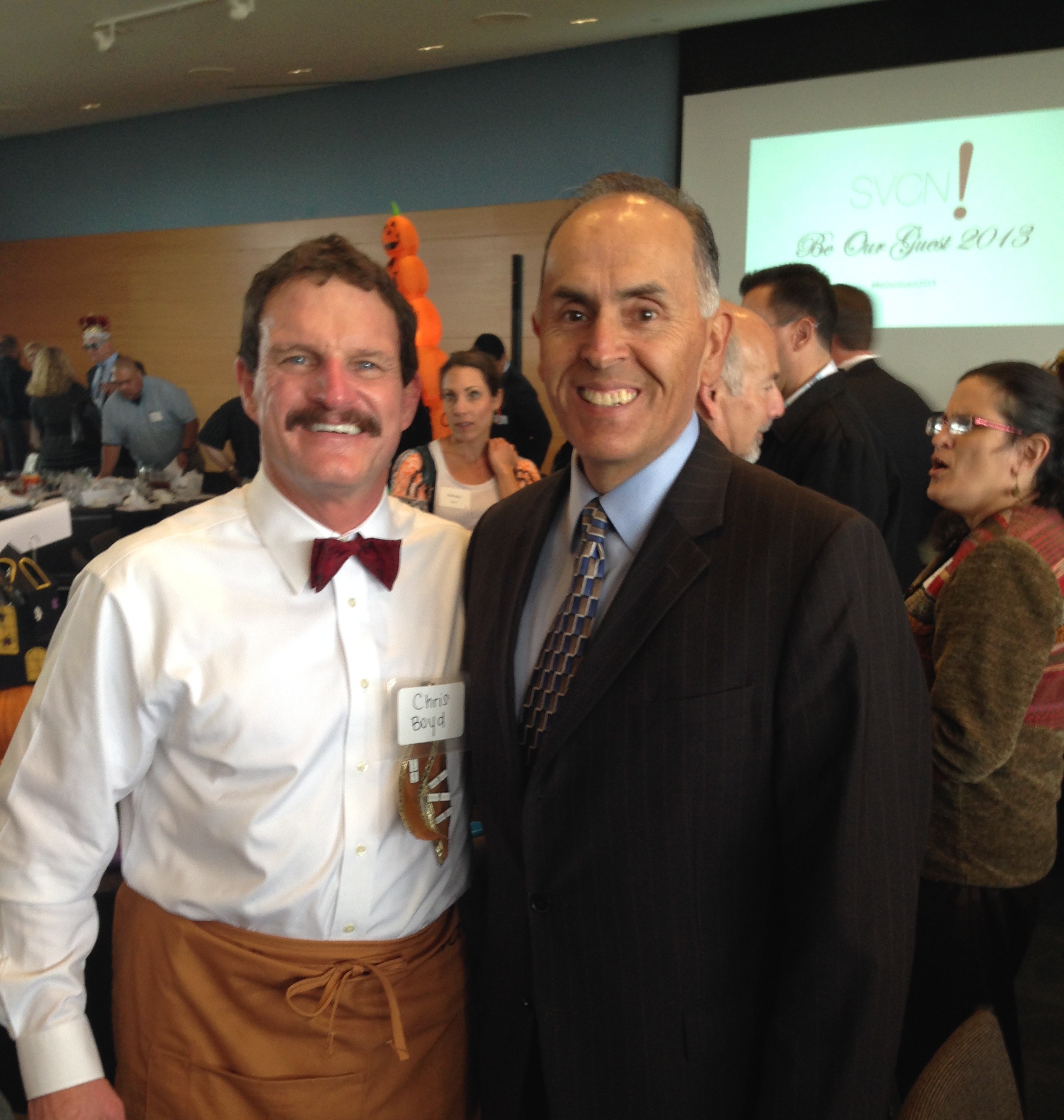
Meeting Chris Boyd at the SVCN Luncheon
(photo courtesy of Darcie Green)

Last Thursday, I attended the annual Silicon Valley Council of Non-Profits “Be Our Guest” luncheon; an event that raises money for charity and features Silicon Valley leaders serving the guests.  The room was filled with solidarity, smiles and handshakes, but below the surface brewed the never-ending battle over ideas and resources.  The scene reminded me that leadership is a tough business.  As one of the valley’s most respected leaders has been known to say, leadership is a “contact sport.”

This seemingly distasteful dance between camaraderie and competition is what turns most people off when it comes to business, education, community, and political leaders.  But, it’s the ability to navigate these dynamic waters that separates the best from the rest and provides the effective leadership that is vital in any organization.  The people serving lunch at the event make decisions that affect our day-to-day lives in so many different ways.

One server in particular, a waiter named Chris Boyd, who happens to be the chief executive at Kaiser Santa Clara Medical Center, made a huge impact on my life even though we never met before Thursday’s luncheon.  Everything I know about great leaders is that they know how to build a positive team environment, provide the resources needed for the team to succeed, and inspire others to achieve.   This understanding of leadership skills and my own experience at Kaiser Santa Clara makes me believe that Chris is an outstanding leader.

My journey to meeting Chris began on June 7, 2010. Feeling sluggish and anxious that day, I arrived at Kaiser Santa Clara Medical Center to learn that I was having a massive heart attack.  Quick action by the emergency room team and successful surgery cleared the blockage that caused the heart attack.  Ten days later, while in the hospital, a blood clot sent me into cardiac arrest causing my heart to stop beating, and ten days after that, I was diagnosed with Acute Respiratory Distress Syndrome (ARDS), a rare disorder that shuts down the lungs.

There is no known cure for ARDS so resting the lungs and providing respiratory therapy is the preferred course of action.  In my case, ARDS was so severe that it was necessary to induce me into a coma and connect me to an oscillator, a recently FDA-approved device that sends puffs of oxygen into the lungs.  At the same time that the oscillator was breathing for me a pump kept my heart beating.  For Sandra and my family, seeing me lying lifeless connected to a bunch of machines was the most difficult part of that horrific summer.

During that time, an army of cardiologists, pulmonologists, ICU doctors, nurses, nursing aides, physical and speech therapists, social workers, and hospital support staff worked around the clock to care for me.  I got to know four members of the team well, speech therapist Suzanne Dabadghav, pulmonologists Mark Mendoza and Sudhir Rajan, and cardiologist Uma Vadlakonda.  They treated me with compassion and consummate professionalism, and I’m inspired by them and eternally grateful for their work.  There were countless others who were cared for me with the same compassion and skill.

After a month and half on life support in the ICU, I began a long and difficult recovery and rehabilitation period.  For family and friends, watching my daily struggle for survival was the most grueling part of the nightmare.  For me, it was waking from the coma and realizing that I couldn’t move my limbs, stand, walk, talk, or swallow.  My muscles had degenerated after two months of lying lifeless in a coma.  I spent most of September at a rehabilitation facility in intensive physical therapy to wake up my muscles and get them working again.  On September 21, 2010, 106 days after the heart attack, I gratefully walked into my house with the aid of a walker.

So where does Chris Boyd fit in? My experience tells me that the Kaiser Santa Clara team has what it needs to succeed: a team-oriented environment, the most advanced tools available, and space needed to maximize team members’ talent.  Watching a talented team of professionals armed with the right tools working together for a common cause is inspirational.  As someone who has been on many teams, and led a few, I know that this can’t happen without a leader who provides the building blocks for success.

Leadership counts.

Thursday turned out to be an inspiring day for me.  It was wonderful to reconnect with old friends and former adversaries who reminded me of the delicate dance among our leaders that makes Silicon Valley one of the best places in the world to live.  Sitting next to the Kaiser table brought back memories of that long and challenging summer when faith, family, friends, and a great healthcare team saved my life.

I’ve been on a mission to thank every person who supported my family, prayed for my recovery, or played even the smallest role in the miracle that was the summer of 2010.  On Thursday, I met the person responsible for providing the Kaiser team with the tools and environment to be the best they could be.  Meeting Chris Boyd and thanking him made my day.

You Can’t Score If You Don’t Shoot

Taking my dad's advice in 1980
Taking my dad’s advice in 1980

The best advice I ever got came from my dad when I was about 12 years old.  We were shooting baskets on our driveway at 48 Viewmont Avenue in east San Jose.  He was teaching me how to make bank shots off the homemade plywood backboard he had hung over the one-car garage door.  My dad grew up during the Depression and was a WWII veteran, so he was practical, no-nonsense, and to the point.  After barking a few pointers about shooting a basketball, he said, “don’t forget that you can’t score if you don’t shoot.”

I’m pretty sure that my high school basketball teammates weren’t too happy with me when I took that advice literally because I know that I missed way more shots than I made.  But my dad’s lesson was clear; success would come by taking calculated risks every now and then, hard work, and perseverance.   I’ve had lots of failures and picked up a few successes along the way in my journey through life, and my dad’s advice on the driveway that day has guided me through the toughest of times.

First of all, I know how to lose a political campaign.  I ran for school board in 1996, 1998, and 2008, and I was a candidate for city council in 2000.  Even though I demonstrated a true passion for public office, I lost all four races.  Undeterred, I got an opportunity to serve when the East Side high school board appointed me in 2006 and 2009.  During my time on the school board, we saved after school sports from the budget ax and passed a historic policy that ensures every student has a chance to go to college.

In 2005, Comcast invited me to its exclusive Comcast Executive Leadership Forum, a year-long executive training program.  I arrived at the company’s Philadelphia headquarters on a cold and snowy January morning wearing my best dark suit and a new overcoat.  Passing a mirror, I suddenly froze, and the fears and doubts of an east side boy in way over his head consumed me.  I debated on whether I should just go back home, but decided to stay.  A little less than two years later, I was promoted to vice president of government affairs for northern and central California.

During the summer of 2010, I faced the biggest challenge of my life.  I had a massive heart attack, and subsequent complications in my lungs left me in a coma for a month and in the hospital for over 100 days.  When I awoke from the coma, I couldn’t talk, walk, or move any of my limbs.  After intensive therapy and a few of years of a disciplined exercise program to strengthen my heart and lungs, I thought about my dad as I crossed the finish line of the annual East Side Save Our Sports 5K walk with my wife Sandra and daughters Marisa and Erica.

You can’t score if you don’t shoot!

Through many defeats and a few victories, I’ve learned that my dad had it right.  Taking a chance, working your behind off, and keeping at it is the path to achievement.  The past several years, I’ve had the great privilege to work with emerging community leaders through the Latino Leadership Alliance Leadership Academy.   We discuss a variety of concepts and strategies needed for leadership.  The conversations usually come to the conclusion that effective leadership results from some version of my dad’s advice.

We live in an age of non-stop media and talking heads with no leadership experience preaching quick fixes to complex problems.  President Theodore Roosevelt famously said that these self-proclaimed leaders “neither know victory nor defeat” because they stay on the sidelines.  To be sure, leadership concepts can be learned in seminars and conferences, but the practice of true leadership can only be achieved by getting into the fray.  When advising aspiring leaders, I tell them that there is no substitute for taking a leadership role when the opportunity presents itself, especially if it’s risky, challenging, and seemingly without success in sight.

So, if you want to serve on the PTA, be a scout leader, run for Congress, or apply for that promotion at work, go ahead and go for it.  Just know that you’ll have to step out of your comfort zone, work extra hard, and hang on for a long and bumpy ride.  It’ll be worth it.  And, never, ever forget that you can’t score if you don’t shoot.

Leadership Lessons at Kinney Shoes

422479_186663308108340_807576089_n

The other day, I was driving on Story Road in east San Jose reflecting on what influenced me to seek out leadership roles at work and in the community.  For starters, I’ve always been fascinated with great leaders.  When I was a kid, I would ride my bike to the county library and check out books about U.S. presidents and WWII generals.  After college, I began gobbling up biographies on Washington, Lincoln, Churchill, LBJ, and others.

Throughout my career, I’ve had the opportunity to participate in leadership programs that opened my eyes to a complex world.  I’ve sat transfixed in corporate seminars listening to words of wisdom from modern-day leaders like President Bill Clinton, General Colin Powell, and Oprah Winfrey.  From Washington to Winfrey, they all had the same qualities: they knew how to build great teams, create trust and loyalty with those around them, and inspire others to greatness.

As I drove by the old Kinney Shoes store on Story Road, it suddenly it hit me that it was there, where I had a part-time job during my high school days, that I learned my first lessons in leadership.  Kinney’s was an institution in east San Jose throughout the 1970s and 80s.  Everybody bought shoes there.  During the last days of summer just before school started, the store was like Grand Central Station at rush hour.  Suede wallabies, Mary Janes, and NBA “tennies” (Chuck Taylor knock-offs) flew off the shelves.

The part-time sales team was a diverse group of east side kids from Latino, Black, White, and Filipino families.  The leader of the crew was the store manager, an African American son of a soldier in his early 30s named Bob Williams.  Looking back on that experience, I realized that Bob was a true leader in the classic sense.  He carefully assembled an effective team, created a work environment that felt more like family than a part-time job, and transformed a bunch of east side teenagers into a shoe-selling machine.

Bob knew what he wanted when he hired people for part-time sales positions.  He put together a team of teenagers who came from hard-working families, participated in high school sports, and demonstrated leadership skills.  Billy Ham, my classmate and baseball teammate at James Lick High School, introduced me to Bob.  At the brief job interview I’ll never forget, Bob asked about my family, what sports I played, and if I was in the starting lineup.  Seemingly satisfied with my answers, he hired me on the spot.

While it was clear that we were there to sell shoes, Bob showed a genuine interest in our family and school life.  From time to time, Bob would invite us to his house for a barbecue where we got to know his wife Tina and son Bobby, played basketball in the driveway and two-hand touch football on the street.  These types of activities solidified us as a team.  It wouldn’t be unusual to see one of us spend a few hours just hanging out at the store on our day off.  Many of my co-workers became life-long friends.

We were a lively bunch that appeared, at first glance, to be undisciplined.  Bob had the rare ability to read people to determine what inspires them to achieve, a quality that distinguishes a leader from a mere manager.  Knowing that athletes loved to compete, he made a competition out of everything.  I still laugh thinking about us, in shirts and ties, playing Wiffle ball, running races, and duck walking in the parking lot.  All it would take was a challenge from Bob to see us run across the street to get a phone number from a girl sitting at the bus stop.  So when Bob declared a sales contest on back-to-school weekend, the race was on to see who could sell the most shoes, socks, purses, nylons, purses, and shoe cleaners.

Today when I think of Kinney’s, I always remember the friends, the contests, and good times.  I laugh reliving the mischief caused by a group of rambunctious teenagers from working-class families with a few dollars in their pockets from selling shoes.  Now I’ve also come to see Kinney’s as the starting point of my amazing journey through the world of leadership.  Those of us who had the privilege of working there during the late 70s and early 80s unwittingly got an education in leadership from a true master.  Right here in east San Jose.  Thanks Bob!