Summer in the Waiting Room: Chapter 1 (excerpt #5)

García Team #1 (clockwise from top: David, Patty, Steve, Barbara - Team#2: Me and Sisi
García Team #1: clockwise from top, David, Patty, Steve, Barbara – Team #2: Me and Sisi               (García Family photos)

Blogger’s note: The following passage is the from my manuscript of Summer in the Waiting Room: How Faith, Family, and Friends Saved my Life. It’s the fifth excerpt from Chapter 1: “48 Viewmont Avenue.” I will post weekly excerpts every Wednesday morning.  To read previous installments, go to the Categories link and click on “Summer in the Waiting Room.”

********************

The protective shell my parents built kept the bad influences out by keeping us away from people or situations that could be harmful. At home, when my parents hosted family parties, a long night of hard-drinking would inevitably lead to tense conditions that could end up in a fight, and my mom would quietly usher us away from the party to our bedrooms.

When I was in elementary school, on my walk home, I would see some of the cool kids hanging out under the trees at the back fence of campus, and they would sometimes wave me over. I told my parents and they warned that under no circumstance should I ever venture out to the fence. As I got older, I realized that the boys were sniffing glue and paint to get high. Many of those kids joined gangs, dropped out of high school, and either died violently or found a permanent home in prison.

Not only did 48 Viewmont provide a cocoon for us, it served as a safe haven for relatives down on their luck or just hiding away from the miseries of the world. It would not be unusual for me to sleep on the couch in the living room so my bed could be used by a cousin, uncle, or aunt who needed a place to stay for a few days while they worked out whatever brought them to our house.

In true American fashion, my dad taught us to be independent, to think for ourselves, and to control our own destinies. We should be good people, he would say, and be there for others in need, but don’t count on others to be there for you, he counseled. Most of all, we should know that they, my parents, would always be there for us. They worked tirelessly to paste together a family budget, and we always had a hot breakfast in the morning, bag lunch to take to school, and dinner on the table when my dad came home from work.

The meals weren’t very healthy, but they filled our stomachs: any combination of chorizo or bacon, potatoes, and eggs for breakfast; bologna sandwiches slathered with mayonnaise on white bread, cookies, and an occasional piece of fruit for lunch; and tortillas, beans, and something fried with the bacon drippings or chorizo grease from the morning for dinner. On payday Fridays, we could count on a piece of chuck steak, fried chicken, or something exotic like spaghetti with hamburger meat sauce.

We could also count on our parents being at school and extracurricular activities. I can’t think of one back to school night or athletic event that wouldn’t include my parents’ attendance, even when there were competing activities like the 1972 World Series between Oakland A’s and Cincinnati Reds. That night, during the school’s open house, my dad found his way to the school office to watch the game with the principal and other dads.

My brothers and sisters all recount similar stories even though we were part of two families from the same parents. My four older siblings – David, Barbara, Patty, Steve – were born in the early 1950s, and my little sister Sisi and I came a decade later; I was born in 1963 and Sisi five years after me in 1968.  Together with the true baby of the family, my little sister Sisi and I make up my parents’ “second” family.  According to our older siblings, she and I had it easy.  I guess that’s the luck of the draw.

At 48 Viewmont Avenue, we had a clear code of conduct and value system from which we were expected to manage our lives.  My dad was no nonsense and no frills, who taught us, through counsel and by way of example, to work hard, play by the rules, and have respect for ourselves and others.  There was no variation from this formula.  Any lack of respect and decorum, especially in public, would immediately lead to a non-verbal response, a stern look with a furrowed brow followed by pursed lips, closed eyes, and a slow shake of the head in disapproval.

He also gave us the lifelong love of reading, learning, and music.  The tight shelf space in my parents’ bedroom was stacked with paperbacks and periodicals, every edition of National Geographic Magazine published since the mid-1950s was displayed on a homemade shelf for all to see. My dad would get home from work every day shortly after 5:00 o’clock with the evening edition of the San Jose Mercury News tucked under his arm, and we had to be prepared at dinner to be peppered with questions about the day’s world and local events.

Even as adults when we gathered around the same kitchen table for the holidays, he would sit at the counter looking into the kitchen with his whiskey and water and make a controversial philosophical or political statement and watch his educated kids flare up in a heated debate.  In the dining room, he had the record player and later cassette player in a place of prominence surrounded by albums that included Tex-Mex, mariachi, other genres of Mexican music, and the standards – Frank Sinatra, Dean Martin, and Nat King Cole.

********************

Next Wednesday: Chapter 1 continues with life at 48 Viewmont Avenue in east San Jose.

Eddie is available to speak at your next event or conference.  To learn more about speaking services click on the “Speaking Engagement” tab under the banner on this page.

To schedule Eddie for your next breakfast, luncheon, or dinner event, e-mail eddie.m.garcia@comcast.net, or call 408-426-7698.
Leadership is a Tough Business…What’s the Goal?

1503384_10201538232523722_285040915_n

Five years ago, I helped create the Latino Leadership Alliance (LLA) Leadership Academy in collaboration with Stanford’s Center for the Comparative Studies in Race and Ethnicity to identify, develop, and support emerging leaders that work with Latino communities. Last week, the group introduced Cohort 5 of the LLA Leadership Academy and Stanford Leadership Institute, and continued to strengthen its role as a respected institution of leadership training and learning in the Silicon Valley.

The LLA Leadership Academy developed a model of servant leadership based on bringing together the business, community, education, and public sectors for the common good of the community. In addition to the intensive eight-month program, one of my favorite dynamics of the academy is the ongoing dialogue the cohorts have about the practical practice of leadership after graduation.

At last Thursday’s announcement event, one of the academy alumni posed a fascinating question. She was deliberating on an issue as a leader of a community group that appeared to be in conflict with her role at work and her personal values. Her thought-provoking description of the situation reminded me that leadership is a complex and tough business.

Although there have been leaders since the dawn of humankind, leadership as an academic discipline has only been around for about 50 years. The academic research has resulted in many schools of thought on business, organizational, educational, and political leadership.  There are common threads like trust, integrity, and the common good.  Unfortunately, however, there’s no silver-bullet to help resolve complicated questions around conflicting considerations.

As a corporate executive, I faced many decisions when company goals, a community group’s objective, and my personal beliefs were seemingly in conflict.  Adding to that soupy recipe are personal relationships and political considerations.  Once you stir it all up, it’s a thick stew that requires balanced deliberation to get to the right decision.  So how do you do that?  One question serves as a solid starting point when confronting these sticky situations: What’s the goal?

The question sounds so simple, but making difficult decisions is usually fraught with a complex web of potential winners and losers, advocates on all sides of the issue, and negative impacts if the decision isn’t sound.  If your goal is to save your own skin, then get out of leadership business.  However, if your goal is to take the best course of action, you must eliminate the noise that could cloud your decision.

Executive management deals with thorny choices on a daily basis.  One such decision I made in my corporate career stands out for me.  When I had secured a coordinator position for my department, the job description was going to be a dynamic on-the-job process because the position was new to the organization.  Therefore, the qualities needed for the role weren’t cut and dry, which made the decision even more complex.

After an initial round of interviews, two candidates stood out from a long list applicants. They had distinctive personalities, unique relationships within the company, and different skill sets.  Since I’ve never made a secret about my passion for providing opportunities to qualified and talented Latinos, the fact that one candidate was Latina and the other wasn’t complicated matters.

The lobbying for both applicants was spirited to say the least.  At the local office, managers and employees vouched for the Latina who worked there while higher-ups and department colleagues advocated for the other candidate who had previous experience in the department.  I had to consider how the decision would impact my personal relationships with the local team and my department colleagues, not to mention trying to keep my bosses happy.

It was a perfect storm where upper management and local office wants, and my personal beliefs seemed to swirl in conflict with each other. The whole purpose for creating the job posting in the first place disappeared in the cacophony of issues not related to the position. Since the pressure from upstairs and my department was stronger than that of the local team, I leaned toward hiring the applicant with department experience.

When I shared my thoughts with Sandra, which I always do before making a decision on complicated work matters, she counseled that I may be hiring someone for the wrong reasons. A sleepless night of tossing and turning ended when I finally cut through the noise and asked myself what I advise others to do in that situation.

With one simple question, I started a deliberation process that addressed the needs of my department, not the personalities or external desires of others. I had created the new position to coordinate employees in the field from the local office to better meet department needs and achieve company goals.  Out of that simple question came a simple answer.

I ultimately selected the person who met the company’s needs and reflected my personal values, the Latina from the local office. At first, the decision was met with skepticism from upper management and my colleagues.  But the new coordinator turned out to be an excellent choice and erased any doubts. I also learned a valuable leadership lesson: When confronted with a complex decision, cut to the chase and ask yourself, “What’s the goal?”

********************

Eddie is available to speak at your next event or conference.  To learn more about speaking services click on the “Speaking Engagement” tab under the banner on this page.

To schedule Eddie for your next breakfast, luncheon, or dinner event, e-mail eddie.m.garcia@comcast.net, or call 408-426-7698.
Summer in the Waiting Room: Chapter 1 (excerpt #4)

García siblings posing in front of the kitchen window at 48 Viewmont Avenue - L to R: Patty, Sisi, Barbara, David, me, Steve (García Family photo, mid-1980s)
García siblings posing in front of the kitchen window at 48 Viewmont Avenue – L to R: Patty, Sisi, Barbara, David, me, Steve (García Family photo, mid-1980s)

Blogger’s note: The following passage is the from my manuscript of Summer in the Waiting Room: How Faith, Family, and Friends Saved my Life. It’s the fourth excerpt from Chapter 1: “48 Viewmont Avenue.” I will post weekly excerpts every Wednesday morning.  To read previous installments, go to the Categories link and click on “Summer in the Waiting Room.”

********************

The first 27 years of my life were marked and influenced by events in and around my parents’ modest house on 48 Viewmont Avenue in east San Jose. The neighborhood was a typical working-class community of small houses on small lots with neatly mowed lawns and little flower gardens on the edge of the east side of town that once thrived with orchards. Just a short walk a few blocks away, was the Alum Rock Village, a row of mom and pop markets, a liquor store, a bakery, a hair salon, a barbershop, and assorted small businesses that included a feed and fuel that served the remnants of a bygone agricultural community.

The area included a county branch library, a couple of elementary schools, a middle school, a high school, and of course, a Catholic church. Next to the high school was a small fire station. Viewmont Avenue itself was a short block of about forty houses. On one end sat an elementary school and on the other the two-lane Alum Rock Avenue that led to downtown San Jose to the west and several miles up the east foothills to large expensive houses and Alum Rock Park which sunk grandly into a deep canyon.

Viewmont Avenue was narrow with rounded curbs, no sidewalks, and wooden telephone poles carrying heavy electrical and telephone wires placed about 50 yards apart running down one side of the street. The poles and wires played an important role during two-hand touch football games – the poles marked the end zones and the wires could be an extra defensive player if the quarterback threw a pass too high.

Our neighbors were working-class families like ours in pursuit of the American Dream. Across the street from our house lived the Ornelas family. My godfather Tony was a sheet metal worker and his wife Marty worked in the canneries. Next door on each side of our house lived widows, Mrs. Wood on one side and Mildred on the other.  Viewmont Avenue was ethnically diverse well before the term became popular in our society.  A few houses away were the Moreno, Romero, Dutra, Marino, Olague, Vasquez, and Zigenhart families.

Mr. Helgeson, a retired widower, could always be seen outside wearing neatly pressed work clothes to care for his meticulous yard and garden. On national holidays, I watched in admiration as he carefully hung the American flag over the porch to show pride for his adopted country. The breadwinners provided for their families working as electricians, landscapers, construction workers, and machine shop operators.

The women worked mostly at the canneries and supplemented the family income by cleaning houses, providing child care, or caring for seniors. The neighborhood around Viewmont Avenue was like a small town on the fringes of a growing city. For me, it had everything I needed and wanted. I felt happy, safe, and comfortable there. It was home.

The house I grew up in was a cozy three bedroom, one bathroom tract home built in the late 1940s. The indoor living space measured about 900 square feet and sat on a 1,800 square foot lot that included a front yard and backyard. In the front yard, was a patch of grass and a magnolia tree surrounded by the plants and flowers that flourished under the tender care of my mom’s green thumb. Above the wooden one-car garage door hung a basketball hoop and a backboard made from a piece of scrap plywood. From the kitchen window, one could see the entire scene.

Inside, the house was a standard mid-20th century tract home with low ceilings and distinct living spaces. It seemed as though key family events always occurred at the kitchen table or at the narrow linoleum countertop, dotted with several cigarette burns, which separated the kitchen from a snug dining room. On the kitchen side of the counter sat my dad’s signature restaurant booth tightly curved around a round table and on the dining room side of the counter stood three barstools.

My oldest sister Barbara would say later in life that we had an “idyllic” upbringing on Viewmont Avenue. My parents made sure that school was a priority and provided me and my siblings with the opportunity to participate in extracurricular activities; girl scouts, cheerleading, and color guard for the girls and little league, boy scouts, and Pop Warner football for the boys.

It was the life of the 1950s and 1960s television genre that dad yearned for after listening to the stories about growing up “American” from his friends in the Navy. At mom’s funeral in 2003, my cousin Tutie Sanchez reminisced that “Tía Mary was like the Mexican Donna Reed” from the 1950s sitcom of the same name. Barbara said years later that  “mom and dad created a cocoon that protected us from all of the bad things in the world.”

********************

Next Wednesday: Chapter 1 continues  with stories about growing up on 48 Viewmont Avenue.

Eddie is available to speak at your next event or conference.  To learn more about speaking services click on the “Speaking Engagement” tab at the top of the East Side Eddie Report.com page.

To schedule Eddie for your next breakfast, luncheon, or dinner event, e-mail eddie.m.garcia@comcast.net, or call 408-426-7698.

NEW FEATURE: Speaking Engagements

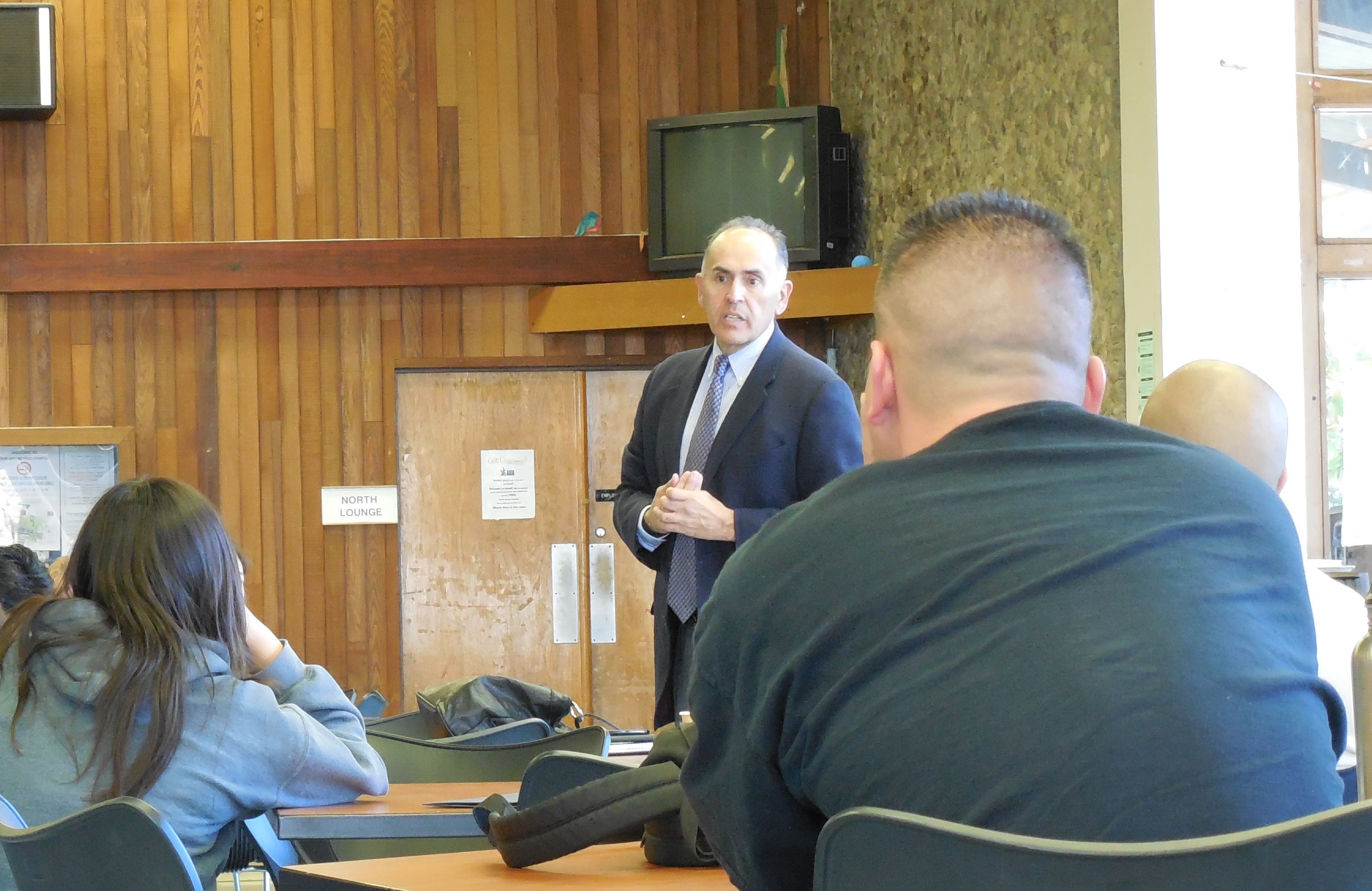
Speaking to a group of community leaders

I’ve written about failing at my first try at college and suffering a health crisis that nearly took my life 25 years later. Both episodes resulted in life-changing transformations. I eventually earned a degree and had a dynamic career in executive management and public service, and after that awful summer in the hospital, I got the gift of time to reflect on my experiences. In the reflection process, I found purpose in life.

Growing up in a working-class family, coaching basketball at my high school alma mater, serving as board president of a large school district, working as a vice president of a major U.S. company, and serving as senior staff to public officials have provided me with a treasure trove of stories and anecdotes. These stories are my inspiration for writing East Side Eddie Report.com.

Along the way, I’ve learned a few life lessons about failure, despair, hope and the power of perseverance. The purpose behind creating East Side Eddie Report.com and writing Summer in the Waiting Room is to share these stories to inspire others to achieve their dreams and aspirations. With that in mind, I’m now available as a motivational speaker at conferences, corporate meetings, school activities, and community events.

For my talks, I draw from a broad set of experiences to engage audiences with inspiring, amusing, and colorful stories. My signature keynote address is called, “From Working-Class Family to Corporate Executive, Life in the ICU, and Beyond.”  In this speech, I share the inspiring story of persevering through failure, a life-threatening illness, and hopelessness to find success and redemption.  I’ve also developed a series of talks on the following topics:

  • How to Navigate the Executive Office and Achieve Success in the Corporate World
  • Creating Educational Equity to Provide Leadership for Diverse School Systems
  • Organizing and Empowering People for the Good of the Community
  • Be Your Own Advocate: Managing Personal Healthcare in the 21st Century

In addition to being an engaging keynote speaker for any breakfast, luncheon, dinner, or fundraising event, I’m available for presentations as a panelist, seminar presenter, or moderator specializing in corporate, non-profit, and education conferences.  My areas of expertise include:

  • Education Policy and Leadership
  • Executive Leadership
  • Healthcare from a Patient Perspective
  •  Coaching Athletics
  • Organizational Development

Speaking fees are reasonable and negotiable in order fit any budget.  I’m also available to speak to middle and high school students at no cost.

To learn more about speaking services and to schedule a speaking engagement for your next event or conference, click on the “Speaking Engagement” tab at the top of the East Side Eddie Report.com page, e-mail eddie.m.garcia@comcast.net, or call 408-426-7698.

Summer in the Waiting Room: Chapter 1 (excerpt #3)

My Family - standing L-R: David, Stevie, Patty, Barbara (Garcia Family photo ca. 1966 )
My Family in Front of Fireplace at 48 Viewmont Avenue – Standing L-R: David, Stevie, Patty, Barbara (Garcia Family photo ca. 1966)

Blogger’s note: The following passage is the from my manuscript of Summer in the Waiting Room: How Faith, Family, and Friends Saved my Life. It’s the third excerpt from Chapter 1: “48 Viewmont Avenue.” I will post weekly excerpts every Wednesday morning.  To read previous installments, go to the Categories link and click on “Summer in the Waiting Room.”

********************

After a few years of marriage and the births of my brother David, and my sisters Barbara and Patty, my parents found that there were no opportunities for them in Phoenix. My dad was going from job to job, many times working two at a time, but none was steady. He scraped enough money together to pay rent on a studio apartment, feed the kids, and buy a broken old Ford to take him to and from his various jobs.

Later in life, my parents would laugh about the time their car had a dead battery and they couldn’t afford to replace it. My dad would get up early in the morning, open the hood of the jalopy and peer into the motor as if there were a problem. Without fail, a Good Samaritan would ask if he needed help and my dad would explain that the battery wasn’t working that morning, and he would appreciate a jump to get the car started. Once his work day was over, he would begin the same routine until a passerby would lend him jumper cables to start the car for the return trip home. This would last for months.

He quickly realized that this was no way to live. He had traveled around the world as a sailor fighting for his country, seen New York City, Boston, and Los Angeles. He knew there were opportunities for those who took risks and sought a better life. So, with a used battery in the rickety car and protests from my Grandma Joaquina, he and my mom packed up their three babies, their meager belongings, my Abuelita Chabela, and headed for San Jose, California, to join his sister Maria, her family, and relatives on his father’s side of the family to find work in the orchards and canneries of the fertile Santa Clara valley.

In San Jose, my parents moved into a relative’s garage until they were able to earn enough money to find a place for their growing family. They found a small apartment not too far away from the town’s bustling canning industry. My Abuelita Chabela took care of the kids at night while my mom worked at the canneries. It’s a cliché, but my dad worked day and nights to earn just enough money to keep a roof over their head and dinner on the table, and there was enough work for my parents to rent a small house in San Jose’s east side.

My brother Steve was born shortly after they moved into the rented house on the east side, and with another baby to clothe and feed, my parents found extra hours working for slave wages in the apricot orchards of the east valley picking the fruit and cutting it for the lucrative dried apricot market. Every bit helped, but they needed steady income to provide stability for their growing family.

During that time, San Jose was rapidly growing and the postal service was looking for reliable veterans to meet the demands of its burgeoning workforce. Soon, my dad’s status as a World War II veteran would pay off when he got a job working at the downtown post office. Although the pay wasn’t nearly enough to meet the needs of their family, the stability gave them a chance to achieve the American Dream and buy a house. They found a house just a couple of blocks away from their rented house.

My parents borrowed money from relatives to put a modest down payment on the outlandish $11,000 mortgage they took to buy the house on 48 Viewmont Avenue. For the next several years, my dad would dutifully drive downtown to the post office to earn a living and my mom would supplement their income taking jobs cleaning houses and working part-time in the cafeteria at the new IBM headquarters in the south side of town. My dad would take every opportunity to work overtime to help pay the bills.

Lucky for them, my abuelita was available to take care of the kids while my parents struggled to stay afloat. This steady way of life continued for nine years and it looked like my parents were starting to slowly build a solid foundation for their family’s future when I arrived.

********************

Next Wednesday: Chapter 1 continues with my first years growing up at 48 Viewmont Avenue in east San Jose.

Holiday Names, Santa, and Ducks: Can We End This Cultural War Already?

fox-news-kelly

In 1787, the Founding Fathers wrote that the U.S. Constitution was necessary “in Order to form a more perfect Union.” Since they were all white Christian men, many of them slave owners, the perfect union they envisioned was probably meant just for them. For the first 70 years of our country’s existence, that’s exactly how it was. Then President Lincoln threw a wrench in the plan by abolishing slavery and keeping the union together.

For the next hundred years, the path to a more perfect union began to form with the women’s right to vote in the early 20th century and the Civil Rights Movement of mid-century. By the 1980s, the LGBT community started to make its voice heard.  By then, the conservative crowd had had enough. At the 1992 Republican Convention, presidential hopeful Pat Buchanan declared that our nation was engaged in “cultural war…for the soul of America.”

While his speech carefully avoided race issues, he was unabashed about conservative views on “radical feminism” and railed “against the amoral idea that gay and lesbian couples should have the same standing in law as married men and women.” Buchanan’s war came to a boiling point two decades later with conservative charges that President Obama is a foreign-born Muslim and women who use birth control are sluts. The nonsense coming from the Right continues to get more desperate and absurd as their war drones on.

Let’s start with the so-called debate about what we ought to name the holiday season in December. As a practicing Catholic who believes in the Jesus nativity story, I say “Merry Christmas” when greeting fellow Christians. I don’t really give a rat’s behind if retail outlets, progressive politicians and others use “Happy Holidays.” How others greet each other during this season doesn’t impact people’s lives, yet it’s a serious topic for conservative news programs.

Then there’s Santa Claus. While channel surfing the other day, I tripped over a Fox News show that was embroiled in a serious discussion about Santa’s racial background. A Fox News personality reacted to a professor’s essay about a black Santa by saying, on air, “For all you kids watching at home, Santa just is white…I wanted to get that straight.” Really? The story actually stayed in the news cycle for another few days, including the obligatory razzing from the nighttime talk shows.

This brings us to ducks. The A&E cable network has a popular show about a duck hunting family business called Duck Dynasty. When the show’s patriarch went on an anti-gay tirade, network executives decided to bench him. Conservatives quickly cried foul claiming that A&E trampled on his 1st Amendment right of free speech. The network big wigs are all about business, not the Bill of Rights, so the complaints were all for naught. A&E put papa duck back on the field as soon as it realized that Duck Dynasty fans aren’t gay.

During the Civil War, maintaining the confederacy’s racist way of life was cloaked as a fight for economic survival. A century later, the same crowd justified legalized segregation in the name of state’s rights. Add another fifty years, the justification to keep same-sex marriage illegal was framed in religious terms. Now the ambitious war plan to maintain “traditional” American values has given way to ridiculous battles about holiday names, Santa Claus, and ducks.

With their entire war effort in peril, the warriors of “traditional” America are no longer armed with the lofty ideals of economic survival, state’s rights, and religious convictions.  They now fight for the soul of America by courageously standing up for holiday names, Santa’s race, and homophobic duck hunters. I have to say though, watching the likes of Jon Stewart pan the conservative news media and its sycophantic audience for trying keep a grip on the not so perfect union of yesteryear is entertaining.

Next summer, on the 22nd anniversary of Pat Buchanan’s vitriolic speech, America’s first Black president will be in his second term, there will be more women in Congress than ever before, and more states will have legalized same-sex marriage. It looks like the conservative Right is losing its own war in a rout. The last major religious war in Europe was called the Thirty Years War, and lasted…well, 30 years. Can we cut Buchanan’s cultural war short by a few years and just end it already?

We’ll never know if the Founding Fathers meant to include everyone. Nonetheless, their words have led to an amazing journey toward a society that is getting ever so close to a place where everyone, regardless of gender, race, ethnicity, or sexual orientation, can fully participate in “life, liberty, and the pursuit of happiness.” Hopefully, the Right’s cultural war is coming to an end. That way, we can move forward together as a nation of American people toward “a more perfect union”.

Summer in the Waiting Room: Chapter 1 (excerpt #2)

My parents taking a walk in Phoenix, Arizona (Garcia Family photo ca. late 1950)


Blogger’s note: The following passage is the from my manuscript of Summer in the Waiting Room: How Faith, Family, and Friends Saved my Life. It’s the second excerpt from Chapter 1: “48 Viewmont Avenue.” I will post weekly excerpts every Wednesday morning.  To read previous installments, go to the Categories link and click on “Summer in the Waiting Room.”

**********************

My parents were children of the Great Depression, an era of desperate times for all but the richest Americans. For both my parents, poverty was compounded as they were children of widowed mothers who endured the racism and discrimination faced by Mexican Americans of that time. As children, they had no understanding of the American Dream and no real path to achieving it. As adults, they worked tirelessly to provide that opportunity for their children, and the little house on 48 Viewmont Avenue was the base of operations for their pursuit of the dream.

My dad was born Federico Olquín García in the dusty hamlet of Las Cruces, New Mexico, on April 15, 1926. The oral history of my family doesn’t provide much about the first 16 years of his life. This much we know: his parents were Juan and Isabela “Chabela” García, also native New Mexicans, and he had one brother and two sisters.  Juan worked in the dangerous and back-breaking copper mines of southern New Mexico and Chabela tended to the home and their four children.

They lived in a small adobe structure with a dirt floor built by Juan and a younger brother. When my dad was about eleven years-old, his father died of respiratory problems related to his endless hours working in the mines.  With her four kids in tow, Chabela left Las Cruces to join relatives in Phoenix, Arizona. Family stories contend that my dad had to help drive the long and hot road to Arizona. If this is true, his childhood had disappeared in a flash and his years of responsibility and obligation came upon him overnight.

In October 1942, my dad left the small apartment he shared with his mother in south Phoenix to join the U.S Navy. Like many of his generation, my dad shared little about his experience as a sailor during World War II. He told us that he served on the aircraft carrier U.S.S. Wasp in the Pacific Ocean, but recounted nothing about battles and dangerous situations. History tells us that the Wasp engaged in several brutal battles with Japanese aircraft from October 1942 through the end of the war, the time my dad served on the carrier. In a personal log he carried, he wrote in detail about the last days of the war and the Wasp’s return to the United States.

My mom was an only child born to a single mother in on January 31, 1930, in Colton, California. Colton, a busy railroad hub and farming town in southern California, was one of many stops on the state’s farm-working circuit where her mother, Joaquina Othon, and her Tía Lipa traveled in search of seasonal work. My grandmother Joaquina was an independent woman trying to eke out a living for herself and her young daughter. Like my dad, little is known about my mom’s early life.

Within several years, my mom and her mom were again on the road, this time to Phoenix to help Tía Lipa care for my great-grandmother who arrived from Sonora, Mexico, to live out the last years of her life. My grandmother continued working odd jobs as a housekeeper, babysitter, and seasonal worker to support her daughter, sister, and ailing mother. Due to my grandmother’s tireless work ethic, my mom had a financially poor, but relatively stable life during her teen years. It was during this time that the lonely young woman raised by her mother, an aunt, and an aging grandmother, dreamed of one day having a big family with many children and grandchildren of her own.

My parents met during a late summer day in 1949 when my mom went out to the neighborhood park with a cousin to watch some boys play baseball. My mom caught the eye of my dad as he strut around the diamond with a smile that could be seen across the field. He was calling at my grandmother’s front door the next morning respectfully asking permission to talk to my mom.

My dad knew his way around girls from the many ports of call on the trip back to the U.S. after the war and his frequent attendance at south Phoenix nightclubs. But this girl was different: polite, demure, and dignified. Before long, he was stopping to see my mom everyday sitting on one end of the old sofa talking with her as she sat on the other end. Her mom and Tía Lipa sat across the tiny living room knitting a blanket or listening to the radio as the young couple talked, laughed, and sometimes just sat.

Their courtship was a whirlwind. After several months dating in my grandmother’s living room, they were allowed to go out to together to the movies or to share a soda, and six months later after they met, mom and dad were married in a small Catholic church on April 23, 1950. They had no place to live, no money, and no idea what the future would hold. All they had was each other and my skeptical grandmother watching their every move.

********************

There will be no post next Wednesday. Chapter 1 returns on January 1, 2014, as my parents move to San Jose looking for opportunity.


Leadership Lessons: Reaching Out to Rivals

President Obama and Cuban Leader Raul Castro Shaking Hand at Nelson Mandela's Funeral (file photo)
President Obama and Cuban Leader Raul Castro shaking hands at Nelson Mandela’s funeral. (file photo)

When President Obama reached out and shook hands with Cuban dictator Raul Castro last week at Nelson Mandela’s funeral the Republican leadership in Congress rushed to the television cameras to criticize the president.  The GOP’s shameful response to the president‘s display of graciousness during a solemn ceremony in honor of someone who epitomized forgiveness is exactly why Congress lacks the leadership skills to get anything done in Washington.

Had President Ronald Reagan declined a working relationship with Soviet Premier Mikhail Gorbachev, the world could have been consumed by nuclear holocaust.  Perhaps the most famous example of leadership by reaching out to rivals is President Abraham Lincoln.  He appointed campaign opponents to cabinet posts; then extended his hand in peace to Confederate rebels promising a post-Civil War America, “with malice toward none, with charity for all.”

One of the most difficult challenges for effective leaders is to be able to bury the hatchet with opponents to benefit those they serve.  True leadership embraces conflict and bridges differences for the common good.  When I served as a trustee on the East Side Union High School District, overcoming differences with a rival led to the approval of two of the most important district initiatives during the past half dozen years.

The district’s board of trustees appointed me in 2006 on a 3-1 vote.  Trustee Frank Biehl was the lone dissenter who vigorously argued against my appointment, so our relationship started off on the wrong foot.  Adding to that dynamic, he and I are from different worlds.  Frank is white, I’m Latino.  He’s the oldest son from a successful family business.  I’m the youngest son from an east side working-class family.  He’s pragmatic, I’m passionate.  On the board, we rarely found common ground.

Two years later, Frank was again the sole “no” vote on my reappointment to the board.  That term we started off on two wrong feet.  I broke the cardinal rule of leadership; I took Frank’s opposition personally.  Instead of looking for common ground, I sought out conflict with him.  The result was a lack of productivity on my part.

When the board took a preliminary vote to eliminate after-school sports, we again were on opposite sides of the fence.  As a former student-athlete I understood the value of athletics and proposed a plan that would restore funding to the programs.  After Frank’s initial vote to eliminate sports programs, he reconsidered and unveiled his own plan to save sports.  I didn’t like his ideas and prepared myself for a long fight.

My personal issues with Frank had trumped doing what was right.  Rather than fighting for student-athletes and their families, I realized I was opposing Frank’s plan because he had opposed me.  It was a valuable on-the-job lesson.  I learned that leadership shouldn’t be about me, it should be about those I serve.  I reached out to Frank and expressed my concerns about his ideas, and he did the same.  With his pragmatic approach and my passion for student athletics, we compromised and saved sports programs.

He supported my candidacy for president of the board a year later.  When I announced an initiative to make college entrance requirements the default curriculum for all students, Frank and I shared ideas and worked together for the good of students.  I spent that summer in the hospital and he came to visit me.  A personal rivalry had turned into friendship.  That fall, Frank and I joined a unanimous board in passing a historic policy that ensured that every East Side graduate can to go to college.

I learned a valuable lesson.  Leaders must overcome personal differences in order to make decisions that benefit those they lead.  Whether you’re PTA president, on the Little League board, a supervisor at work, or President of the United States, these three simple rules can help you avoid the pitfalls caused by personal problems:

  1. It’s not about you.  Your role as a leader is to serve others, not the other way around.  Your decisions will impact, negatively or positively, those you lead.  So make decisions with them in mind.
  2. Keep Your Eye on the Prize.  Why did you seek out a leadership role in the first place?  Probably to make things better or to make a change.  Don’t let personal issues get in the way of accomplishing what you set out to do.
  3.  Find Common Ground.  Rival leaders may share your vision to make improvements or change, but have different notions on how to get there.  Listen to what they have to say.  You may find that you have more in common than you think.

Leaders are like the rest of us replete with biases, emotions, fears, and dislikes.  Yet unlike the rest of us, they must overcome those personal barriers to ensure the common good.  Just imagine what kind of world we would be living in if President Lincoln didn’t have the courage to embrace his rivals to keep our nation united or President Reagan and Premier Gorbachev let personal philosophies keep them from the Cold War peace table.

Summer in the Waiting Room – Chapter 1 (excerpt #1)

With mom on the day of my baptism ca. 1964 (Garcia Family photo)

Blogger’s note: The following passage is the from my manuscript of Summer in the Waiting Room: How Faith, Family, and Friends Saved my Life. It’s the first excerpt from Chapter 1: “48 Viewmont Avenue.” I will post weekly excerpts every Wednesday morning.

**********************

Chapter 1

48 Viewmont Avenue

The sky was clear and the weather was in the low 50s, a typical crisp November night in San Jose, California. But for my mom and dad, that night and early the next morning wouldn’t be typical at all. As they raced north on U.S. Highway 101 in the their two-toned orange and white 1955 Mercury, they wondered how they were going to make ends meet now that another mouth to feed would soon be added to the family.

 They both grew up in poor single-mother households. Now that they had their own family, they were just getting by living check to check on my dad’s postal worker salary and mom’s odd jobs cleaning houses and working in the canneries. The little creature in her belly causing her so much pain and discomfort would be their fifth child. Nevertheless, both of my parents were excited and happy as the Mercury pulled into the hospital parking lot.

 My dad jumped out of the car to walk her into the emergency room. Wearing a camel colored coat and carrying a small overnight bag, she waddled up the steps to the hospital and breathlessly slumped herself onto the waiting wheelchair. As was the custom in the 1960s, nurses rushed my mom into the maternity room to await the doctor who would deliver the baby and told my dad to wait outside. Hospital volunteers showed him the way to the waiting room to join other nervous, expectant fathers who were smoking up a storm as they paced the floor.

Impatient and restless, my dad didn’t stay for very long. He left the hospital to find a place where he could belly up to the bar and knock down a few whiskey and waters before going back to meet his newest baby. My mom was an old pro, he rationalized to himself, she had been to the delivery room four other times and each time the baby came out without any problems.

Back at the hospital, my mom was going through labor pains as one day ended and another began. The baby would soon arrive as the nurses and doctors prepared for the delivery. Labor for her was not much different than the other four times. Actually, this time seemed to go smoother, the pains weren’t as strong and the actual time in labor was much shorter. Just as my dad predicted, the delivery would be quick and simple.

After finishing his drinks and taking a few more drags of his cigarette, he was back in the maternity ward anxiously waiting for the good news. They had two boys and two girls at home waiting. He was sure this one would be another boy. In the delivery room all was going well. When the baby was finally born, the doctor gently gave the newborn the obligatory slap on the backside and waited for the familiar wails of a new life catching its breath for the first time.

The doctor cut the umbilical cord and the nurses wiped the baby clean before swaddling it and allowing my tired, but happy, mom to cuddle her baby for the first time. As the doctor completed one last check of vital signs, the baby slipped out of his arms and banged its face against the metal railing of the bed. A nurse broke the baby’s fall and prevented a disastrous accident. The baby screamed in pain as the nurses and doctors worked to stop the bleeding that had emerged from the baby’s face. Luckily, that scary incident only resulted in a small scar at the tip of the newborn’s nose.

That baby with the cut on his nose was me, born on November 6, 1963, at 5:25 AM at Sequoia Hospital in Redwood City, California. The third García boy, I was 21 inches long, weighed 7.2 pounds, with dark brown eyes, and lots of thick dark hair. My parents were excited and relieved, especially after the brief scare in the delivery room. That little scar at the tip of my nose would forever find a special place in my mom’s heart.

Exhausted, she suggested a name for me, Michael. My dad wanted to name me Edward. After a few minutes of negotiation, my proud parents settled on a name: Edward Michael García. My dad spent a few more minutes at my mom’s side, slipped out of the hospital, stopped at the watering hole for one more whiskey and water on the rocks, slid onto the front seat of the two-toned Mercury, and headed south for the 45-minute drive to San Jose to tell my siblings that they had a baby brother.

At home, my brothers and sisters, David 12, Barbara 11, Patty 10, and Steve 9, were still asleep unaware of what had happened earlier that morning. When my dad burst through the front door of his modest house on 48 Viewmont Avenue in east San Jose, his four older children suddenly woke up and rushed to meet him to hear the good news.  He stood at the counter that separated the kitchen from the dining room, and excitedly told his kids about “Eddie’s” chubby cheeks and thick black hair, and how he slipped, and cut his nose.  After a few minutes of taking questions, my dad turned to the heavy black phone sitting on the counter and started dialing everyone he knew.

********************

Next Wednesday: Chapter 1 flashes back to my parents courtship in Phoenix, Arizona .