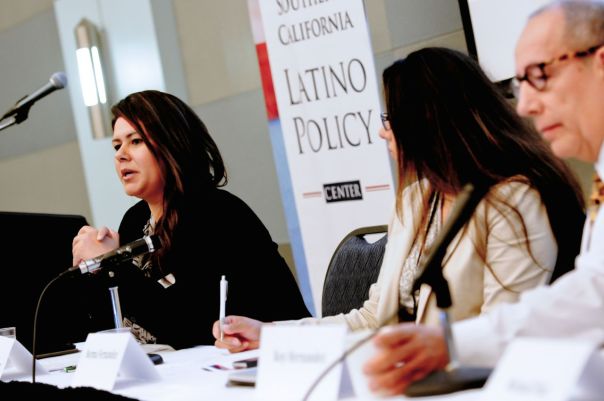
Leadership Series: Making the Case for Latino Leadership

Michele
Image by socalatinos.org

Within a generation, California and many parts of the nation will have to depend on well-prepared Latino leaders to ensure continued social and economic growth and stability.

Here’s what needs to happen: Smart, talented, and compassionate Latinos need to seek out leadership roles in business, education, politics, and community service, and, the business, education, political, and community service sectors need to seek out smart, talented, and compassionate Latino leaders.

It’s a simple formula.

The term Latino leader isn’t limited to those who represent just Latino interests. Latinos are capable of representing people of all backgrounds, be it racial, ethnic, social, or economic. When I use Latino leader, I’m talking about a leader who happens to be Latino, but provides leadership for an entire community.

Making the case to develop Latino leaders to be stewards of our community’s economic, political, and educational health is in the numbers.

According to the California Department of Education, 53% of students who attend public school today are Latino. That means that in the next twenty years or so, one out of every two workers in California will look like us. Economics require that those of working age carry the financial burden of keeping a community solvent.

To ensure a robust economy, it’s important that breadwinners represent the spectrum of workers from frontline employees to executives. If more than half of the population is under-educated and unprepared, thus under-employed, the economic impact on the state’s future could be catastrophic. That’s why it’s imperative that Latinos are prepared for all levels of employment, including leadership roles.

Here are some more numbers: Despite representing over half of the students in California, only 9% of college graduates, 18% of teachers, and 6% of education administrators are Latino. So what’s the deal? Our school system is preparing more than half of its students to be service sector workers, not managers and decision-makers. The better question is: Why is this happening?

I got an inside look on how school systems work while serving on the board of trustees at the largest high school district in California. With 26,000 students and a $220 million dollar budget, it’s a pretty big and complex operation. The district serves a majority of Latino neighborhoods in the city. Its demographics match the state’s numbers on Latino students, teachers, and administrators.

The most influential interest groups, employee bargaining groups and parent organizations, are mostly led by non-Latinos. Only one of the five current school trustees is Latino. This dynamic reflects the typical school district in California where the overwhelming majority of decision-makers doesn’t demographically represent the majority of its students.

The problem with this is that education leaders who aren’t Latino are more susceptible to making decisions based on preconceived notions about Latinos. Sociologists call this phenomenon inherent bias. These biases impact public policy decisions, class schedule assignments, student disciplinary action, and the allocation of resources, all of which results in disproportionate harm to half of the students.

I met the full force of the impact of how an unbalanced demographic relationship between students, teachers, administrators, and policy-makers in 2010 when I served as board president. A few years earlier, the district chapter of the student group Californians for Justice met with me to advocate for a policy that would make graduation requirements the same as eligibility standards for acceptance to University of California and California State University schools.

Makes sense, right? I thought so. When I was elected board president, I excitedly began to reach out to administrators, teachers, and my board colleagues to get buy-in for a policy proposal that connected high school graduation requirements to college prerequisites. I was met with immediate resistance. The stumbling block was a requirement to complete Algebra II.

Administrators counseled against moving too fast raising concerns about the lack of student preparation coming from middle school, especially schools with large Latino populations. Math teachers fiercely opposed the idea. The teacher’s union president, an Algebra teacher, sat across the table from me in a coffee shop lecturing with authority that “these kids” can’t do Algebra II.

Conversations with other trustees didn’t fare any better. Two of them wanted to “study” the issue further, a standard tactic to delay a policy proposal to death. One trustee expressed concerns that the policy would “force” every student to be on a college track. What about the students who wanted to learn a trade so they could begin working right after high school graduation, he asked. I knew who he was talking about.

Was this a case of inherent bias? You better believe it. Each one of these decision-makers raised concerns about Latino students’ ability to succeed in a rigorous academic environment. But I disagreed. I was one of those students. My high school counselor recommended that I consider learning a trade instead of going to college. Fortunately, that was a non-starter for my parents.

Because of my experience, I didn’t have any preconceived notions about Latino kids. There was no inherent bias driving my decision to fight for the more rigorous graduation requirements. I figured if I could complete a college track curriculum and succeed in college so could other students who grew up in neighborhoods like mine. So, I charged ahead to change the policy.

I learned that Latino leaders can deliberate about decisions without the filter of inherent bias in the way. With Latinos serving as decision-makers in business, politics, education, and community engagement, half of the population will have more opportunities to contribute to the success of the entire state.

The other half of the population will benefit as well from this kind of leadership. After a long and contentious campaign to raise graduation requirements in 2010, a board majority led the way to approving a policy that made college-prep classes the curriculum for all students enrolling in a district high school.

The Class of 2015 was the first class in the district’s history to complete a four-year program with every graduate eligible to apply to a University of California and California State University college.

That’s precisely why smart, talented, and compassionate Latinos need to seek out leadership roles and that’s why the community could use a bunch of smart, talented, and compassionate Latino leaders.

**********

Next time on the ESEReport.com Leadership Series: We’ll explore the success of an institution that isn’t hampered by inherent bias.

Leadership Series: The Path to the Corner Office

corner-office
Corner Office photo by http://www.bigisthenewsmall.com

Can you imagine yourself in the corner office with a great view, an expense account, an assistant, and company car?

How about banging the gavel as chair of a city commission or standing on the floor of the state legislature to make an important speech?

Maybe you want to be a school principal, a non-profit executive, or get that big promotion at work.

All of these high-profile positions require an aptitude for leadership. Becoming a successful leader requires great work product, strategic thinking, perseverance, and an ample supply of people skills. It also demands that you have the ability to bounce back from the failures that come with taking the risks necessary to succeed.

Leadership isn’t for everyone. It’s a tough business. ESEReport.com can show you how to manage the complex world of effective leadership.

For almost 30 years, I’ve had the opportunity to serve in many leadership roles (https://esereport.com/eddie-garcia-biography/).

I was 23 years old when I became the head coach of a high school varsity basketball team. I changed careers and worked my way through corporate middle management to eventually rise to vice president in a Fortune 100 company. I also served as board president for a large school district, and created the LLA Leadership Academy in collaboration with Stanford University’s Center for the Comparative Studies in Race and Ethnicity.

Through it all, I learned what it takes to lead.  I created the ESEReport.com Leadership Series to share my experiences and my secrets for successfully navigating the path to the corner office.

While the concepts I discuss could benefit anyone with the ambition to be a leader, the series will focus on helping Latinos and Latinas reach their potential. That’s where my heart is. That’s my experience. That’s what I know how to do.

My inspiration for the ESEReport.com Leadership Series comes from the many bright, talented, passionate and ambitious Latinas and Latinos who have crossed my path during many years of coaching emerging leaders.

I’ve worked with over 70 professional Latinas and Latinos who are mid-level corporate executives, non-profit organization executives, attorneys, elected public officials, and community activists. These talented people have been educated at elite private universities and public state universities. They’re leaders in the organizations they represent. Their gifts and capacity to lead are exceptional.

Even more inspiring is that they share the same humble beginnings that many of us do. The combination of working-class roots and a solid college education creates an opportunity for common sense leadership. Practical knowledge of how it all works and how to apply it for the common good will give rise to innovative, more compassionate, thought-leaders and decision-makers.

That’s where the ESEReport.com Leadership Series comes in. By sharing my experiences and success secrets, I hope to inspire the next generation of leaders.

Latinas and Latinos are poised play a major role in what tomorrow looks like. If you want to be part of that future, stay tuned. The ESEReport.com Leadership Series is for you.

*****

What others say about Eddie García’s approach to leadership development:

“Eddie García brings a wealth of personal experience and leadership training development to his ESEReport.com. His advice and suggestions are a treasure trove for those wishing to become effective leaders.” ~Dr. Al Camarillo, Professor of History and Founder, Center for the Comparative Studies in Race and Ethnicity, Stanford University

“Eddie was one of the first people who believed in me and he became an integral part in my early development. He is an excellent facilitator and he not only teaches great lessons but he makes them fun and easy to comprehend. I didn’t just learn from his experiences but I also gained even more confidence in myself. Today I represent over 100,000 residents in one of the fastest growing urban centers in the United States.” ~Honorable Raul Peralez, Councilmember, District 3, City of San José

“Understanding Eddie García’s Four Pillars of Leadership Model is essential for anyone who wants to lead an organization. His experience as a leader in each of the Pillars gives students of his approach first-hand knowledge of how it works. ~Sandra García, Principal, Adelante Dual Language Academy; Named “2013 Principal of the Year” by the Silicon Valley Chamber of Commerce

“Eddie’s passion for leadership development in the Latino community is clear. I regularly hear from graduates of the LLA Academy who share stories of how they used the tools that they received from Eddie, to advance to the next level in their career or take on a civic leadership role.” ~Honorable Andrés Quintero, Trustee, Alum Rock Union School District Board of Trustees

“I’ve known Eddie since he was a corporate executive. His real-world experience as an effective strategist forms the foundation of his approach to teaching leadership and his unique capacity to work among diverse groups of people makes him an excellent leadership coach.” ~Maria Bonilla Giuriato, President, Bonilla Giuriato & Associates; former City Councilwoman, Salinas California

Eddie García has played a pivotal role in supporting my development as an educational leader. I believe so deeply in Eddie’s ability to develop quality leaders that I have hired him as a consultant to work with our student government.” ~Jeffery Camarillo, Founding Director, Luis Valdez Leadership Academy

“Eddie’s extensive experience in East San Jose combined with his tell-it-like-it-is coaching skills have helped me make a stronger impact in my community beyond my role as a school principal.” ~Daisy Barocio, Principal, Escuela Popular Dual Language Academy

*****

To get notifications for the ESEReport.com Leadership Series click the “Follow ESEReport.com” tab on the upper right hand corner of this page.

You can also follow and “Like” the ESEREport.com Facebook page by going to https://www.facebook.com/esereport/?fref=ts or find us on Twitter at https://twitter.com/EastsideEddieG.

Latino Thursday: The Next Generation of Leaders Looks Good

"Thank You" Poster Made by Luis Valdez Leadership Academy Student Leaders
“Thank You Poster”  by Luis Valdez Leadership Academy Student Leaders

One of my pet peeves is the phrase, “kids these days.” You know what I mean. What happened to the days when kids would speak only when spoken to and say “yes, ma’am” and “no sir.” Remember those days? My favorite is, “Kids these days don’t say ‘please’ when they want something or ‘thank you’ to show gratitude.

We old timers worry about what will happen when we get older and have to rely on the next generation to take care of us. What a mess, right? These kids can’t even write full sentences when they text. They would rather send “pics” on Instagram and Snapchat than pick up a phone or write a letter.

They listen to music that isn’t even music. What happened to the good old school days when you could understand the lyrics? Earth, Wind, and Fire. Santana. Al Green. Lionel Richie. Malo. Remember “Suavecito”?

That was music.

Many people my age wonder how kids these days will run the place when we retire. The old folks are sure that the world will go straight to the dogs when the youngsters take charge.

Well my dear readers, I absolutely, overwhelmingly, vehemently, and respectfully disagree!

I know we’ll be in good hands when the next generation of Latino leaders takes the helm. Let me tell you why.

During the last two school years, I’ve had the privilege and pleasure to teach leadership classes at three east side high schools: Latino College Prep Academy, Luis Valdez Leadership Academy, and Roberto Cruz Leadership Academy. Latino students represent over 90% of the population at the schools. The program I teach is a six-week freshman course that provides students with the tools to present and conduct themselves in a professional manner.

The students learn how to set and plan goals, make professional presentations, and work in teams. They also do professional development exercises to help them with shaking hands, sitting and standing posture, making eye contact, and using body language to convey confidence. This is all done within the framework of understanding and respecting Latino cultural norms. The goal of the program is to send our kids to college and beyond with the self-assurance to succeed.

At Luis Valdez Leadership Academy (LVLA) I’ve been able to see the results of the program as the student government advisor. LVLA is in its second year of operation, so the student government is comprised of freshmen and sophomores. That means that these young leaders have an opportunity to set the cultural tone for the school well into the future.

After taking the six-week course, the elected leaders learned how to run a working decision-making government. The leadership group is large. There are four school-wide elected officers, class officers, and classroom representatives. In all, 23 students represent their peers to create and manage events and activities for the school year. In any governmental environment, a leadership team of that size is challenging to manage.

With that in mind, the student leaders are studying the fundamentals of the rules of order used by city halls, statehouses, and congress. They’re learning how to share their ideas with their fellow leaders through orderly debate and discussion. The students are using the committee system to tackle the details of putting their ideas into an actual plan.

After several weeks of intense training, the student government was ready to take on its first project. They decided to have a fall dance. As the first-ever dance in the school’s history, these young leaders felt much pressure to make the event successful. They had heated debates about the theme of the dance, the date, fundraising, the food and refreshments, decorations, and much more.

To have the event they wanted, student leaders had to raise $800 by selling tickets. They had less than three weeks to achieve this goal. That’s a tall order in a working-class neighborhood. Many on campus quietly shared concerns that the student council took on too much than they could handle.

Using the rules of order they learned, the young decision-makers developed a ticket sales and marketing strategy, and created a plan for a 100% student led and managed dance. I’ve been around many leadership teams in my career, and the students experienced all of the potential pitfalls and challenges that any team of leaders could confront. Through their raucous use of the democratic process, they worked through each barrier.

When the dust settled, here’s what happened:

LVLA had its first-ever school dance, they called it the “Falling for Fall” event. More than half of the student body attended. The student government made money on the event by raising over $1,000. The buzz on campus the next Monday was all about the dance. Everyone had a great time. The event was an overwhelming success by any and every measurement.

This gets me back to “kids these days.” Given the right tools and the confidence to succeed, Latino students will be exemplary leaders in the future. We’re in good hands. Today’s Latino civic and community leaders could learn a few things about teamwork and cooperation from the LVLA student government. In fact, so could our do-nothing United States Congress.

Oh, by the way, the student government planned and hosted an appreciation potluck for me and fellow advisor Mr. Osvaldo Ruelas, a young educator who is a future leader himself. The student leaders wanted to say “thank you” for the small role we played in supporting them.

Kids these days.

Summer in the Waiting Room: Feeling Grateful

Mark and me
Mark and me

I went for an annual physical with my doctor at Kaiser Santa Clara Medical Center today. Dr. Aaron Williams has been my doctor for over a decade. He’s a great guy and an outstanding doctor. In addition to keeping me on track, I always enjoy our visits. This time was no different, especially after he gave me a clean bill of health.

As is my custom after the yearly visit, I walked through the medical center to the intensive care unit. The way to the hospital is a familiar route. Five years ago, a nurse whisked me in a wheelchair to the emergency room taking the same path. This morning, as I walked by the ceiling to floor windows that line the causeway between the clinic and the hospital, I began reflecting on that life-changing day.

For the past two years, I’ve been writing about that day in Summer in the Waiting Room, How Faith, Family, and Friends Changed My Life. The story is about my life growing up in a working-class neighborhood, tirelessly chasing the American Dream, and surviving a summer in the ICU with God’s help and the support of my family, friends, and an amazing medical team.

I haven’t finished the book. I’m stuck on the last part. Writing about my life experiences and the 100-plus days in the hospital was easy to do. Translating what it all means has proven to be more challenging.

My thoughts on life, faith, and gratitude evolve almost on a daily basis. Since that fateful summer, I’ve met many people who have made a meaningful impact on me and brought focus to my life’s true purpose. They’re an important part of my story about hope and redemption. I’m still trying to make sense of it all.

This brings me to my annual ICU pilgrimage this morning.

The ICU occupies the second floor of the hospital at Department 230. I called this place home from June 18, 2010 through August 1, 2010. The cold avocado green walls and shiny antiseptic linoleum floors give me the same sense of warmth and comfort as my childhood home. While these feelings seem contradictory, there’s a simple explanation. For me, this is sacred ground.

For six weeks during the summer of 2010, I clung to life behind the plain white double doors that open up to the unit. In an adjacent waiting room, my family and friends, prayed, laughed, and cried in faithful vigilance. In the bowels of the unit, doctors, nurses, therapists, and nursing assistants waged a daily battle to keep me alive.

The names of those I remember are forever seared into my grateful consciousness: Drs. Mendoza, Rajan, and Fisk. With the expertise of a team of rehab therapists – Suzanne, Sonia, Christine, Jennifer, and Mark – I learned how to sit up, walk, talk, and eat all over again. I stay in contact with many of them to this day.

During my visits to this special place, I sit on a silver aluminum bench outside of the ICU and reflect on those names and the faces of an army of nurses whose names are too many to remember. I say a prayer and thank God for bringing these special people into my life.

Sometimes, I’ll see a familiar face pass by. Today was one of those days.

As I got up to leave, a man in green hospital scrubs was making his way through the hallway. We made eye contact and gave each other that “I know you” look. Seeing his nametag, I remembered him immediately. When I was learning how to stand up, he was the rehab assistant who helped the therapist lift my listless body. He was with me the day I took my first steps with the help of parallel bars.

His name is Mark (not the same Mark who is a physical therapist).

I mentioned my ICU experience with him. I could see his brain trying hard to remember me. During the difficult therapy sessions when I struggled to stand, I used to joke with him that I would come back someday so I could express my appreciation over a Coors Light on tap in a tall frosty glass. When I reminded him of that, he broke into a wide smile and we instinctively embraced in a bear hug.

I still feel the warmth and comfort of this sacred place. It’s called gratitude.

My story continues to write itself.  I’ve been telling readers for almost a year that I will soon publish my book. I just need to make sense of events like today. My brief visit with Mark has given me renewed energy and purpose to finish writing my story. I’ll get it done. I promise.


Latino Thursday: Let’s Play Presidential Hardball

Image by mediaite.com

As the Republican nomination circus rolls through cyberspace, I don’t know whether to laugh or cry.

Yesterday, Donald Trump reposted a tweet with a variety of anti-Latino images featuring rival presidential candidate Jeb Bush posing with his Mexican-born wife and wearing a photo-shopped mariachi outfit. The retweet included the following caption, “ADIOS, JEB aka JOSÉ.”

I love the reference to “José,” the standard Mexican slur. That’s a good one, Mr. Trump. Very original.

Actually, the 2016 presidential race is starting to get interesting for Latinos.

Republicans continue to dismiss the fastest growing voter bloc in the country. To satisfy the Racist Right, new Speaker of the House Paul Ryan has already announced that comprehensive immigration reform will never see the light of day. The party doesn’t have the courage to refute Trump’s racist taunts. Same old you know what, different day.

On the other hand, Democrats remain strategically quiet on immigration reform. They appear supportive, but the support is lukewarm at best. None of the candidates for president has made reform a cornerstone of their campaigns. We might be subject to another election cycle when the latte liberal left takes Latinos for granted because the other side is so terrible for us.

There are some interesting developments that may put Latinos in the driver’s seat of the 2016 presidential race.

If the wacky base of the GOP comes to its senses and figures out that someone who has never served in public office would be a disaster for our country, the party’s best chance to win in November just may be a Latino, Sen. Marco Rubio of Florida. The Bush team calls him “the GOP Obama.” It was meant to be an insult, but that could be bad for Democrats. Remember, President Obama is undefeated in presidential elections.

Latinos are a large voting bloc in the states with a bunch of the Electoral College votes needed to win the presidency: California, Florida, Texas, Illinois, and New York. Experts believe that Republicans need to win at least 40% of the Latino vote for a chance to win. President George W. Bush has been the only Republican able to poll those kinds of numbers since Latinos have emerged as a key voting bloc.

Only 18% of Latino registered voters are Republican. That means all registered GOP Latino voters have to cast a vote for their party’s nominee and over 20% of registered Democrats and independents have to crossover for a Republican to win. If Republican Latinos vote against their party for any reason, the GOP has big problems.

However, if the bilingual Sen. Rubio gets the Republican nomination and moderates his stance on immigration reform, the Democrats could be in trouble. He could saturate the Spanish language airwaves in his own voice to woo Latino independents and some conservative Democrats. This could be enough to get to the elusive 40% the GOP needs to secure a home at 1600 Pennsylvania Avenue.

So what does this all mean? Latino voters have a shot to decide who will be the next President of the United States.

Let me explain.

Last week, a group of Latino GOP leaders made an ultimatum to the party. Stop disparaging the Latino community or else. The threat was directed to Mr. Trump, but it was clear that the demand could include others. Rosario Marin, the former Republican Treasurer of the United States, said, “Heed our warning, don’t expect us to come to your side during the general election…If you are not with us now, we will not be with you then.” These are tough words, indeed.

A Latino Republican rebellion could cause them to stay home on Election Day or vote Democrat. In both cases, the GOP has no chance to win. Of course, this probably won’t happen if the group of influential Latino Republican leaders gets its way or if Sen. Rubio is the nominee

If the GOP gets its act together and heeds Ms. Marin’s warning, things could get awfully close in the General Election next fall. In that case, Latino Democrats have to come out in big numbers for the Democratic nominee to prevail.

That brings us to the Democrats.

The Democratic Party historically has been favorable to Latino issues, but only as a sideshow. Let’s be honest, the party has taken the Latino vote for granted since the “Viva Kennedy” campaign in 1960. For more than a half century, we’ve been a loyal and automatic yes vote for the Democratic ticket.

President Obama’s 2008 campaign promise for comprehensive immigration reform took a back seat during his administration, yet Latinos voted for him overwhelmingly in 2012. Our community can’t let the Dems slide anymore. This time is different. The Democratic Party needs Latinos.

I tip my cap to former Treasurer Marin and her cohorts for having the courage to tell the GOP the way it’s going to be. If their party listens, it has a chance to win back the White House.

Latino Democratic leaders should take a cue from their Republican counterparts and let the party know that we no longer want to be relegated to the back seat. Comprehensive immigration reform is our issue. It crosses party lines. People need to safely come out of the shadows, families need to stay together. If the Democratic ticket won’t make this issue the centerpiece of its platform, Latinos should consider staying home next November.

Then, as we Latinos like to say, “Let’s see what happens.”


Monday Meanderings: Staying Young at Heart

Image by clipart101.com

Later this week, I’ll celebrate my 52nd birthday. Turning 30, 40, and even 50, was no big deal for me. Even 51 didn’t seem to register as a transition point from regular adulthood to real adulthood. But for some reason, the idea of 52 is making me rethink this whole old guy thing.

I’ve always been young at heart. I’ve never wanted to really be a responsible grown-up. Yeah, I got married, bought a house, had kids, and spent most of my waking hours on the treadmill of life trying to stay one step ahead of the next batch of bills that was sure to arrive in the mail. But, I never let it stop me from channeling my inner kid.

I love to party!

With some music, a little dancing, and a few (too many) adult beverages, I’m easily transformed into the irrepressible adolescent that lives inside of a body that has seen better days.

My daughters keep me up to date with the latest music, fashion, and phrases. Like I low-key want a cheeseburger right now (unfortunately, my cardiologist-recommended no-sodium, low-fat diet doesn’t allow such a thing). Oh, well.

Anyways…

I love hip-hop and alternative music. I like low-top navy blue Chucks, Vans, skinny jeans, and slim-fitting suits. Really, I do.

I’m connected too. I’m on Facebook, Twitter, Instagram, and Snapchat. I text, Instant Message, Google, YouTube, and Facetime. My Smartphone has become an extension of my left hand.

I’ve always scoffed at old fogeys who begin sentences with, “kids these days” or “in the old days.” Times change. Each generation brings new and exciting ways of doing things. To those who yearn for the past, get with the program, I implore.

A couple of weeks ago, everything changed. I was at the Delta terminal at La Guardia Airport in New York. The place is super high-tech. Almost every chair has an outlet to charge electronic devices. There is a bank of i-Pad stations where I’m sure phone booths used to sit.

Looking for something to eat before my flight, I walked by several restaurants. I noticed that every establishment had an electronic ordering device. When I sat down to order, I ran into a problem. There was no way to communicate that I needed salt-free options, a side of fruit instead of fries.

When I asked the server, she curtly told me that everything available was on the computer as she whisked by to leave a plate of food on another table. Yeah, but…I started to say. I wasn’t able to finish my sentence as she swiftly turned the corner to deliver food to the other side of the restaurant.

Are you kidding me? What happened to the good old days when waiters and waitresses greeted you with a smile and a helping hand? I sat like a grumpy old man eating a sandwich I really didn’t want and longingly staring at fries I couldn’t eat, only to pay the same machine I ordered from.

And then, to my horror, the device asked for a tip! What had the world come to?

Bam! There it was. I said it. I sounded like a bitter senior citizen decrying new-fangled things. I started questioning if I was from a bygone era when people actually talked with each other. I like to talk. I like to give and get hugs. I like to look someone in the eye when having a conversation. Was I a man of the 20th century? Did the train of progress leave me at the depot?

I hope not. I love progress and everything it brings to our lives and culture. But, I have to say that I’m perplexed when I see a young couple sitting in a restaurant booth on their respective hand-helds instead of flirtatiously giving each other goo goo eyes. There’s nothing like a warm smile and human interaction. No device can replace that.

In the meantime, I plan to celebrate my birthday with my wife over a nice dinner. I’ll gaze into her beautiful eyes and we’ll talk about whatever crosses our minds. I might even entertain sipping good old-fashioned bourbon over ice as a nightcap.

On the other hand, pounding a few Mike’s Hard Lemonades and dancing to Drake and DJ Mustard sounds like more fun. I’ll Snapchat my daughters and nieces and nephews, and share pics on Instagram with the world. I might even invite my old fogey friends who are on the couch watching TV and complaining about “kids these days.” Of course, I’ll have to call them. They’re soooo 20th century!


Monday Meanderings: Donald Trump is the Voice of the Racist Right

Image by Red-carpet.de

I’m taking a page from the Trump playbook. I won’t be politically correct and give in to the PC police. I’ll just tell it like it is. Donald Trump is the voice for the Racist Right in America.

He’s a smart guy. The average person isn’t worth $10 billion. It takes some brainpower to make that happen. So what gives? He really wants to be President of the United States. Who knows what was behind his initial motive for running for the highest office in the land. Now, he thinks he can win.

Trump has sustained his standing in the Republican polls despite comments that are seemingly at odds with conservative icons. At a family conference, he said that he didn’t need God’s forgiveness for his sins. He called war hero Senator John McCain a loser for getting captured in Vietnam and belittled conservative news celebrity Megyn Kelly at the Fox News debate. Not one of these incidents resulted in a slide in his support.

Shrug off God, Mr. Trump. That’s okay according to the religious evangelists on the right. Proclaim that John McCain isn’t a war hero. No problem, say some veterans. Insult the star of a conservative news show. Wagging their fingers, the PC police scold women for being too sensitive.

That’s where the racist thing comes in. Trump revived the racially divisive term “Silent Majority” in a speech at a rally last month in Arizona. That term is not without historical significance. To exploit the civil unrest of 1960s urban America, Richard M. Nixon coined “Silent Majority” to rally the racist Deep South to support his election. Angry and frustrated by civil rights gains, southern voters swept Nixon into the White House in the 1968.

Trump is trying to bring that racist anger and frustration back as a political strategy. He hopes to replicate the Nixon landslide. The thrust of his message is “make America great again.” For the Silent Majority types, this means going back to the days when Blacks knew their place and Mexicans stayed in Mexico. That explains why conservatives give Trump a pass on trivializing Republican stalwarts like God, Senator McCain, and Megyn Kelly.

When he outlined his immigration proposal, Trump solidified his support in Racist America. The lynchpin to his plan is to abolish the 14th Amendment of the United States Constitution. The Supreme Court has cited the amendment to rid our nation of the evils of racial segregation, ensure voting rights to all Americans, and guarantee equal treatment under the law for everyone. Repealing those values has always been the goal of the Racist Right.

Trump wants to take away the birthright of American-born citizens guaranteed by the 14th Amendment. He believes that their parents don’t belong here, so those born in the U.S. don’t have the right to be American citizens. There’s plenty of legal and constitutional precedent that demonstrates that Trump might be drinking too much Southern Comfort. That doesn’t matter though. He just wants to rally the Racist Right to go to the polls and vote for him. It worked for Nixon.

Fortunately, the group of Americans who want to return to a nation that provided equal treatment for just a few white folks is shrinking. These people scream at the tops of their lungs that they want to “take America back.” During a Trump rally in Alabama last weekend, his supporters heard shouts of “white power” coming from the crowd. The Silent Majority is really the vocal minority. They now have a self-proclaimed champion in Donald Trump.

While his poll numbers continue to hold steady with those who yearn for an America of yesteryear, we’ve come a long way since 1968. The rest of the country has moved on. Poll after poll shows that a vast majority of Americans support a pathway to citizenship for undocumented workers. We are part of a reasonable majority that sees the true greatness of America, not in the past, but just on horizon.

Despite the belief shared by most Americans that our nation is better off with cultural diversity, Trump will continue his assault on immigrants, especially those from south of the Rio Grande. With each promise to build the Trump Wall to keep Mexicans out and every proclamation that all undocumented immigrants and their American-born children “have to go,” the vocal minority will cheer with enthusiasm and hope for the return to the racist America they loved.

The Trumpnado, as his followers call his campaign, will soon pass. Sadly, it will leave a trail of destruction and bitterness in its wake. When the winds of primary season calm down, Americans will go the voting booth and elect a president who will govern from the center. For 225 years, Americans have always found a way to elect thoughtful leaders that have kept us on the road to equality and justice.

After Election Day 2016, I’m confident that we’ll continue on our journey to make the United States the “more perfect union” that our Founding Fathers envisioned. I believe in America and I have faith in God that He will lead us down the right path.

San Jose City College: Home to World Champions

Photo by Golden State Warriors

Yes! The Golden State Warriors are world champions! I’m still nursing my celebration hangover from Game 6 of the NBA Finals. It was quite a story. There was all the hoopla about the the Splash Brothers vs. “the greatest player in the world.” With the exception of Warrior fans, the rest of the country was sure that King James would carry the day like Michael, Magic, and Larry did in the 1980s and 1990s. But he didn’t.

And the Golden State Warriors are world champions!

This was a topic of conversation when I had lunch with Hall of Fame basketball coach Percy Carr last week. Coach Carr just finished his 40th season at San Jose City College and has his fair share of championships. He mentioned a tidbit of history that I’m sure not many people know about. The last time the Warriors were world champs, the team’s practice facility was the gym at San Jose City College.

The team practiced at SJCC from the mid-1960s through the end of the next decade. Hall of Famer and 1975 NBA Finals MVP Rick Barry played there, as did Warrior greats Al Attles, Clifford Ray, Jeff Mullins, Jamal Wilkes, Phil Smith, and Charles Johnson. Attles was also the head coach of that 1975 championship squad.

Coach Carr shared stories about the NBA stars playing pick-up hoops with the SJCC players during open gym. He recounted how the NBA players were right at home on his floor. They interacted with students and others who happened to hang around the court. Coach still has one of Clifford Ray’s size 19 high-top sneakers in his office as a souvenir from those days.

I peppered Coach Carr with questions: When did the Warriors start practicing at SJCC? How did it happen? Why did the team choose to workout in San Jose, not Oakland or San Francisco? Since the the Warriors/SJCC relationship started before he arrived in 1976, Coach Carr didn’t have answers to my questions. I could see the light bulb illuminate above his head as he picked up his cell phone and dialed his old friend and “Mr. Warrior,” Al Attles.

After a few minutes of friendly ribbing and chit chat, Coach Carr asked Coach Attles some of my questions before handing the phone to me. It was pretty cool for me to be able talk to the legendary Al Attles just a week after the Golden State Warriors won the NBA championship. Actually, it was VERY cool!

Here’s what I learned: A generation ago, the NBA wasn’t the glitzy showbiz entertainment juggernaut it is today. That had its beginnings in the late 1970s with Dr. J’s acrobatic dunks and the Magic vs. Bird show. Then came Air Jordan, and the rest is history. The NBA evolved from a hard-nosed league of large men who happened to be the best basketball players in the world to today’s multi-billion dollar mega business featuring large men who are the best players on the planet.

In 1962, the Warriors came to San Francisco from Philadelphia in when a group of local businessman pooled their money together to buy the team. When the Warriors arrived in San Francisco, there was only one other NBA team on the west coast, the Los Angeles Lakers came from Minnesota just two years earlier. The group bought the franchise for a whopping $850,000.

Yeah, you read that correctly.

A few years later, San Jose native Franklin Mieuli, who made his fortune in the local radio and television business, eventually bought out his partners and became principal owner of the franchise.

As the NBA was getting a foothold in California during the early years, the Warriors were having a hard time finding a place to practice. The University of San Francisco was the only local college that was willing to give up some gym time for the pro team. That arrangement didn’t last long. The club then moved to the Oakland Mormon Temple where the old ABA Oakland Oaks practiced during its one year in existence. The Oaks failed to pay the rent, so the deal almost fell through because church leaders mistook the NBA for the ABA.

That’s where owner Franklin Mieuli’s San Jose roots came in handy. He reached out to the SJCC administration and secured a long-term commitment to use the gym as the pro team’s official practice facility. Part of the deal included the construction of a professional-style locker room that the SJCC Jaguars still use today. Coach Attles told me that the SJCC community was always warm and welcoming. “We loved our time at San Jose City College,” he said.

Today, the Warriors play regular season games at the Oakland Coliseum and work out in a state-of-the-art practice facility befitting a 21st century NBA franchise in that city’s downtown. The team is the best basketball club in the world. The best two players have a splashy nickname that resonates with fans in the high-energy entertainment industry the NBA is today. Steph Curry jerseys are the hottest items in the NBA’s retail business.

In simpler times, the NBA champs hung out in a little gym in San Jose. Earlier this spring, I wrote that the SJCC men’s basketball team was the best kept secret in town (click here to read that article: https://esereport.com/2015/02/23/monday-meanderings-san-joses-best-kept-secret/). Now we know that the college has another wonderful secret. It is home to world champions.

The Day That Changed My Life – Five Years Later

stock-photo-10274898-june-2010-calendar-series

In just a few days, I will celebrate the 5th anniversary of the day that changed my life. I haven’t been the same since that fateful day when a massive heart attack wrought havoc on my body. Before that day, I was the archetypical workaholic spending ungodly hours at the office and chasing every new potential opportunity. I loved the hectic pace of my career and the financial benefits that came along with it.

Growing up in a working-class neighborhood, I believed I had achieved the American Dream. I was married to a beautiful and successful woman, had two wonderful daughters, and owned a home in the suburbs. My career was limitless as was my future earning potential. I felt like King Midas, everything was going my way. Who could ask for more?

Suddenly, without warning, it all came to a screeching halt. Just like that.

After the heart attack, things got worse. I spent the next 100 or so days in the hospital on a variety of life support machines. I’ve been writing about that crazy summer in the blog series, Summer in the Waiting Room: How Faith, Family, and Friends Saved My Life.

As a result of the health crisis of a half decade ago, my energy level has been critically compromised. I no longer have the physical strength and vigor to work 16-hour days in the dynamic high-paced, pressure cooker environment I came to love. My limitless earning potential is now severely limited. My voracious appetite for delicious food has been relegated to a strict no-salt, low-fat, non-processed, and bland diet with few options, especially when going out to eat with family and friends. Perhaps most dispiriting is that Mark’s Hot Dogs has seen the last of me.

What’s to celebrate then, you might ask.

The answer is simple: life. That’s what I celebrate.

It may sound like a cliché and I now wonder if people truly understand its meaning. We’re all conditioned to say that we should be grateful for life when things get tough. But, are we really ready to settle for just being alive, even if it isn’t on our own terms? That’s the eternal question of humankind. When I thought that I was the master of my own universe, I never gave the question a first thought, much less a second thought.

Like most of us, I was preoccupied with career advancement, titles, and the trappings of climbing the ladder of success. Work challenges, future college tuitions, retirement, and 401Ks dominated my mind. I didn’t have time to consider the meaning of life, so I left that to the philosophers, clergy, and people who I thought were afraid to confront the realities of the world.

Now I think about it all the time. And it’s a blessing. During the past two-plus years, I’ve been on an amazing spiritual journey. I’ve stopped asking God “why?” and now reflect on “what.” What does He want me to do with this life he saved five years ago? What can I do to better appreciate His gift? What does He have in store for me today? I know I’m in for a long voyage, but I’m ready for the ride.

Earlier this spring, I announced on this blog that my book about that summer five years ago would be finished this summer. I had planned to end the story with my triumphant return home from the hospital. However, my spiritual awakening has been an important part of the ongoing story that began the day that changed my life. So I’m re-writing the final part of the book.

For those readers that don’t subscribe to a particular religious belief, fear not. My reflections aren’t designed to change your own beliefs. The final part of the book will be about faith, destiny, and my perspective on the eternal question.

Stay tuned!

In the meantime, if you have a moment, join me in celebrating five years of life. Click on the links below for the previously posted excerpts that chronicle that life-changing day in June.

**********************

https://esereport.com/2014/09/10/summer-in-the-waiting-room-the-day-that-changed-my-life-part-1-excerpt-32/

https://esereport.com/2014/09/17/summer-in-the-waiting-room-the-day-that-changed-my-life-part-2-excerpt-33/

https://esereport.com/2014/09/24/summer-in-the-waiting-room-the-day-that-changed-my-life-part-3-excerpt-34-2/

https://esereport.com/2014/09/30/summer-in-the-waiting-room-the-day-that-changed-my-life-part-4-excerpt-35/

https://esereport.com/2014/10/08/summer-in-the-waiting-room-the-day-that-changed-my-life-part-5-excerpt-36/

https://esereport.com/2014/10/15/summer-in-the-waiting-room-the-day-that-changed-my-life-part-6-excerpt-37/

https://esereport.com/2014/10/22/summer-in-the-waiting-room-the-day-that-changed-my-life-part-7-excerpt-38/


Monday Meanderings: San Jose’s Best Kept Secret

Speed City Getting Ready to Run (photo courtesy of Twitter @SJCCBasketball #sjcchoops #speedcity )
Speed City Getting Ready to Run
(photo courtesy of Twitter @SJCCBasketball
#sjcchoops #speedcity )

Okay, please bear with me. I’m really going to meander today.

I want to talk about the best kept secret in San Jose. First, let me say this: San Jose doesn’t have a clue how to attract, support, and celebrate big-time sports. There, I said it.

We pride ourselves in being the 10th biggest city in America. Yet, when it comes to sports teams, one of the characteristics of a big-time city, we have but one major-league organization, the National Hockey League Sharks. Oh yeah, we also have the Earthquakes.

I still sting over the voters’ rejection of a ballot measure to build a stadium and bring the Major League Baseball Giants to town in 1990. I can’t forget how the Golden State Warriors used the city to get a better deal in Oakland a few years later. What about the ongoing effort to lure the A’s here?  Don’t even ask. And, please don’t even mention that little hamlet on our northern border getting one of the most storied franchises in NFL history.

For goodness sake, the 40th largest city in America has the Braves (MLB), Hawks (NBA), and Falcons (NFL).

I must also confess that I’m not much of a hockey fan. As someone who is a native of our beloved city, I didn’t play hockey or watch it on TV as a kid, although I do remember that it snowed here once for about 10 minutes when I was in the 7th grade. The Earthquakes is a major league soccer franchise, but its new 18,000-seat stadium is a far cry from the 114,000 seats in Estadio Azteca, Mexico City’s soccer venue.

But, I digress (and meander).

The best kept secret in town is the San Jose City College Jaguars men’s basketball team. The program is also the most successful sports organization in the history of our fair city. Period.

Let’s start with the numbers. During the past 39 years under Coach Percy Carr, the Jags have won 864 games, the most wins for a California college basketball coach ever. Seventeen players have earned All-State honors. The best number, however, is the 97% of players who move on to a four-year college.

On Saturday afternoon, the team clinched its 14th conference championship and 35th playoff appearance in the Carr era by finishing 12-0 in Coast Conference play and 25-3 overall.

And, guess what? No one outside of the SJCC community knows about it. No mention in the Mercury News, no stories on NBC Bay Area, ABC 7, CBS 5, or KTVU Channel 2. Was the mayor on hand on Saturday to celebrate with the college chancellor and president? Nope.

What gives here? How can a city that prides itself on success and innovation completely ignore one of its most successful institutions?

Unfortunately, I don’t know the answer to that. But I know this: San Jose City College basketball is fun to watch! If you love basketball like I do, you won’t find a better place in this town to watch a game than in the Jaguar’s gym. And it’s up close and personal.

The squeak of basketball shoes on the maple floor, the referee’s whistle, coaches shouting directions to the players and scolding officials, and the sweet sound of the ball swishing through the net after a three-point shot can all be found at SJCC.

And, the basketball is big-time. The players are big, strong, fast, talented and well-coached. More than a few of them will play at a NCCA Division I school. Fans call them Speed City. At any given moment, a breathtaking fast break or a thunderous slam-dunk will ignite the small crowd.

Did I mention that the basketball is big-time?

Luckily, this season isn’t over. The Jags will host the first-round of the state playoffs at home on Saturday, February 28th at 7:00 PM. Do yourself a favor. Go watch them play. Follow their quest for a State Championship.

It’s the best kept secret in town.