Tag Archives: Summer in the Waiting Room

Summer in the Waiting Room: Chapter 1 (excerpt #4)

García siblings posing in front of the kitchen window at 48 Viewmont Avenue - L to R: Patty, Sisi, Barbara, David, me, Steve (García Family photo, mid-1980s)
García siblings posing in front of the kitchen window at 48 Viewmont Avenue – L to R: Patty, Sisi, Barbara, David, me, Steve (García Family photo, mid-1980s)

Blogger’s note: The following passage is the from my manuscript of Summer in the Waiting Room: How Faith, Family, and Friends Saved my Life. It’s the fourth excerpt from Chapter 1: “48 Viewmont Avenue.” I will post weekly excerpts every Wednesday morning.  To read previous installments, go to the Categories link and click on “Summer in the Waiting Room.”

********************

The first 27 years of my life were marked and influenced by events in and around my parents’ modest house on 48 Viewmont Avenue in east San Jose. The neighborhood was a typical working-class community of small houses on small lots with neatly mowed lawns and little flower gardens on the edge of the east side of town that once thrived with orchards. Just a short walk a few blocks away, was the Alum Rock Village, a row of mom and pop markets, a liquor store, a bakery, a hair salon, a barbershop, and assorted small businesses that included a feed and fuel that served the remnants of a bygone agricultural community.

The area included a county branch library, a couple of elementary schools, a middle school, a high school, and of course, a Catholic church. Next to the high school was a small fire station. Viewmont Avenue itself was a short block of about forty houses. On one end sat an elementary school and on the other the two-lane Alum Rock Avenue that led to downtown San Jose to the west and several miles up the east foothills to large expensive houses and Alum Rock Park which sunk grandly into a deep canyon.

Viewmont Avenue was narrow with rounded curbs, no sidewalks, and wooden telephone poles carrying heavy electrical and telephone wires placed about 50 yards apart running down one side of the street. The poles and wires played an important role during two-hand touch football games – the poles marked the end zones and the wires could be an extra defensive player if the quarterback threw a pass too high.

Our neighbors were working-class families like ours in pursuit of the American Dream. Across the street from our house lived the Ornelas family. My godfather Tony was a sheet metal worker and his wife Marty worked in the canneries. Next door on each side of our house lived widows, Mrs. Wood on one side and Mildred on the other.  Viewmont Avenue was ethnically diverse well before the term became popular in our society.  A few houses away were the Moreno, Romero, Dutra, Marino, Olague, Vasquez, and Zigenhart families.

Mr. Helgeson, a retired widower, could always be seen outside wearing neatly pressed work clothes to care for his meticulous yard and garden. On national holidays, I watched in admiration as he carefully hung the American flag over the porch to show pride for his adopted country. The breadwinners provided for their families working as electricians, landscapers, construction workers, and machine shop operators.

The women worked mostly at the canneries and supplemented the family income by cleaning houses, providing child care, or caring for seniors. The neighborhood around Viewmont Avenue was like a small town on the fringes of a growing city. For me, it had everything I needed and wanted. I felt happy, safe, and comfortable there. It was home.

The house I grew up in was a cozy three bedroom, one bathroom tract home built in the late 1940s. The indoor living space measured about 900 square feet and sat on a 1,800 square foot lot that included a front yard and backyard. In the front yard, was a patch of grass and a magnolia tree surrounded by the plants and flowers that flourished under the tender care of my mom’s green thumb. Above the wooden one-car garage door hung a basketball hoop and a backboard made from a piece of scrap plywood. From the kitchen window, one could see the entire scene.

Inside, the house was a standard mid-20th century tract home with low ceilings and distinct living spaces. It seemed as though key family events always occurred at the kitchen table or at the narrow linoleum countertop, dotted with several cigarette burns, which separated the kitchen from a snug dining room. On the kitchen side of the counter sat my dad’s signature restaurant booth tightly curved around a round table and on the dining room side of the counter stood three barstools.

My oldest sister Barbara would say later in life that we had an “idyllic” upbringing on Viewmont Avenue. My parents made sure that school was a priority and provided me and my siblings with the opportunity to participate in extracurricular activities; girl scouts, cheerleading, and color guard for the girls and little league, boy scouts, and Pop Warner football for the boys.

It was the life of the 1950s and 1960s television genre that dad yearned for after listening to the stories about growing up “American” from his friends in the Navy. At mom’s funeral in 2003, my cousin Tutie Sanchez reminisced that “Tía Mary was like the Mexican Donna Reed” from the 1950s sitcom of the same name. Barbara said years later that  “mom and dad created a cocoon that protected us from all of the bad things in the world.”

********************

Next Wednesday: Chapter 1 continues  with stories about growing up on 48 Viewmont Avenue.

Eddie is available to speak at your next event or conference.  To learn more about speaking services click on the “Speaking Engagement” tab at the top of the East Side Eddie Report.com page.

To schedule Eddie for your next breakfast, luncheon, or dinner event, e-mail eddie.m.garcia@comcast.net, or call 408-426-7698.

Summer in the Waiting Room: Chapter 1 (excerpt #3)

My Family - standing L-R: David, Stevie, Patty, Barbara (Garcia Family photo ca. 1966 )
My Family in Front of Fireplace at 48 Viewmont Avenue – Standing L-R: David, Stevie, Patty, Barbara (Garcia Family photo ca. 1966)

Blogger’s note: The following passage is the from my manuscript of Summer in the Waiting Room: How Faith, Family, and Friends Saved my Life. It’s the third excerpt from Chapter 1: “48 Viewmont Avenue.” I will post weekly excerpts every Wednesday morning.  To read previous installments, go to the Categories link and click on “Summer in the Waiting Room.”

********************

After a few years of marriage and the births of my brother David, and my sisters Barbara and Patty, my parents found that there were no opportunities for them in Phoenix. My dad was going from job to job, many times working two at a time, but none was steady. He scraped enough money together to pay rent on a studio apartment, feed the kids, and buy a broken old Ford to take him to and from his various jobs.

Later in life, my parents would laugh about the time their car had a dead battery and they couldn’t afford to replace it. My dad would get up early in the morning, open the hood of the jalopy and peer into the motor as if there were a problem. Without fail, a Good Samaritan would ask if he needed help and my dad would explain that the battery wasn’t working that morning, and he would appreciate a jump to get the car started. Once his work day was over, he would begin the same routine until a passerby would lend him jumper cables to start the car for the return trip home. This would last for months.

He quickly realized that this was no way to live. He had traveled around the world as a sailor fighting for his country, seen New York City, Boston, and Los Angeles. He knew there were opportunities for those who took risks and sought a better life. So, with a used battery in the rickety car and protests from my Grandma Joaquina, he and my mom packed up their three babies, their meager belongings, my Abuelita Chabela, and headed for San Jose, California, to join his sister Maria, her family, and relatives on his father’s side of the family to find work in the orchards and canneries of the fertile Santa Clara valley.

In San Jose, my parents moved into a relative’s garage until they were able to earn enough money to find a place for their growing family. They found a small apartment not too far away from the town’s bustling canning industry. My Abuelita Chabela took care of the kids at night while my mom worked at the canneries. It’s a cliché, but my dad worked day and nights to earn just enough money to keep a roof over their head and dinner on the table, and there was enough work for my parents to rent a small house in San Jose’s east side.

My brother Steve was born shortly after they moved into the rented house on the east side, and with another baby to clothe and feed, my parents found extra hours working for slave wages in the apricot orchards of the east valley picking the fruit and cutting it for the lucrative dried apricot market. Every bit helped, but they needed steady income to provide stability for their growing family.

During that time, San Jose was rapidly growing and the postal service was looking for reliable veterans to meet the demands of its burgeoning workforce. Soon, my dad’s status as a World War II veteran would pay off when he got a job working at the downtown post office. Although the pay wasn’t nearly enough to meet the needs of their family, the stability gave them a chance to achieve the American Dream and buy a house. They found a house just a couple of blocks away from their rented house.

My parents borrowed money from relatives to put a modest down payment on the outlandish $11,000 mortgage they took to buy the house on 48 Viewmont Avenue. For the next several years, my dad would dutifully drive downtown to the post office to earn a living and my mom would supplement their income taking jobs cleaning houses and working part-time in the cafeteria at the new IBM headquarters in the south side of town. My dad would take every opportunity to work overtime to help pay the bills.

Lucky for them, my abuelita was available to take care of the kids while my parents struggled to stay afloat. This steady way of life continued for nine years and it looked like my parents were starting to slowly build a solid foundation for their family’s future when I arrived.

********************

Next Wednesday: Chapter 1 continues with my first years growing up at 48 Viewmont Avenue in east San Jose.

Summer in the Waiting Room: Chapter 1 (excerpt #2)

My parents taking a walk in Phoenix, Arizona (Garcia Family photo ca. late 1950)


Blogger’s note: The following passage is the from my manuscript of Summer in the Waiting Room: How Faith, Family, and Friends Saved my Life. It’s the second excerpt from Chapter 1: “48 Viewmont Avenue.” I will post weekly excerpts every Wednesday morning.  To read previous installments, go to the Categories link and click on “Summer in the Waiting Room.”

**********************

My parents were children of the Great Depression, an era of desperate times for all but the richest Americans. For both my parents, poverty was compounded as they were children of widowed mothers who endured the racism and discrimination faced by Mexican Americans of that time. As children, they had no understanding of the American Dream and no real path to achieving it. As adults, they worked tirelessly to provide that opportunity for their children, and the little house on 48 Viewmont Avenue was the base of operations for their pursuit of the dream.

My dad was born Federico Olquín García in the dusty hamlet of Las Cruces, New Mexico, on April 15, 1926. The oral history of my family doesn’t provide much about the first 16 years of his life. This much we know: his parents were Juan and Isabela “Chabela” García, also native New Mexicans, and he had one brother and two sisters.  Juan worked in the dangerous and back-breaking copper mines of southern New Mexico and Chabela tended to the home and their four children.

They lived in a small adobe structure with a dirt floor built by Juan and a younger brother. When my dad was about eleven years-old, his father died of respiratory problems related to his endless hours working in the mines.  With her four kids in tow, Chabela left Las Cruces to join relatives in Phoenix, Arizona. Family stories contend that my dad had to help drive the long and hot road to Arizona. If this is true, his childhood had disappeared in a flash and his years of responsibility and obligation came upon him overnight.

In October 1942, my dad left the small apartment he shared with his mother in south Phoenix to join the U.S Navy. Like many of his generation, my dad shared little about his experience as a sailor during World War II. He told us that he served on the aircraft carrier U.S.S. Wasp in the Pacific Ocean, but recounted nothing about battles and dangerous situations. History tells us that the Wasp engaged in several brutal battles with Japanese aircraft from October 1942 through the end of the war, the time my dad served on the carrier. In a personal log he carried, he wrote in detail about the last days of the war and the Wasp’s return to the United States.

My mom was an only child born to a single mother in on January 31, 1930, in Colton, California. Colton, a busy railroad hub and farming town in southern California, was one of many stops on the state’s farm-working circuit where her mother, Joaquina Othon, and her Tía Lipa traveled in search of seasonal work. My grandmother Joaquina was an independent woman trying to eke out a living for herself and her young daughter. Like my dad, little is known about my mom’s early life.

Within several years, my mom and her mom were again on the road, this time to Phoenix to help Tía Lipa care for my great-grandmother who arrived from Sonora, Mexico, to live out the last years of her life. My grandmother continued working odd jobs as a housekeeper, babysitter, and seasonal worker to support her daughter, sister, and ailing mother. Due to my grandmother’s tireless work ethic, my mom had a financially poor, but relatively stable life during her teen years. It was during this time that the lonely young woman raised by her mother, an aunt, and an aging grandmother, dreamed of one day having a big family with many children and grandchildren of her own.

My parents met during a late summer day in 1949 when my mom went out to the neighborhood park with a cousin to watch some boys play baseball. My mom caught the eye of my dad as he strut around the diamond with a smile that could be seen across the field. He was calling at my grandmother’s front door the next morning respectfully asking permission to talk to my mom.

My dad knew his way around girls from the many ports of call on the trip back to the U.S. after the war and his frequent attendance at south Phoenix nightclubs. But this girl was different: polite, demure, and dignified. Before long, he was stopping to see my mom everyday sitting on one end of the old sofa talking with her as she sat on the other end. Her mom and Tía Lipa sat across the tiny living room knitting a blanket or listening to the radio as the young couple talked, laughed, and sometimes just sat.

Their courtship was a whirlwind. After several months dating in my grandmother’s living room, they were allowed to go out to together to the movies or to share a soda, and six months later after they met, mom and dad were married in a small Catholic church on April 23, 1950. They had no place to live, no money, and no idea what the future would hold. All they had was each other and my skeptical grandmother watching their every move.

********************

There will be no post next Wednesday. Chapter 1 returns on January 1, 2014, as my parents move to San Jose looking for opportunity.


Summer in the Waiting Room – Chapter 1 (excerpt #1)

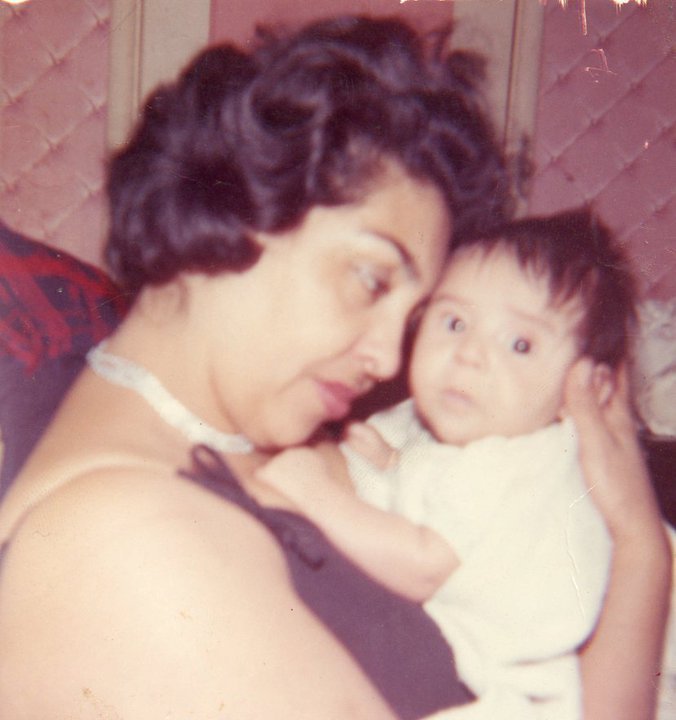
With mom on the day of my baptism ca. 1964 (Garcia Family photo)

Blogger’s note: The following passage is the from my manuscript of Summer in the Waiting Room: How Faith, Family, and Friends Saved my Life. It’s the first excerpt from Chapter 1: “48 Viewmont Avenue.” I will post weekly excerpts every Wednesday morning.

**********************

Chapter 1

48 Viewmont Avenue

The sky was clear and the weather was in the low 50s, a typical crisp November night in San Jose, California. But for my mom and dad, that night and early the next morning wouldn’t be typical at all. As they raced north on U.S. Highway 101 in the their two-toned orange and white 1955 Mercury, they wondered how they were going to make ends meet now that another mouth to feed would soon be added to the family.

 They both grew up in poor single-mother households. Now that they had their own family, they were just getting by living check to check on my dad’s postal worker salary and mom’s odd jobs cleaning houses and working in the canneries. The little creature in her belly causing her so much pain and discomfort would be their fifth child. Nevertheless, both of my parents were excited and happy as the Mercury pulled into the hospital parking lot.

 My dad jumped out of the car to walk her into the emergency room. Wearing a camel colored coat and carrying a small overnight bag, she waddled up the steps to the hospital and breathlessly slumped herself onto the waiting wheelchair. As was the custom in the 1960s, nurses rushed my mom into the maternity room to await the doctor who would deliver the baby and told my dad to wait outside. Hospital volunteers showed him the way to the waiting room to join other nervous, expectant fathers who were smoking up a storm as they paced the floor.

Impatient and restless, my dad didn’t stay for very long. He left the hospital to find a place where he could belly up to the bar and knock down a few whiskey and waters before going back to meet his newest baby. My mom was an old pro, he rationalized to himself, she had been to the delivery room four other times and each time the baby came out without any problems.

Back at the hospital, my mom was going through labor pains as one day ended and another began. The baby would soon arrive as the nurses and doctors prepared for the delivery. Labor for her was not much different than the other four times. Actually, this time seemed to go smoother, the pains weren’t as strong and the actual time in labor was much shorter. Just as my dad predicted, the delivery would be quick and simple.

After finishing his drinks and taking a few more drags of his cigarette, he was back in the maternity ward anxiously waiting for the good news. They had two boys and two girls at home waiting. He was sure this one would be another boy. In the delivery room all was going well. When the baby was finally born, the doctor gently gave the newborn the obligatory slap on the backside and waited for the familiar wails of a new life catching its breath for the first time.

The doctor cut the umbilical cord and the nurses wiped the baby clean before swaddling it and allowing my tired, but happy, mom to cuddle her baby for the first time. As the doctor completed one last check of vital signs, the baby slipped out of his arms and banged its face against the metal railing of the bed. A nurse broke the baby’s fall and prevented a disastrous accident. The baby screamed in pain as the nurses and doctors worked to stop the bleeding that had emerged from the baby’s face. Luckily, that scary incident only resulted in a small scar at the tip of the newborn’s nose.

That baby with the cut on his nose was me, born on November 6, 1963, at 5:25 AM at Sequoia Hospital in Redwood City, California. The third García boy, I was 21 inches long, weighed 7.2 pounds, with dark brown eyes, and lots of thick dark hair. My parents were excited and relieved, especially after the brief scare in the delivery room. That little scar at the tip of my nose would forever find a special place in my mom’s heart.

Exhausted, she suggested a name for me, Michael. My dad wanted to name me Edward. After a few minutes of negotiation, my proud parents settled on a name: Edward Michael García. My dad spent a few more minutes at my mom’s side, slipped out of the hospital, stopped at the watering hole for one more whiskey and water on the rocks, slid onto the front seat of the two-toned Mercury, and headed south for the 45-minute drive to San Jose to tell my siblings that they had a baby brother.

At home, my brothers and sisters, David 12, Barbara 11, Patty 10, and Steve 9, were still asleep unaware of what had happened earlier that morning. When my dad burst through the front door of his modest house on 48 Viewmont Avenue in east San Jose, his four older children suddenly woke up and rushed to meet him to hear the good news.  He stood at the counter that separated the kitchen from the dining room, and excitedly told his kids about “Eddie’s” chubby cheeks and thick black hair, and how he slipped, and cut his nose.  After a few minutes of taking questions, my dad turned to the heavy black phone sitting on the counter and started dialing everyone he knew.

********************

Next Wednesday: Chapter 1 flashes back to my parents courtship in Phoenix, Arizona .

Summer in the Waiting Room: How Faith, Hope & Love Saved My Life – Prologue

The Giant Dipper in Santa Cruz, California (photo from Wikipedia)

Author’s note: The following passage is the first installment of my manuscript of Summer in the Waiting Room: How Faith, Hope, and Love Saved my Life.

**********************

Prologue

There are those who say life is like a roller coaster with its ups and downs, and twists and turns.  I’ve loved riding roller coasters as far back as I can remember.  My favorite is the Giant Dipper, a whitewashed wooden 1920s era coaster with bright red tracks that dominates the Santa Cruz Beach Boardwalk on California’s central coast.  Santa Cruz is about a 40 minute drive from where I grew up in San Jose, California. As my dad drove into town, I remember getting excited to see the high point of the coaster jutting above the squat motels, restaurant buildings, tourist gift shops, and mom and pop stores that lined the streets.

The Giant Dipper was an exhilarating experience from the moment you stepped into the long line that wound its way into the building that housed the coaster station.  While in the safe confines of the fast-moving line, friends and relatives would laugh, joke, and revel in each other’s company, with an occasional pause to watch and hear the frantic riders above squeal and scream as the chaotic train roared by.  I always began to feel anxious excitement when entering the coaster station as riders took their seats on the train.  Soon, I would be securely seated in the two-person car, and without warning, the train swooshed out of the coaster house and quickly vanished into a tunnel.

Adrenalin shot through my body, and fellow riders hooted and hollered, as the train sped through a dark curvy tunnel to a low point before emerging from the darkness and slowly climbing to the first peak with the classic clicking sound of a roller coaster train laboring upward.  Once at the top, the train slowly scaled the peak and screamed down the other side of the tracks in a free fall as it rushed toward the earth.  After a scaling a couple smaller hills and valleys, the train rapidly rose into the sky to reach its highest point before it violently curved downward to its left on the way to its deepest drop.  A few more ups and downs and a slow straight-way led the train to its final resting place in the safety of the coaster station.

My love for roller coasters came from my dad. When we went to the boardwalk, usually because relatives from out of town were visiting, my dad would strut straight to the Giant Dipper. With his trademark mischievous grin, he would egg everyone on to join him on the ride, especially those who looked nervous or scared. My mom never got on the coaster, no matter how much my dad tried to persuade her. My brother Stevie was also a regular holdout, which was funny because he was our family’s tough guy. Stevie had a big heart, but masked it with a perpetual scowl and a look in his eyes that shouted out, “you wanna fight?” He was tough, uncompromising, and angry.

As his little brother, I was regularly collateral damage when he was mad at the world. When Stevie was a teenager, he wore his hair long in the style of a 1970s anti-establishment rebel. Wearing jeans, a leather vest, steel-toed biker boots, and a buck knife attached to his belt, I’m sure he scared people as he lumbered along his way. Despite his bad-boy persona, he was scared to death of that tortuous and seemingly unpredictable roller coaster that overlooked the Pacific Ocean.

Stevie had a big heart, but masked it with a perpetual scowl and a look in his eyes that shouted out, “you wanna fight?”  He was tough, uncompromising, and angry. As his little brother, I was regularly collateral damage when he was mad at the world.  When Stevie was a teenager, he wore his hair long in the style of a 1970s anti-establishment rebel.  Wearing jeans, a leather vest, steel-toed biker boots, and a buck knife attached to his belt, I’m sure he scared people as he lumbered along his way.  Despite his bad-boy persona, he was scared to death of that tortuous and seemingly unpredictable roller coaster that overlooked the Pacific Ocean.

When I was about nine years old, I persuaded Stevie to ride with me.  In line, he had the steely eyes of a gunslinger preparing for battle, but once the train disappeared into the tunnel, he began to scream, giggle, and screech like a teenage girl at a boy band concert.  I laughed harder during the next few minutes than I had ever laughed.  With each dip, twist, and turn, this tough guy with the biker boots became ever more vulnerable to the fierce journey of the roller coaster.

As the train slowly entered the coaster station at the end of the ride, Stevie gathered himself, brushed his long, thick mane away from his face, put that bad look back on, and glowered at passersby as if he was about to kick someone’s ass. I didn’t know what was funnier, his screeching on the ride or the mask he put on as soon as the danger went away.  Either way; I sure wasn’t going to ask him.

That was one wild ride.

The first forty-six years of my life followed the path of the Giant Dipper. Growing up in a working-class neighborhood on San Jose’s east side was like waiting in line for the coaster. I loved being in the safe confines of family and friends. From time to time, I would be away from them and hear and see the chaos that sometimes unfolded around me. After high school, I ventured away from the neighborhood to attend San Jose State University with the same excitement and apprehensiveness I felt when entering the coaster station as a kid. I eventually flunked out of college and chose a lifestyle fueled by alcohol, dead-end jobs, and the next party. The ensuing undisciplined meandering through the darkness of life was just like the Giant Dipper’s wild ride through the dark tunnel.

I gradually and methodically pieced my life back together in the same way that the Giant Dipper slowly scaled its first peak. I got married, went back to SJSU, graduated from college, and started a family. Vowing to never fail again, I worked tirelessly, eventually climbing the corporate ladder all the way up to the executive suite and serving in public office. The sudden plunge of the Giant Dipper’s first dip and the following short waves that quickly lead to the coaster’s summit mirrors a crushing election loss and subsequent rapid rise to school board president.

Midway through my forty-sixth year, my wife Sandra and I were approaching our 20th wedding anniversary, our two daughters were healthy and happy, and I had achieved some success in my career and public service. I felt like I was on top of my little world. Like the Giant Dipper’s next move after reaching its climactic high point, my life would soon make an abrupt and furious downward turn and plummet toward its lowest depths, changing my very existence forever. What followed was unimaginable horror intermingled with an incredible spiritual journey powered by faith, hope, and love.

********************

Next Time – Chapter 1: 48 Viewmont Avenue

NEW FEATURE – Summer in the Waiting Room: How Faith, Family, and Friends Saved My Life

ICU Waiting Room at Kaiser Santa Clara Medical Center

Dear Readers,

For those who believe that they alone hold the keys to their own destiny, God sure has a funny way of teaching life lessons. Due to self-perceived shortcomings, I deemed myself a complete failure by the time I was 22 years old.  With an obsession to excel and a naive quest for redemption, I fought my failure demons for more than two decades working endlessly in my elusive pursuit to find success.

Thinking I had almost conquered the demons, I had a massive heart attack on June 7, 2010.  Ten days later, cardiac arrest caused my heart to stop, and ten days after that, I had an allergic reaction that led to Acute Respiratory Distress Syndrome (ARDS), a potentially fatal lung condition that affects just 150,000 people per year according to the ARDS Foundation.  To treat ARDS, doctors medically induced me into a coma and put me on full life support.

Emerging from the coma, I had to learn how to move my limbs, stand, walk, talk, and swallow all over again. On September 21, 2010, 106 days after the June 7th heart attack, I went home. During my long and difficult recovery and rehabilitation, I had hours and hours to think about mortality, God, faith, and the meaning of love, family, friends, and redemption.

Doctors told me that surviving three life-threatening episodes in one summer is a miracle and encouraged me to write about the experience.  With that in mind, I interviewed family, friends, and the medical team at Kaiser Santa Clara Medical Center.  What resulted is a 200-page manuscript I named, Summer in the Waiting Room: How Faith, Family, and Friends Saved My Life.

It’s the unique and inspiring story of a boy who grew up in a working-class neighborhood, failed at college and lost hope, met and married the love of his life, returned to finish college, raised a family, and built a career in corporate America and public service.  It’s also the story of a man who vowed never to fail again and toiled tirelessly trying to redeem himself, only to find true redemption while in a state of complete helplessness in the ICU.

To share this story, beginning this Wednesday, East Side Eddie Report.com will add a new feature posting weekly excerpts from Summer in the Waiting Room: How Faith, Family, and Friends Saved my Life.  My dream is to someday publish the manuscript as a book, so please let me know what you think.  Also, if you like the story, please share the Wednesday posts with your family and friends.

I truly appreciate you taking the time to read East Side Eddie Report.com each Monday.  I hope the posts are interesting and look forward to Summer in the Waiting Room bringing you back every Wednesday too.  If you have any suggestions or comments, please send them along.

Gratefully Yours,

Eddie García