Tag Archives: ICU

Summer in the Waiting Room: How Faith, Family, and Friends Saved My Life (excerpt #43)

Image by jhems.com (click on image to read all excerpts)
Image by jhems.com
(click on image to read all excerpts)

Author’s note: The manuscript of my book, Summer in the Waiting Room: How Faith, Family, and Friends Saved My Life, is divided into three parts. The title of Part 2 is The Waiting Room. Excerpt #43 is the second installment of  The Waiting Room.

********************

Sandra started the morning on Friday, June 18, 2010, feeling good about my prognosis. I was still in the ICU, but I slept through the night breathing well, and it seemed like I was on the proper regimen of medication to manage my congestive heart failure. Erica was in Washington, D.C. with her class for the school’s annual trip for incoming 8th graders, so it was just Sandra and Marisa at home. They slept together in the master bedroom to comfort and support each other.

In addition to managing my health crisis, Sandra was preparing to close school for the summer and planning for the new school year. She was exhausted as she stepped into the shower and absorbed the soothing water raining down on her. She felt uneasy about going home for the night and leaving me in the hospital alone, but did so at the urging of family, friends, and doctors.  As a woman of faith, Sandra was confident that I would be just fine in God’s hands.

When Sandra got out of the shower, the phone started ringing and Marisa, recognizing the caller ID, told her that someone from Kaiser was calling. Sandra said “it’s probably daddy calling to say good morning” and quickly answered the phone as Marisa watched nervously assuming the worst had happened.

Sandra ended the call after a few minutes of intently listening and responding with one word answers. She told Marisa that something had happened earlier in the morning. The doctors had stabilized the situation, but she and Marisa needed go to the hospital right away.

They were soon on the familiar route to the Kaiser Santa Clara Medical Center – Highway 101 to Interstate 280 to Lawrence Expressway – when the hospital called again. Activating the cell phone’s hands-free device, Sandra placed the call on speaker phone so both she and Marisa could hear the caller. Again, it was a doctor from the hospital providing more information about that morning’s episode.

Another blood clot formed on an artery and I had gone into cardiac arrest. Once stabilized, doctors were getting me ready for another angioplasty procedure. The doctor told Sandra and Marisa that they would be able to see me before I went into surgery. While Sandra called her mom to let her know what was going on, Marisa anxiously sat through the long ride to the hospital.

My body had a negative reaction to Plavix, a common blood-thinning medication prescribed after the first surgery. It wasn’t working, so a blood clot formed on the metal stent doctors placed in my heart almost immediately. This is a rare occurrence caused by the body’s rejection of the medication.

By the early morning of June 18th, the clot had closed off the blood flow to the heart’s lower left chamber causing my heart to pump furiously in its efforts to deliver oxygenated blood to the body. Within seconds of the closure in the artery, my heart raced to 280 beats per minute, alarmingly above the average heart beat of 65 beats. In less than a minute, I went into cardiac arrest.

Cardiac arrest is a medical way of saying that the heart stops beating. Without blood circulation and delivery of oxygen to the body and brain, the patient loses consciousness.  On a heart monitor, the normal peaks and valleys of a heartbeat suddenly turn into a flat line. If cardiac arrest goes untreated for more than five minutes, the lack of oxygen could cause death or, if the patient survives, severe brain damage.

The best chance of survival requires immediate cardiopulmonary resuscitation (CPR) and the use of an automated external defibrillator (AED), the electronic paddles that shock the heart so it could start beating. Unless someone nearby is trained in CPR and an AED is readily available, the chance of survival for someone who suffers from cardiac arrest is remote.

I was fortunate to be in the hospital ICU when my heart began to race uncontrollably then suddenly stopped. My memory of that episode is brief, but harrowing. It seemed like one minute I was watching the NBA Finals with George, and the next minute I was sitting up in the bed violently screaming for help because I couldn’t catch my breath.

For me, the whole scene was hazy and chaotic as doctors and nurses appeared to be moving in fast motion, then slow motion, as they worked to save my life. According to my medical record, I repeatedly shouted, “I can’t get enough air.”

Dr. Stephen Fisk, a short and slender pulmonary doctor in his late 60s with gray thinning hair and a trimmed white beard, was trying to calm me down by telling me to relax so he could help me. The fear of dying entered my mind for the first time as the doctors and nurses hovering around me looked concerned and even scared themselves.

As Dr. Fisk urged me to relax, I noticed a nurse standing calmly at the foot of the bed with a soothing smile telling me, in a soft but audible voice that could be heard above the bedlam, that everything was going to be okay and that I would be fine.

The nurse looked exactly like my sister Patty who had died of a heart condition seven years earlier. A sudden warmth and comfort came over me as the madness around me disappeared and I peacefully fell asleep.

********************

SPECIAL NOTE: To accommodate your Thanksgiving Week schedule, Summer in the Waiting Room: How Faith, Family, and Friends Saved My Life is posted today instead of Wednesday.

Next Wednesday: Doctors scramble to save my life a second time after cardiac arrest…

Summer in the Waiting Room: Part Two – The Waiting Room (excerpt #42)

Click on image to read all excerpts

Author’s note: The manuscript of my book, Summer in the Waiting Room: How Faith, Family, and Friends Saved My Life, is divided into three parts. The title of Part 2 is The Waiting Room. Excerpt #42 is the first installment of  The Waiting Room.

********************

Chapter 5 

Buen Corazón

My earliest memory of a hospital waiting room is from the day my sister Sisi was born. I had just turned five-years-old the month before. We were at the old Kaiser Santa Clara Hospital that was built in the early 1960s. I remember waiting in the main waiting room at the lobby of the hospital with my brothers and sisters, all of whom were teenagers by then.

Sitting in arm chairs were older people reading magazines or engaging in whispered conversation.  My brother David and sister Patty had their noses stuck in either books they brought from home or the magazines that were strewn on the little tables that sat around the chairs.

My sister Barbara was trying to keep me and my brother Stevie from getting in the way of hospital visitors as we scampered around the lobby looking for mischief.  Our exploits came to an abrupt end when a giant nurse wearing green hospital scrubs scolded us for playing on the elevators.

That first visit to a hospital waiting room was fun and exciting to me as Stevie and I darted in an out of the elevator on different floors until we got caught by that super tall nurse.  And all ended well when we brought home a baby sister the next day.

My next experience in a waiting room wasn’t the same. I was about nine or ten-years-old when a cousin named Albert, who was in his early 20s, was in a terrible car accident that left him badly hurt and in a coma. He was driving a small sports car on the winding highway that weaves its way through the steep Santa Cruz Mountains connecting the Santa Clara Valley to the beaches in Santa Cruz.

Near the summit, Albert’s car was sideswiped by another vehicle that sent him and his car tumbling 200 hundred feet into a deep ravine.  I remember my dad driving through those same mountains to be by his sister’s side.  That waiting room was small and windowless, so it just added to the gloom of those of us who were waiting there.  Albert never recovered from the coma and died a few months later.

From that day forward, visits to hospital waiting rooms were brief and usually meant doom and gloom with an occasional sigh of relief if all ended well. My grandmother Joaquina died of a heart attack when I was 10-years-old. The news came via the waiting room.

My dad’s first heart attack in the early 1980s and my mom experiencing the same a few years later were marked by the stress and anxiety of the waiting room while doctors performed surgeries behind the operating room doors.  Both of those episodes ended with huge sighs of relief for successful operations.

A decade later, my dad suffered a major stroke early one morning as my mom and I sat alone in a small, cold, windowless emergency department waiting room at the old Alexian Brothers Hospital in east San Jose.  This time it didn’t end very well.  My last memory of my dad was watching him convulse with a faraway look in his eyes while doctors ushered my mom and me out of the emergency room.  Minutes later, the doctor walked into that little waiting room to deliver the bad news.

From June 18th through August 31st, 2010, the ICU waiting room at Kaiser Santa Clara Medical Center was a living breathing metaphor for sadness, joy, despair, hope, anticipation, disappointment, and triumph. In that waiting room, faith was tested and strengthened, family bonds grew tighter, and the true meaning of friendship emerged.

It became a gathering place for those who loved me, Sandra, and the girls. It was a place to share food, stories, and a sense of community. Day after day, week after week, throughout the summer of 2010, friends and family stopped by to check in on Sandra and the girls, gossip, laugh and cry, or just sit and take it all in.

My compa Will would later describe the scene as a three-act play that kept everyone riveted and coming back for more. Act I was the early part of July when my prognosis for survival changed almost on a daily basis. Act II continued from late July through mid-August when survival seemed possible, but my future uncertain. The final act during the last weeks of August brought a sigh of relief as I stabilized and began the long road to recovery.

It was compelling drama that drew people there. Will and Juanita remembered rushing home from work every day because, “we couldn’t wait get to the hospital to be with everyone.” Amid the emotion, camaraderie, steadfastness, and love, “the waiting room” supported Sandra while she fought for me and I clung to life just two rooms behind the plain double doors that led to the ICU.

********************

SPECIAL NOTE: To accommodate your Thanksgiving Week schedule, Summer in the Waiting Room: How Faith, Family, and Friends Saved My Life continues NEXT MONDAY with Part 2: The Waiting Room.

Summer in the Waiting Room: How Faith, Family, and Friends Saved My Life (excerpt #41)

ICU Waiting Room at Kaiser Santa Clara Medical Center

Author’s note: The manuscript of my book, Summer in the Waiting Room: How Faith, Family, and Friends Saved My Life, is divided into three parts. The title of Part 1 is The Giant Dipper (https://esereport.com/2013/12/04/summer-in-the-waiting-room-how-faith-family-and-friends-saved-my-life-prologue/). The following excerpt #41 is the final installment of  The Giant Dipper.

********************

Although I felt miserable and frail, I didn’t want to go back to the hospital. I knew the routine: ER technicians and nurses would put a hospital gown on me in the emergency room, stick IVs into my arms, insert a catheter into my urinary tract, and paste electrodes to my chest to monitor my heart. Doctors would come in, do some tests, and admit me.

So I tried to remain composed and I breathlessly made it through dinner. After dinner, Pancho stopped by to see me, only to watch me cough up blood-soaked phlegm and struggle to breathe. I started to feel tightness in my chest so Sandra finally demanded that I go to the emergency room. The girls were worried and also insisted that I go to the hospital immediately.

Sandra, the girls, and I climbed into Sandra’s silver Ford Explorer for the short ride to Shelley’s house to drop off the girls. It was like déjà vu all over again. Sandra and I continued on to Kaiser Santa Clara Medical Center. The drive to the hospital was filled with fear and anxiety for Sandra.

I slipped two nitroglycerin pills under my tongue to sooth the tightness in my chest. I began to fall asleep during the ride, probably due to the codeine in the cough medicine I had been taking all day. Sandra thought I was losing consciousness and screamed at me to stay awake and shook me to keep me from passing out while she sped down the freeway.

I remember little of that ride, other than the warm and comfortable feeling of falling into a deep sleep and hearing Sandra’s voice in the distance begging me not to fall asleep. When we arrived at the emergency department, a nurse with a wheelchair waited for me at the curb.  Sandra jumped out of the car and helped the nurse hoist me onto the wheelchair for the sprint to the emergency room.

It was just after midnight on June 17th.

While I lay on a gurney in one of the individual emergency rooms for the third time in less than 10 days, nurses began to follow the emergency room procedure I had come to know all too well. My vital signs were worse than the last two visits to the ER: blood pressure, 72/48 and oxygen saturation, 88%.

An initial X-ray showed that I had patches in my lungs, beginning signs of pneumonia or worse. This was something new. ER doctors stabilized my condition and admitted me into the hospital for more tests. A few hours later, my gurney rolled into the ICU. I was scared as I read those words on the wall to the entrance of the unit.

I was clearly in trouble, and it was apparent that the doctors didn’t know how to fix whatever was ailing me. Marisa and Erica, the Peraltas, Rochas, Leyvas, Velez, Medinas, and Rudy stopped by to see me throughout the day. During the evening, doctors came in to tell me and Sandra that my heart was very weak and not pumping efficiently.

The CHF (congestive heart failure) that caused my last visit to the ER wasn’t getting better.  Once the right combination of medication was identified, they said, my heart would work better and management of CHF would be more productive.

Just before bedtime, George stopped by to see me for about an hour. We watched the Boston Celtics and Los Angeles Lakers duke it out on TV in Game 7 of the 2010 NBA Finals, and we laughed, joked, gossiped about local politics. Neither one of us mentioned anything about the work at the office.

When he left, Sandra came in to tell me that I needed to have faith because God had a plan.  She knew that I would recover and everything would be okay. We prayed and hugged and kissed before she left for home for the night. Although weak and tired, I felt optimistic and decided, for the first time in my life, to put my destiny and life completely into God’s hands.

I turned on my side, tried to fluff up the hard hospital pillows, closed my eyes, and fell into a peaceful sleep.

The last 10 days had thrown my life into a tailspin. I had ridden the Giant Dipper of life for 46 years and survived all of the ups and downs, and twists and turns that the wild ride had to offer.

The path included an idyllic childhood, promising high school years, failure in college and an alcohol induced fall from grace, a hard won comeback to graduate from college, build a family and achieve some success in business and public service, and finally a deep dive caused by a health crisis.

Surely, I had to be at the bottom of the violent dip, but as I slept comfortably in the Kaiser Santa Clara Medical Center ICU, little did I know that I was only part way down the Giant Dipper’s famously ferocious plunge.

********************

To read all excerpts click here: https://esereport.com/summer-in-the-waiting-room/

Next Wednesday: Summer in the Waiting Room: How Faith, Family, and Friends Saved My Life continues with  Part 2: The Waiting Room.

NEW FEATURE – Summer in the Waiting Room: How Faith, Family, and Friends Saved My Life

ICU Waiting Room at Kaiser Santa Clara Medical Center

Dear Readers,

For those who believe that they alone hold the keys to their own destiny, God sure has a funny way of teaching life lessons. Due to self-perceived shortcomings, I deemed myself a complete failure by the time I was 22 years old.  With an obsession to excel and a naive quest for redemption, I fought my failure demons for more than two decades working endlessly in my elusive pursuit to find success.

Thinking I had almost conquered the demons, I had a massive heart attack on June 7, 2010.  Ten days later, cardiac arrest caused my heart to stop, and ten days after that, I had an allergic reaction that led to Acute Respiratory Distress Syndrome (ARDS), a potentially fatal lung condition that affects just 150,000 people per year according to the ARDS Foundation.  To treat ARDS, doctors medically induced me into a coma and put me on full life support.

Emerging from the coma, I had to learn how to move my limbs, stand, walk, talk, and swallow all over again. On September 21, 2010, 106 days after the June 7th heart attack, I went home. During my long and difficult recovery and rehabilitation, I had hours and hours to think about mortality, God, faith, and the meaning of love, family, friends, and redemption.

Doctors told me that surviving three life-threatening episodes in one summer is a miracle and encouraged me to write about the experience.  With that in mind, I interviewed family, friends, and the medical team at Kaiser Santa Clara Medical Center.  What resulted is a 200-page manuscript I named, Summer in the Waiting Room: How Faith, Family, and Friends Saved My Life.

It’s the unique and inspiring story of a boy who grew up in a working-class neighborhood, failed at college and lost hope, met and married the love of his life, returned to finish college, raised a family, and built a career in corporate America and public service.  It’s also the story of a man who vowed never to fail again and toiled tirelessly trying to redeem himself, only to find true redemption while in a state of complete helplessness in the ICU.

To share this story, beginning this Wednesday, East Side Eddie Report.com will add a new feature posting weekly excerpts from Summer in the Waiting Room: How Faith, Family, and Friends Saved my Life.  My dream is to someday publish the manuscript as a book, so please let me know what you think.  Also, if you like the story, please share the Wednesday posts with your family and friends.

I truly appreciate you taking the time to read East Side Eddie Report.com each Monday.  I hope the posts are interesting and look forward to Summer in the Waiting Room bringing you back every Wednesday too.  If you have any suggestions or comments, please send them along.

Gratefully Yours,

Eddie García

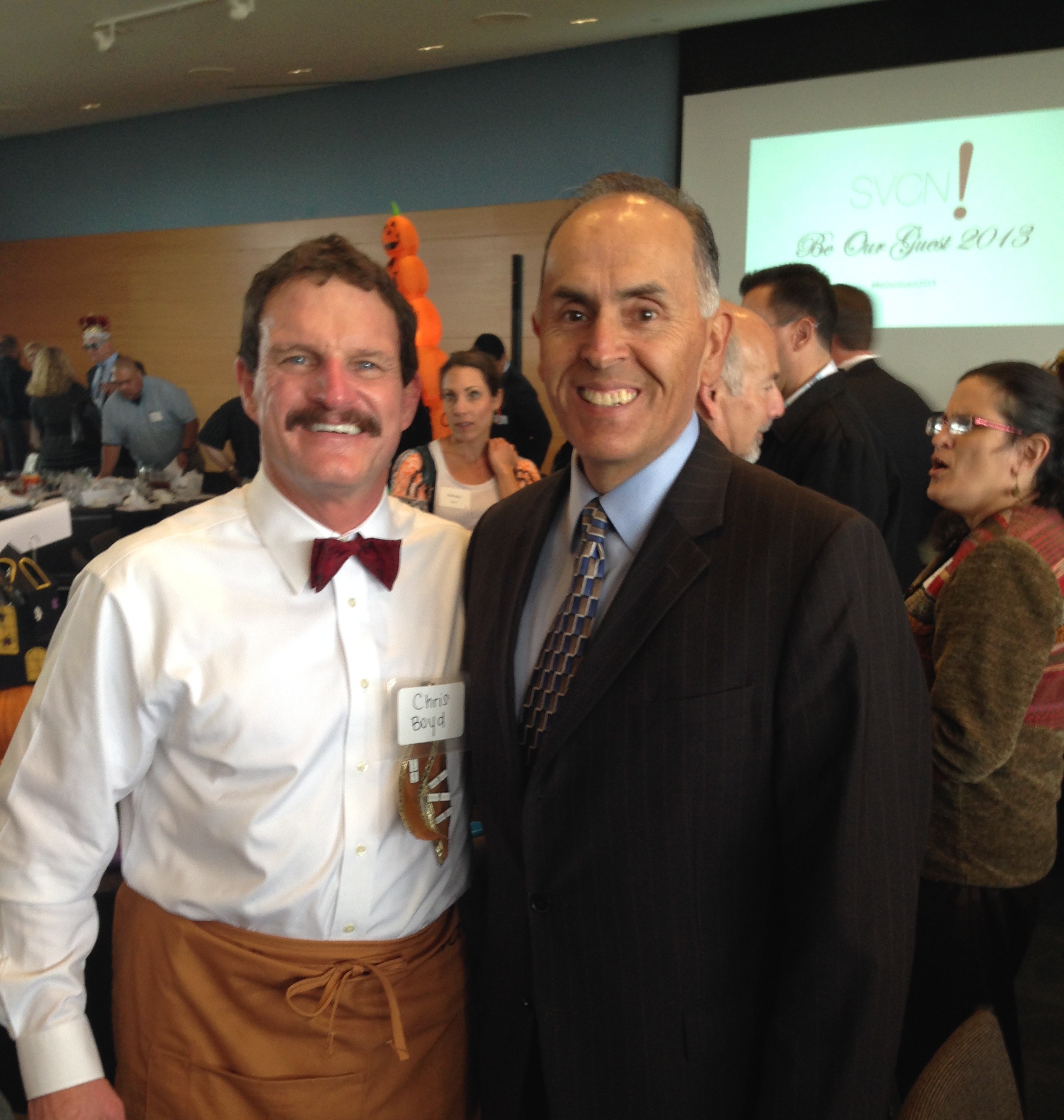
Why Leadership Counts: Chris Boyd & the Kaiser Santa Clara Team

Meeting Chris Boyd at the SVCN Luncheon
(photo courtesy of Darcie Green)

Last Thursday, I attended the annual Silicon Valley Council of Non-Profits “Be Our Guest” luncheon; an event that raises money for charity and features Silicon Valley leaders serving the guests.  The room was filled with solidarity, smiles and handshakes, but below the surface brewed the never-ending battle over ideas and resources.  The scene reminded me that leadership is a tough business.  As one of the valley’s most respected leaders has been known to say, leadership is a “contact sport.”

This seemingly distasteful dance between camaraderie and competition is what turns most people off when it comes to business, education, community, and political leaders.  But, it’s the ability to navigate these dynamic waters that separates the best from the rest and provides the effective leadership that is vital in any organization.  The people serving lunch at the event make decisions that affect our day-to-day lives in so many different ways.

One server in particular, a waiter named Chris Boyd, who happens to be the chief executive at Kaiser Santa Clara Medical Center, made a huge impact on my life even though we never met before Thursday’s luncheon.  Everything I know about great leaders is that they know how to build a positive team environment, provide the resources needed for the team to succeed, and inspire others to achieve.   This understanding of leadership skills and my own experience at Kaiser Santa Clara makes me believe that Chris is an outstanding leader.

My journey to meeting Chris began on June 7, 2010. Feeling sluggish and anxious that day, I arrived at Kaiser Santa Clara Medical Center to learn that I was having a massive heart attack.  Quick action by the emergency room team and successful surgery cleared the blockage that caused the heart attack.  Ten days later, while in the hospital, a blood clot sent me into cardiac arrest causing my heart to stop beating, and ten days after that, I was diagnosed with Acute Respiratory Distress Syndrome (ARDS), a rare disorder that shuts down the lungs.

There is no known cure for ARDS so resting the lungs and providing respiratory therapy is the preferred course of action.  In my case, ARDS was so severe that it was necessary to induce me into a coma and connect me to an oscillator, a recently FDA-approved device that sends puffs of oxygen into the lungs.  At the same time that the oscillator was breathing for me a pump kept my heart beating.  For Sandra and my family, seeing me lying lifeless connected to a bunch of machines was the most difficult part of that horrific summer.

During that time, an army of cardiologists, pulmonologists, ICU doctors, nurses, nursing aides, physical and speech therapists, social workers, and hospital support staff worked around the clock to care for me.  I got to know four members of the team well, speech therapist Suzanne Dabadghav, pulmonologists Mark Mendoza and Sudhir Rajan, and cardiologist Uma Vadlakonda.  They treated me with compassion and consummate professionalism, and I’m inspired by them and eternally grateful for their work.  There were countless others who were cared for me with the same compassion and skill.

After a month and half on life support in the ICU, I began a long and difficult recovery and rehabilitation period.  For family and friends, watching my daily struggle for survival was the most grueling part of the nightmare.  For me, it was waking from the coma and realizing that I couldn’t move my limbs, stand, walk, talk, or swallow.  My muscles had degenerated after two months of lying lifeless in a coma.  I spent most of September at a rehabilitation facility in intensive physical therapy to wake up my muscles and get them working again.  On September 21, 2010, 106 days after the heart attack, I gratefully walked into my house with the aid of a walker.

So where does Chris Boyd fit in? My experience tells me that the Kaiser Santa Clara team has what it needs to succeed: a team-oriented environment, the most advanced tools available, and space needed to maximize team members’ talent.  Watching a talented team of professionals armed with the right tools working together for a common cause is inspirational.  As someone who has been on many teams, and led a few, I know that this can’t happen without a leader who provides the building blocks for success.

Leadership counts.

Thursday turned out to be an inspiring day for me.  It was wonderful to reconnect with old friends and former adversaries who reminded me of the delicate dance among our leaders that makes Silicon Valley one of the best places in the world to live.  Sitting next to the Kaiser table brought back memories of that long and challenging summer when faith, family, friends, and a great healthcare team saved my life.

I’ve been on a mission to thank every person who supported my family, prayed for my recovery, or played even the smallest role in the miracle that was the summer of 2010.  On Thursday, I met the person responsible for providing the Kaiser team with the tools and environment to be the best they could be.  Meeting Chris Boyd and thanking him made my day.