Tag Archives: history

Mexican Heritage Plaza: Part 1

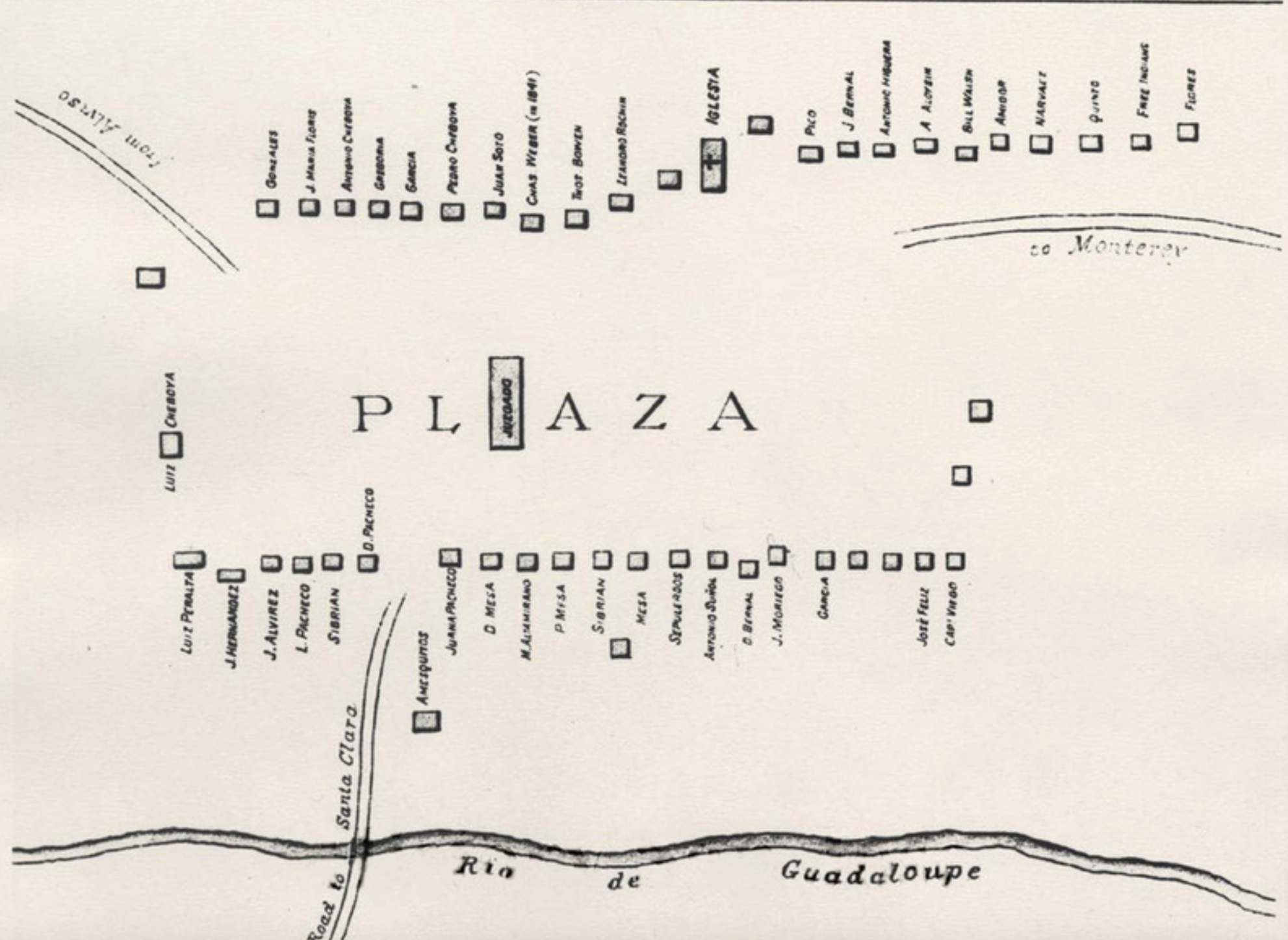
Map of the original El Pueblo de San José site (Courtesy of SJSU King Library)

Part 1

The Mexicans

November 29, 1777 ~ November 3, 1980

When Neve (Governor of Alta California, New Spain) reported to the viceroy that the Guadalupe area would make an excellent town site, he requested 40 to 60 colonists, all experienced Mexican farmers with families, be recruited.

~Edwin A. Beilharz, Santa Clara University Professor and Author, San José, California’s First City, 1980

* * *

San José, California, has existed as an organized governmental pueblo, town, or city for 248 years. Despite being the first civil settlement in California, San José has few published historical works. Fredric Hall, an obscure attorney and amateur historian, conducted extensive documentary research and kept a diary of his youth in San José to write The History of San José and Surroundings, published in 1871.

A century later, Santa Clara University history professor Edwin A. Beilharz and Donald O. Demers published a coffee-table book titled San José, California’s First City as part of a series on local history from Continental Heritage Press. Beilharz and Demers acknowledge the presence of Mexicans in San José’s history but offer no in-depth analysis of its implications for the city’s development.

During that same period, an amateur historian named Clyde Arbuckle was encouraged by a fellow history buff to write the “definitive” History of San José. When Arbuckle published the book in 1985, the foreword stated, “In these pages we will relive the founding and emergence of our city as recounted by one who knows it better than any other.”

 It’s important to note that Arbuckle was not an academically educated or trained historian. In fact, he dropped out of high school at 15 to work as a laborer in a printing shop and ultimately spent 25 years as a delivery driver for the firm. He took a few history classes at night school and became quite the history buff. In 1945, the City of San José named him the official City Historian, most likely because he had a passion for the community’s past.

Nevertheless, Arbuckle’s book is detailed and well-researched. While the statement in the book’s foreword that Arbuckle knew the city’s history “better than any other” may have been accurate, the History of San José author only tells part of the story. Arbuckle makes no mention of the Mexican presence or contributions to San José’s development. His retelling of the Pueblo’s founding in 1777 occupies only four paragraphs in a book spanning 535 pages.

Aside from an odd statement asserting that the settlers “were not the best material in the world for their task,” Arbuckle provides no historical analysis at all, especially with respect to the people who settled on the banks of the Guadalupe River. How Arbuckle concluded that the settlers “were not the best material” is anyone’s guess.

In an April 15, 1778, letter to superiors, Felipe de Neve, Governor of Alta California, New Spain, wrote that he assigned “nine soldiers with farming experience” to settle El Pueblo de San José de Guadalupe. Fredric Hall’s 1871 book describes the settlers as “skilled in agriculture.” Those accounts confirm that the settlers were the best material for developing an agricultural community.

Whatever the reason for Arbuckle’s omission of the Mexican experience in San José, his manuscript does not provide a comprehensive or definitive history of the city and perpetuates the false narrative that Spaniards founded the pueblo.

It wasn’t until 2003, when Yale historian Stephen J. Pitti published The Devil in Silicon Valley, that historical works about San José correctly identified the Pueblo’s founders as “ethnic Mexicans.” In 2025, San José State University historian Gregorio Mora-Torres wrote a comprehensive account of what he calls the ethnic Mexican experience in San José.

The facts, as chronicled by Beilharz, Pitti, and Mora-Torres, are that each person in the small band of 66 pobladores (settlers) who pitched camp along the Guadalupe River was born in México, including the “Spanish” army captain José Joaquín Moraga, who led the expedition. He was born at the Mission Los Santos Ángeles de Guevavi in Sonora, México (now in modern-day Arizona).

Within a few years, San José’s settlers were producing enough food to feed the military presidios in Monterey and San Francisco. By the mid-1780s, the pueblo’s leaders established a thriving community. Although still under the King of Spain’s royal authority, the Mexican settlers produced abundant crops. They established a “town council” in San José, launching a form of self-government for the faraway outpost settled by people from Sonora and Sinaloa, México.

In 1846, U.S. troops invaded México in a war of conquest. On the eve of the war, four out of every five people living in the Pueblo were Mexican. Through intermarriage and legal sleight of hand after the 1846-48 American War with México, Mexicans began to lose their land and influence in San José gradually.

By the 1880 U.S. census, Mexicans made up only 6% of the town’s population. This number is likely inaccurate as American officials probably undercounted Mexicans. Nonetheless, the Mexican population decreased significantly in the three decades following American statehood.

While ethnic Mexicans seemed to disappear from the written annals and minds of the white business and ruling class in San José, they continued to thrive and contribute to the city’s development. Over 1,000 miners from Sonora, México, lived and worked in the quicksilver mines in the southern hillsides known as the misnamed Spanishtown. Immigrants from México and native-born descendants of the founders led cattle drives, cultivated crops, picked fruit, and worked in the growing canning industry, which was the valley’s economic engine.

By the mid-20th century, a burgeoning ethnic Mexican middle class had emerged. The Mexican neighborhoods west of downtown thrived, with businesses lining Market Street. Dance halls hosted local talent and major musical acts from México. Radio programs featured personalities that read the news in Spanish and played the latest popular Latin music.

During the late 1960s, Mexican and Mexican American business and community leaders were poised to take civic leadership roles in a town that their ancestors had founded almost 200 years earlier.

***

Note: Stay tuned for more information about the release of Mexican Heritage Plaza: A Symbol of Resilience and Perseverance
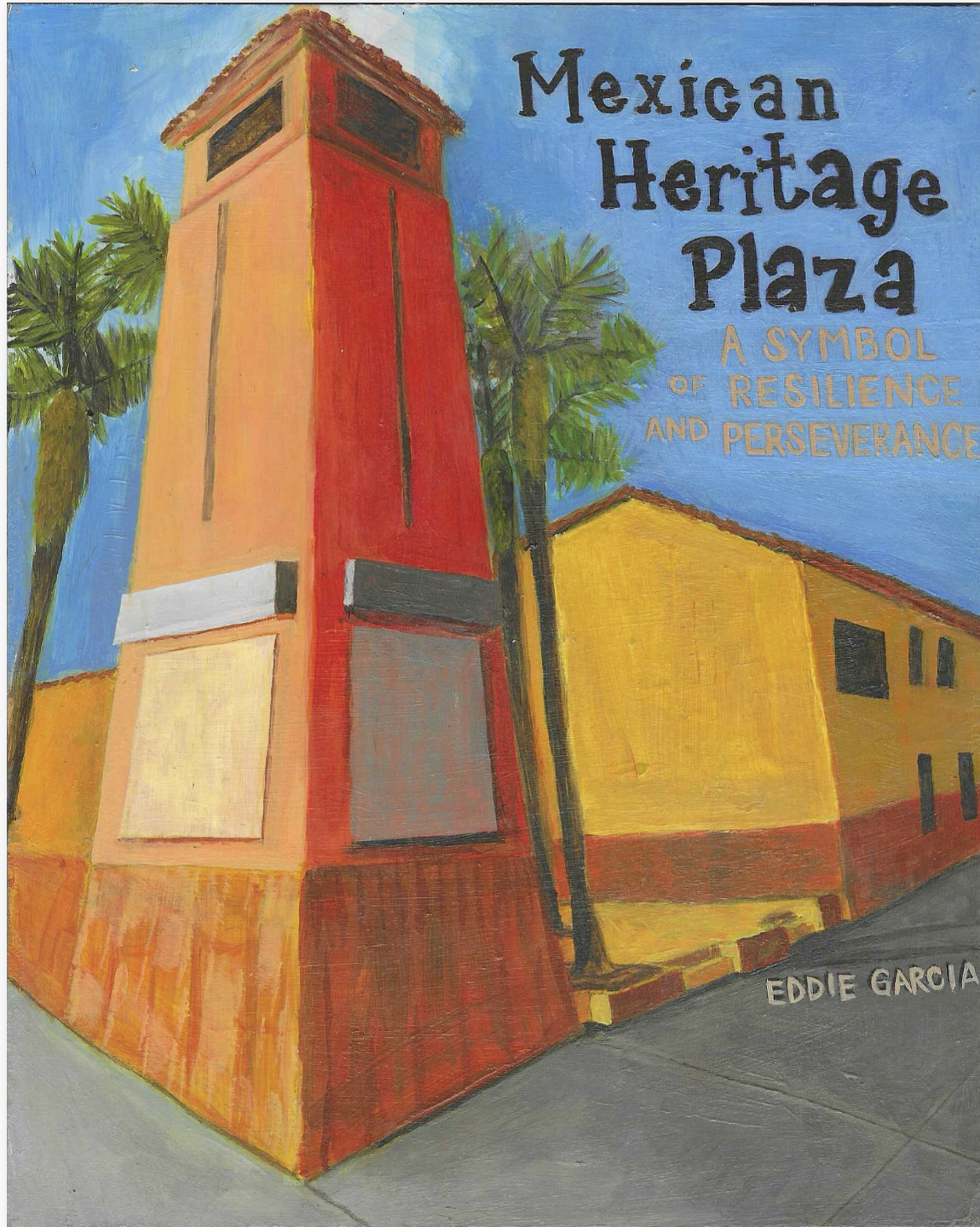
Mexican Heritage Plaza: A Symbol of Resilience and Perseverance

Cover design and artwork by Erica García — https://proyectoxtra.com/

My new book is titled Mexican Heritage Plaza: A Symbol of Resilience and Perseverance. La Raza Historical Society Publications is scheduled to release the book in Spring 2026. The prologue is reprinted below.

***

Prologue

September 9, 1999, was a beautiful day in San José, California. A large crowd gathered for the dedication of the Mexican Heritage Plaza, the city’s most ambitious neighborhood cultural arts project. Although the first day of autumn was less than two weeks away, clear skies, a light breeze, and a comfortably warm 74 degrees blanketed the plaza. There was a sense of excitement, accomplishment, and relief that this day had finally come. It was as if the gods conspired to make a perfect day for the much-anticipated consecration of a living and breathing monument to the city’s Mexican origins. 

When the 1,000 or so people settled into their seats, Santa Clara County Supervisor Blanca Alvarado stood and walked up the few steps onto the stage to address the gathering. The audience included San José’s political class, community activists, neighborhood leaders, and other guests. When she approached the podium, Alvarado opened her comments with equal parts passion and eloquence:

“To be here with you at this official dedication is to stand in awe and wonder at what we have accomplished in the spirit of community. To stand here is to feel free at last from the stinging rejection that so many of us have felt for being Mexican-American. To be able to speak our language and to experience our cultura in its many forms is to acclaim our right to be.”

With that opening flourish, Alvarado brought to life recognition of the city’s Mexican roots, which white Americans had dismissed since their arrival in the late 1840s.

***

The first human beings to occupy the land that is now San José, California, were the Ohlone people. They descended from nomads who migrated across a land bridge that connected modern-day Asia to North America in search of food and game about 15,000 to 30,000 years ago. Archeologists believe that descendants of those wanderers settled in what is now the Santa Clara Valley 4,000 to 10,000 years ago. 

In January 1777, Franciscan friars established the first European settlement in the valley by founding Mission Santa Clara de Asis. Eleven months later, a group of settlers representing the Spanish king founded El Pueblo de San José de Guadalupe just east of the river that dissected the two communities. Although they settled on the eastern bank of the Guadalupe River as subjects of Spain and under the orders of the Spanish government, all 66 people who established the camp were born in modern-day Mexico. Contrary to assertions by 20th-century San José historians and those who claim to be descendants of the settlers, members of the 1777 group were most likely not culturally Spanish. They were ethnically Mexican.

Since its birth as a European-style civil settlement, San José has been a community with a rich Mexican history. From its founding in 1777 to 1822, the town was a colony of the Spanish Crown. The Mexican Empire and its successive governments ruled the people of San José from 1822 until the United States acquired the pueblo as spoils of war in 1848. With the influx of Americans traveling to California in search of fame and fortune during the Gold Rush of 1849, San José began its slow ascent as an industrial city. First, with quicksilver mining in the Almaden Hills, and later, with the robust canning business tied to the agricultural boom that created the Valley of Heart’s Delight. 

During that time, Mexicans worked the mines, cultivated grain and vegetables in the fields, and harvested the fruit trees that blanketed the valley floor and hillsides. Civic leaders and 20th-century San José chroniclers have spent nearly two centuries trying to erase that history. Through the 20th century, the handful of scribes who wrote about San José’s history ignored the ethnic Mexican experience. While historians, professional and otherwise, erased ethnic Mexicans from published historical works, the Mexican community of San José continued to thrive.

Beginning in the early 1950s, ethnic Mexicans unsuccessfully attempted to establish a cultural center to celebrate the city’s Mexican birthright. Proposals from the 1950s, 1960s, and 1970s faced institutional roadblocks, financial challenges, and community divisions. Ultimately, none of these projects progressed beyond the idea phase. Despite efforts by generations of San José’s ruling class to marginalize the contributions of ethnic Mexicans to the city’s development, a group of Mexican American civic leaders overcame seemingly impossible odds in the 1990s to build a state-of-the-art Mexican cultural center that would become a symbol of Mexican American resilience and perseverance.

Thank You, LLA!

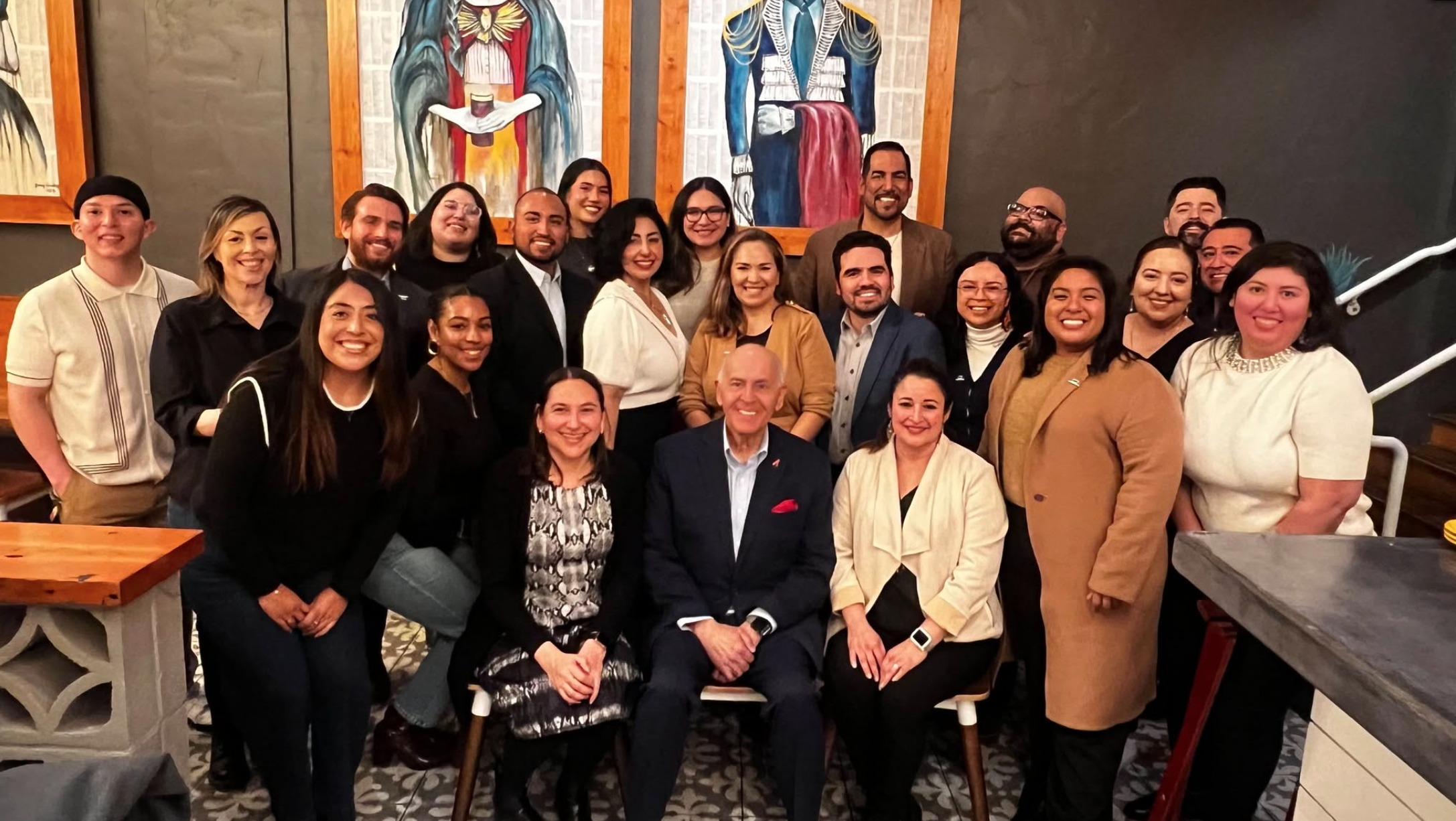
LLA Leadership Academy and Stanford Summer Leadership Institute, Cohort 15

The mission of the Latino Leadership Alliance (LLA) is to empower Silicon Valley Latino leaders to promote a common voice that addresses the interests of our community, and to identify, develop, and support future leadership. ~ Adopted by LLA Cofounders, 2005

***

During the summer of 2004, while hiking in the Sierras as a Class XVIII fellow with the American Leadership Forum of Silicon Valley (ALF-SV), I thought about creating a similar organization that could train emerging Latino and Latina community leaders to manage the complex world of civic leadership. I shared the idea with a couple of Latino and Latina elected officials. They convened a group of eight community leaders to brainstorm ideas to create such an organization. 

The group included San Jose City Councilwoman Nora Campos, San Jose Planning Commissioner Xavier Campos, San Jose City Councilwoman Cindy Chavez, Santa Clara/San Benito Counties Building Trades Council Executive Josue Garcia, East Side Union High School District Trustee George Shirakawa, MACSA Executive Director Olivia Soza Mendiola, and Mt. Pleasant Elementary School District Trustee Fred Tovar. As the eighth member of the group, I was a junior executive at Comcast and board chair for the Mexican Heritage Corporation.

Over the course of several months meeting in living rooms, we established a name for the  organization, adopted a mission statement and core values, and discussed the concept for a leadership academy. By early 2005, we established the Latino Leadership Alliance (LLA) “to empower Silicon Valley Latino leaders to promote a common voice that addresses the interests of our community, and to identify, develop, and support future leadership.” Guiding our work were seven core values:

  1. Cultural pride is the foundation of our success.
  2. Honor and integrity guide our every action.
  3. When united we are an effective force.
  4. Our community deserves to be respected and portrayed honestly and fairly.
  5. We are committed to leading and nurturing the community that nurtures us.
  6. Our united presence and influence are vital to the success of the community.
  7. We will never take money or support those who harm the Latino community.

I eagerly accepted the task of developing the leadership academy. The eight Cofounders agreed that the academy should focus on three overarching objectives: (1) servant leadership, (2) practical (as opposed to theoretical) application of leadership, and (3) challenges of serving the community as a Latino leader. As senior fellows with the ALF-SV, we were inspired to base the academy on that proven model. I also included elements of the Comcast Executive Leadership Forum, a program I benefitted from as a young and ambitious junior executive.

Both programs included three major components: (1) monthly seminars, (2) leadership retreat, and (3) alumni network. To ensure that the Cofounders’ shared commitment to preparing participants for civic leadership was covered, I developed the Four Pillars of Community Leadership model (Business, Nonprofit, Education, and Politics/Government) based on my career experience working in each pillar.

An early challenge was creating a leadership retreat from scratch. The ALF-SV retreat is a week-long camping trip in the high Sierras. Cofounders were in agreement that operating the academy should be affordable to participants. A wilderness retreat was financially out of the question. The Comcast ELF retreat was a week at the company headquarters in Philadelphia. Comcast senior executives and college professors served as presenters. That concept led to the idea of the LLA collaborating with a university. 

What happened next could be a scene from a feel-good movie or maybe a sitcom. Three of us, including fellow Cofounder George Shirakawa, drove north on U.S. 101 to meet with Professor Al Camarillo, the legendary Father of Chicano Studies . . . at the Stanford Faculty Club! We were excited about the opportunity just to be there, making jokes about three traviesos from east San Jose in the distinguished Stanford Faculty Club without supervision to meet the university’s most decorated professor. What could go wrong?

Professor Camarillo was down to earth and “one of us.” He praised our presentation and supported our proposal. Under his leadership, the LLA would collaborate with Stanford’s Center for the Comparative Studies of Race and Ethnicity. We had the final piece needed to build a solid leadership academy that would be culturally relevant to our experiences as civic leaders in a political environment that isn’t always accommodating or friendly to Latinos.

The Academy consists of twelve to fourteen participants from the business, education, nonprofit, and political/government sectors. The cohorts engage in eight monthly full-day seminars that include workshops, reading assignments, leadership exercises, and guest speakers. The monthly seminars are held at a variety of places in the community. During the summer, the cohort spends three days and two nights with university faculty at Stanford.

Participants learn about five major leadership concepts: (1) Servant Leadership, (2) Relationship Development & Management, (3) Living and Leading Holistically, (4) Civic Engagement, and (5) Leadership Communications. The LLA Stanford Summer Leadership Institute is developed and coordinated by Stanford faculty. The capstone to the program is the Cohort Community Project developed and executed entirely by the cohort participants. In early 2010, the inaugural cohort of the LLA Leadership Academy and Stanford Summer Leadership Institute served as the beta test. Fifteen cohorts have completed the program through September 2025.

The LLA Alumni Network includes 184 members who have made significant contributions to community life in Silicon Valley. Eight alumni served or currently serve on city councils in three different cities. Nine alumni served or currently serve as trustees on five different schools boards. There are scores of LLA alumni serving as local government commissioners and nonprofit board members.

LLA-trained business and nonprofit executives, and public school administrators and superintendents serve the community with cultural relevance and skill. In 2022, Governor Gavin Newsom appointed a LLA alumnus to serve as a judge in the Santa Clara County Superior Court. By all measures, the LLA Leadership Academy and Stanford Summer Leadership Institute has been an overwhelming success.

My professional career included four distinct periods. While each of those experiences holds a special place in my journey, the creation and development of LLA combined all four into one passion – sharing my experiences to support talented civic-minded and career-focused Latinos and Latinas on their leadership journeys. For 21 years, LLA has been my life’s work.

On June 7, 2025, I sent a letter to the LLA Board of Directors to announce that Cohort 15 would be my last. It was a difficult decision with a practical purpose. It’s important for leaders to have the wisdom to hand over the keys to the next generation so the organization can grow and thrive. The time was right for LLA to forge a path into the future without my support. Although my door is always open to LLA alumni, my work here is done.

As I say goodbye to LLA, my heart is filled with gratitude and accomplishment. There are too many individuals to thank, so I’ll do it in groups. First and foremost, I have deep respect and appreciation for my fellow Cofounders for having the vision, courage, and determination to bring an overdue idea to life. Thank you for your confidence in me to develop the Academy in collaboration with your guidance. We had our share of challenges and trials in building the LLA. Our commitment to be united, stay true to the mission and core values, and leave our titles and personal political agendas at the door ensured that we weathered any and all storms.

Second, thank you to the twelve cohorts and 145 participants I had the privilege to work with while facilitating the Academy. You all are valued leaders in the community. Third, thank you to the many guest speakers and panelists who took precious time from their busy schedules to share their wisdom with our cohorts. I’m also grateful for the private companies, school districts, nonprofit organizations, city council members, and county supervisors for generously providing space or monthly seminars over the years.

Last, but certainly not least, two individuals warrant special acknowledgement. Thank you, Dr. Al Camarillo for taking a chance on a LLA. The Stanford collaboration has been the hallmark of the Academy. Thank you, Dr. Tomas Jimenez for carrying the torch and for your continued commitment to LLA. I appreciate and value the partnerships and our friendship.

It’s been an honor of a lifetime to work with all the people it takes to make the LLA Leadership Academy and Stanford Summer Leadership Institute the premier Latino civic leadership development organization in the Bay Area. All I can do is humbly offer my deepest appreciation and respect for you all.

As time goes on, LLA is sure to expand and explore different leadership development models. My hope is that the current board leadership and future LLA leaders find wisdom in the core values envisioned by the Founders. If they conduct the organization’s business with those values in mind, LLA’s future is without limits!

Once again, thank you LLA! It’s been an amazing journey.