All posts by eddiemgarcia

NEW FEATURE: Quotes & Quips

writing-center

Dear Readers,

Since September 2013, I’ve posted stories on different topics every Monday. On Wednesday mornings, I post excerpts of my manuscript of Summer in the Waiting Room: How Faith, Family, and Friends Saved my Life. I hope to publish Summer in the Waiting Room as a book, so I’ve decided to dedicate more time to finish the manuscript.

With that in mind, I will no longer write stories and essays for Monday posts. In their place, I will add a new feature to East Side Eddie Report.com beginning on April 21st.  The new feature, Quotes & Quips, will be a brief posting of inspiring, provocative, or amusing thoughts to start your work week. I would love to share your favorite lines, anecdotes, and sayings on Quotes & Quips, so please send them to me at eddie.m.garcia@comcast.net.

Keep reading every Wednesday morning for regular installments of Summer in the Waiting Room: How Faith, Family, and Friends Saved my Life. Chapter 3: “Redemption” starts this week.

I truly appreciate your support of East Side Eddie Report.com. I hope to keep you coming back for more.  Thanks for reading!!

Eddie

***********************

About Summer in the Waiting Room

Summer in the Waiting Room: How Faith, Family, and Friends Saved My Life is the inspiring story of a boy who grew up in a working-class neighborhood, failed at college and lost hope, met and married the love of his life, returned and finished college, raised a family, and found some success in business and public office.  It’s also the story of a man who vowed never to fail again and worked tirelessly trying to redeem himself, only to find true redemption, while in a state of complete helplessness in the ICU.

To read past excerpts from Summer in the Waiting Room, click on“Summer in the Waiting Room” tag to the right.

Summer in the Waiting Room: Chapter 2 (excerpt #18)

423435_2913085552261_1978388929_n

Every semester, the results of that term’s academic performance arrived in the mail on light blue computer paper, and term after term, an “A” would be recorded next each course I completed.  I was on a mission. I stayed up later, studied more, and worked harder in class as the semesters went by.  During the spring before my thirtieth birthday, I was still shy of graduation so I put myself into overdrive to get to the finish line.  That semester I took seven classes, plus a required physical education class for a total of twenty-two units, an overloaded schedule that had to be approved by an advisor.

It was a hectic term, and I earned a straight “A” report card again, then it was done.  It was a bittersweet moment as I was relieved to have achieved my goal; but I still felt inferior and a sense of guilt for the earlier college failure, so I didn’t want to participate in commencement ceremonies.  Fortunately, Sandra made me don the cap and gown of a San Jose State graduate.

At the age of twenty-nine, just slightly ahead of schedule, I walked onto the football field at Spartan Stadium with 5,000 other graduates while our 30,000 friends and family members watched from the stadium seats.  I was proud to have earned my degree, especially because my parents, who both suffered heart attacks in their mid-fifties, were healthy enough to celebrate with me.

My bond with Sandra was stronger than ever, and the true meaning of giving unconditional love entered my consciousness for the first time.  As I started working on a career and Sandra got settled in hers, we decided to have a family.  I’ve always loved babies and kids so I couldn’t wait to have some of my own.  Of course, with Sandra at the helm, we planned our family methodically; we would have two children, three to four years apart, regardless of the gender so we could provide them with enough love and resources to be successful.

We would read to them while Sandra was pregnant and continue the practice until they became readers on their own, we would talk with them to build up confidence, and we would support their efforts as they grew.  I wanted babies with chubby cheeks and beautiful eyes like their mother, and of course, I hoped that they would love to read history and plays sports like me.  On March 20, 1994, our oldest daughter Marisa was born, and Erica came three and a half years later on October 19, 1997.

Marisa is the archetype of the oldest sibling; she is smart, responsible, focused, and cautious.  From the time she was a baby, Marisa was all smiles, cheerful, and attracted attention everywhere we went.  Skipping the crawling phase, she scooted about on her bottom to get from place to place in the house, and suddenly one day she stood up and began walking.  Marisa was and still is articulate.  As a baby she could use simple words before she walked and, when she was a little older, she could memorize the storybooks we read and appear to be reading them herself.

I have to dig deeply into my memory to remember a time when Marisa didn’t talk.  Mr. Peralta remarked more than once that, “this girl is going to be a lawyer.”  Like her mother, she has fair skin, full cheeks, pretty brown eyes, and a smile that is contagious.  She is thoughtful, articulate, a voracious reader with a diverse taste for music, and always ready to participate in a good debate.  At about the age of ten, she began to have challenges with anxiety, of which she is constantly learning to manage.  A straight “A” student throughout her life, she studies communications at Loyola Marymount University in Los Angeles.

Erica has an endearing personality. She’s witty, daring, and playful.  At times she could be unfocused due to her artistically creative nature.  She was a chubby baby with expressive eyes and a mischievous grin who began to crawl quickly and walk shortly thereafter.  It took her awhile to start talking. I even raised concerns that she might be slightly deaf as it runs in my family.  But that wasn’t the case.  Although she wasn’t talkative as a toddler, you could see her taking everything in and studying the sights and sounds around her.  This keen sense of observation gives her a comedic timing that easily attracts people.

While seemingly shy and reserved upon first meeting her, Erica is outgoing and social once she is comfortable with those around her.  It’s not unusual to see her holding the attention of little kids, her peers, or adults with her musings that end in howls of laughter.  Although frustrating to Sandra and me, she does just enough to get by in the classroom. Nonetheless, she plans to study art and design in college.  While she internalizes her feeling during times of crisis and disappointment, she maintained a faith that was unshakeable during the most challenging time of her life when I was in the intensive care unit clinging onto life

Together, the four of us are a close-knit unit.  I’m a prolific practitioner of nicknames and Sandra and the girls have many, and two have stuck for the girls: Marisa is “Tita” because Erica couldn’t say her name as a baby, and Erica is “X,” a warped progression of “Ericas,” one of my earliest nicknames for her.  When Sandra and I aren’t toiling away at an evening meeting, we have dinner with each other every night so the girls could talk about their day at school, complete with the schoolgirl gossip that came as they grew older.

Sandra and I share stories about our workday, constantly focusing on the positive outcomes of the challenges we face daily so the girls could see that work didn’t have to be drudgery if they followed their passions.  Before Marisa went off to college, the girls fought constantly, only to make up in an instant laughing and joking about inside jokes.  Now when Marisa returns for breaks from school, the two of them are the best of friends.

Sandra has always been the one to provide discipline and stability in their lives while I’ve been head cheerleader and dreamer in chief.  Since they were born, the girls have had me tightly wrapped around their little fingers so Sandra has said that she has to be the “tough” one while I’m the “pushover.”  Although overly simplistic, and in dispute like the argument about how I asked her to dance so many years ago, this dynamic has caused the most tension in our house.

With their mom, the girls love to shop, cuddle up on a lazy Sunday afternoon watching TV, and tease me about my idiosyncrasies.  With me, Marisa likes to talk about music, books, and politics. Erica and I talk about sports and history, and make each other crack up with our silly humor.  The four of us enjoy being with each other, whether going to the movies or out to dinner, or just staying home, hanging out and talking nonsense.  For too many years, our good times together must have seemed like special occasions to my family, because for most of their lives, Sandra, Marisa, and Erica have endured watching me fight demons through my obsessive and passionate pursuit of my ambitions.

*************************

Blogger’s note: This is the 18th installment from my manuscript of Summer in the Waiting Room: How Faith, Family, and Friends Saved My Life. I post weekly excerpts every Wednesday morning.  To read previous installments, go to the “Tags” link and click on “Summer in the Waiting Room.”

Winning the Fight for Higher Standards on the East Side

(Stock Photo)
(Stock Photo)

Sitting in the back of the multi-purpose room at Mt. Pleasant High School in east San Jose on Friday, I reflected on the untapped potential of this dynamic community. The occasion was the annual MESA (Mathematics Engineering Science & Achievement) College Poster Contest.  MESA is a non-profit organization that helps prepare educationally underrepresented students to graduate from college with an engineering, science, business or mathematics degree.

The college poster contest, one of many MESA programs, challenges students to research a college of their choice, make a poster, and present their findings to a panel of judges. For the past two years, I’ve had the honor to serve as a judge in the high school division. To my delight, the entire afternoon was an east side affair. MESA’s executive director at San Jose State University is a James Lick High School alum like me, the contest coordinator is an Evergreen High School grad, and the students represented east side schools.

I was impressed by the meticulous research, creativity and oral presentation skills demonstrated by the students. Two junior girls from Silver Creek High School, who chose to highlight UCLA, made my day. When I asked if they took the A-G class schedule needed to apply to UCLA, one of the girls said, “everyone takes A-G classes,” while the other smiled and nodded in agreement. A rush of emotion washed over me as I remembered the 2010 “A-G” fight at the East Side Union High School District.

In California, the A-G curriculum is the checklist of classes students need to take to be eligible to apply for college in the University of California (UC) and California State University (CSU) systems. Most school districts don’t require an A-G curriculum for all students. According to a 2009 California Post Secondary Education Commission report, “the college-going rate for students in California to UC schools was 7.2% and the rate to CSU schools was 10.5%.”

In 2008, just six of the state’s over 400 school districts that issued high school diplomas required an A-G curriculum. The East Side was like the vast majority of school districts where 90% of the graduates weren’t even eligible to apply to a UC or CSU. During my term serving on the school board at the East Side from 2006-2010, a group of students from the district’s chapter of Californians for Justice (CFJ) were campaigning the school board to make A-G the required curriculum for all students.

When I was elected board president in 2009, I joined the CFJ students, their families, and community supporters to fight for A-G at East Side schools by announcing at the annual State of the District Address that I would ask the board to approve an A-G curriculum for all students by the end of the year. The standing room-only crowd in James Lick’s multi-purpose room that night expressed full support for what would be called the A-G Initiative.

I thought the proposal was a no-brainer that would easily pass the board by mid-summer. The day after the State of the District Address, I quickly learned that it would be anything but easy. I met with opponents who were concerned and angry that I made such a bold statement without consulting the broader education community. They warned that the rigorous curriculum would “set up students to fail” as “these students weren’t prepared to pass Algebra II.”

Together with students, parents, and community supporters, we moved forward nonetheless. The Silicon Valley Education Foundation joined the fight by providing critical resources to educate the public and my board colleagues on the values of A-G. Later that spring, I had a massive heart attack with complications that kept me in the hospital for over 100 days. As I fought for my life in the ICU, the community fought for A-G and higher standards on the east side.

The A-G vote was scheduled for the October board meeting and the initiative’s opponents had asked the board to delay the vote and convene a study session to better understand the impacts. Although I was home from the hospital, I was in no condition to participate in the board meeting, so my four board colleagues would determine the fate of A-G. The board ended up deadlocked so both proposals failed to get the required three votes for move forward. A-G was dead.

The next day, I confirmed with district officials that I was still board president and could vote by teleconference, so I asked the administration to once again place the issue on November’s board agenda. Student, parents, and community supporters rallied their troops to attend the November board meeting to show solidarity for the initiative. I planned to by on telephone standby until the issue came to a vote.

By the night of meeting, I was strong enough to attend and persuaded Sandra to let me participate in the A-G vote. An overflow crowd came to the board chambers on November 18, 2010, to enthusiastically urge the board to vote for the A-G Initiative. After brief comments by each board member, we unanimously voted to require the A-G checklist to be the default curriculum for all students beginning with the Class of 2015.

After casting my last vote as a school board member, I turned toward the door behind the dais and walked out of the board chambers for the last time as students and families celebrated their hard-fought victory. That was, and always will be, my proudest moment as an eastsider . We showed everyone that our community valued high standards that night. Last Friday, when the young woman from the Silver Creek High Class of 2015 matter-of-factly told me that, “everyone takes A-G classes,” I smiled, assured that 2010 was worth the fight.

Summer in the Waiting Room: Chapter 2 (excerpt #17)

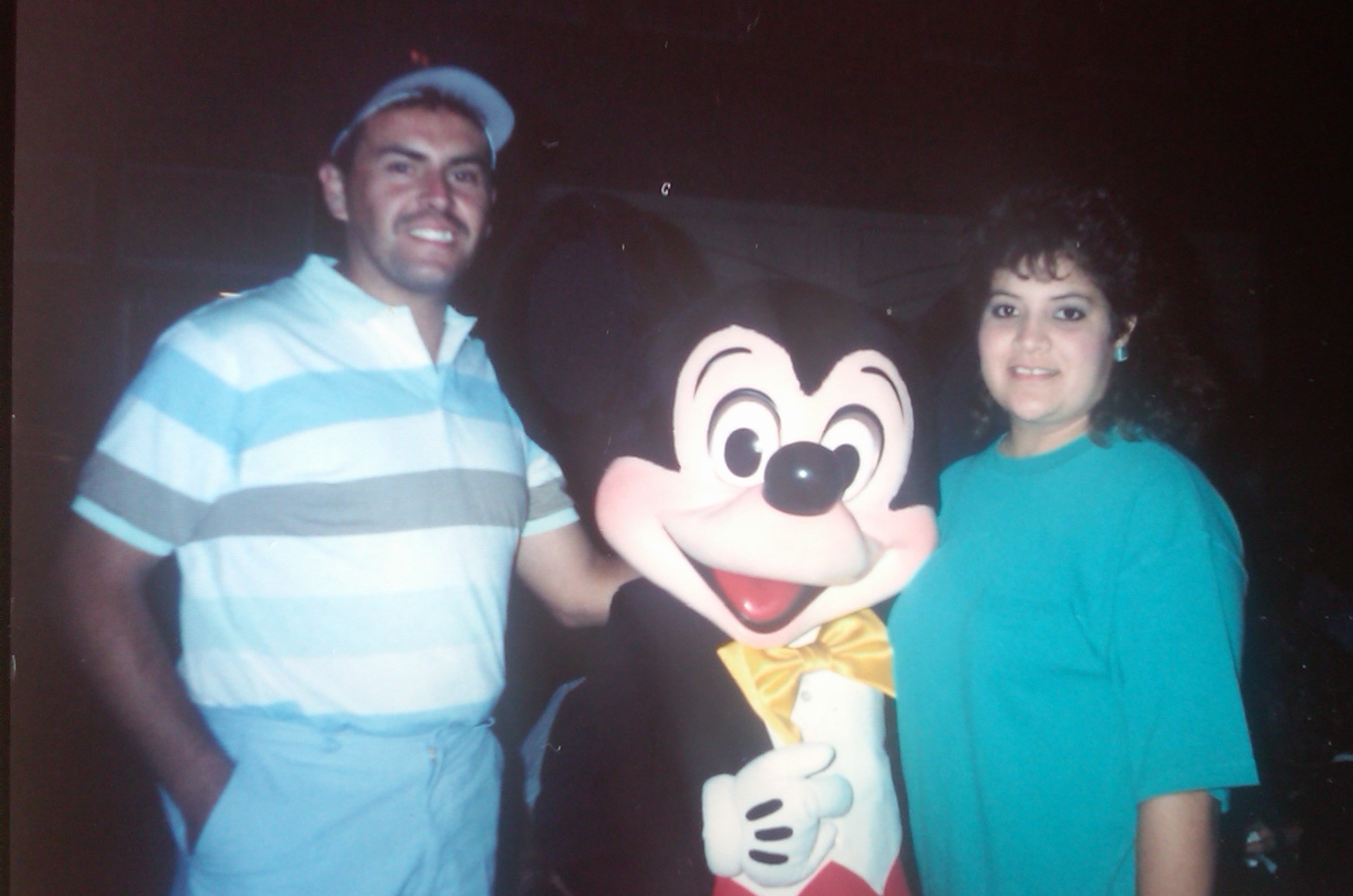
The newlyweds hanging out with Mickey during the summer of 1991 (Eddie & Sandra García Family photo)
The newlyweds hanging out with Mickey during the summer of 1991
(Eddie & Sandra García Family photo)

Sandra and I rented a small one bedroom apartment in the east foothills, not far from Alum Rock Park and the expensive houses up the hill.  She was in her first year as an elementary school teacher and I taught Spanish to pre-school kids at a private elementary school/day care center.  It was a job that didn’t require a college degree and paid next to nothing.  I also coached basketball at City College and made extra money tutoring the basketball players.  We were able to scrape by financially and married life was treating me well.

For the first time since I was a teenager I felt a sense of accomplishment and stability, this time without the brashness and bravado of one of the big men on campus.  Soon after the basketball season ended, Sandra and I made the decision that I should return to San Jose State on a full-time basis and put my career as a basketball coach on hold until I earned my bachelor’s degree and teaching credential.

I had been taking courses at State here and there for a couple of years to meet reinstatement eligibility to the university and to remove the academic disqualification from my record, so I was ready to submit an application for acceptance.  When a letter from San Jose State arrived in the mail, I anxiously opened the envelope, read the letter, and let out a huge sigh of relief.  My failed academic record had been cleared, and I was officially a college student once again.

The next day, a Saturday, Eddie Velez and I were working on a side job with Mr. Peralta replacing sidewalks at an apartment complex, but I wasn’t participating in the usual banter about sports, politics, the weather, and the aches and pains that come with construction work.  My mind was spinning with thoughts about my past failures, my new opportunity, and my second, and perhaps, last chance to redeem myself by earning a college degree and pursuing my dream of being a teacher and a coach.  Right then and there, I decided that I would work harder than ever in college to stay focused on the prize.

Because the acceptance letter arrived just days before classes were to begin, I had to sit in on the classes I wanted to secure a space before I could actually register.  It would be a tedious process that required patience and perseverance.  With a determination I never had before, I sat in class after class, cajoled professors to allow me to stay, and registered for a full load of classes to qualify as a full-time student.  I threw myself into my schoolwork, finishing projects, writing papers, and completing reading assignments ahead of schedule.

Early that first semester, I ran into a mental roadblock that could have compromised the entire effort; I realized that I was almost ten years older than my classmates in first year general education courses.  I started to doubt myself, I questioned my decision to drop everything to return to school, and I felt out of place as a weathered twenty-seven year old man among bright, young, and eager college students.

I shared these sentiments with a professor, Dr. Randall Jimenez, with whom I had developed a good relationship in his freshman communications course.  He told me that I had a natural talent for public speaking and using words to persuade and lead others.  Then he asked me how old I was and when did I anticipate on finishing my degree, and I responded that I hoped to graduate by my thirtieth birthday.  He said with good health and God’s will I would be thirty years old, so I had to decide whether I wanted to be thirty years old with a college degree or thirty years old without one; the choice was mine and mine alone.

From that day on I had a laser focus toward achieving success at the highest level possible, as a student and in my future career as an educator and basketball coach.  To help Sandra with living expenses, I spent the next three years tutoring freshman for the professor’s public speaking courses.  I ran into Dr. Jimenez two decades later, and with a bear hug and heartfelt smile, he mentioned how happy he was to see me, and that he had followed my career and medical problems in the newspaper.

I reminded him of and thanked him for the wise words he imparted on me that day early in my return to college.  He thanked me for listening because he knew that I would use my gift for public speaking to make an impact in people’s lives.  His wise advice twenty-one years before sent my college career and the professional life that was to follow into high gear.

For the next three years, I was a full-time student and part-time homemaker.  After that first semester, I met with an advisor on campus, selected history as my major, and mapped out the schedule of classes I would need to graduate by the time I was thirty years old.  At home, in between reading and writing assignments, I washed clothes, kept our little apartment clean, and experimented making different meals so dinner would be ready when Sandra got home from a long day with her students.

More often than not, my experiments would go badly and we would end up at one of the mom and pop restaurants or fast food joints that dotted our new neighborhood.  In addition to my studies and tutoring for the professor’s public speaking courses, I worked as a referee for intramural sports at San Jose State and tutored a neighborhood kid to further supplement Sandra’s teaching salary.  I was absolutely dedicated to my studies, devouring books faster than professors could assign them; reading in the laundry room at our apartment complex or at the kitchen counter while preparing another disastrous meal.

East Hills Little League: Birthplace of a Lifelong Passion

Tire Outlet #2 - East Hills Little League Farm Division - 1971 (García Family Photo)
Tire Outlet #2 – East Hills Little League Farm Division – 1971
(García Family Photo)

I got the “Throwback Thursday” bug last week on Facebook and posted a photo from 1971 of my first little league team, Tire Outlet #2. Those were the days when sponsors were team names, rather than a using the name a professional major league team. Rich Archuleta, an old friend from those days, commented on Facebook that I “really brought back a flood of memories with this picture.” Boy was he right!

I played baseball at East Hills Little League in east San Jose for six years from 1971-1976. It was an era before parents saw youth sports as a ticket to a college scholarship, glory, and potential riches as a professional athlete. As a little leaguer, there was no pressure to meet with a batting coach for weekly lessons at the batting cage, compete on a travel team, and equip ourselves with the best high-tech gear available. We just played baseball.

During those six years, we were Tire Outlet #2, Imwalle Farms (there was a giant red and white pumpkin on our red-sleeved jerseys), and the East Valley Lions Club. My last season, when I was 12 years old, I was the winning pitcher in the major division championship game. There were no full uniforms (until the major division), bat bags, cleats, or customized gloves and helmets. Baseball has always been part of my life and playing at East Hills Little League started that lifelong love of our national pastime.

I still remember the day that my mom took me to register for little league at August Boeger Middle School. The registration fee was $5.00 and a book of S&H Green Stamps or Blue Chip Stamps. For that fee, we got a baseball cap with “EH” in block letters across the front, a shirt, and a 20-game schedule. I was placed in the “Red” organization. Due to an ordering error, we wore blue shirts that first year.

The Red teams were a family affair led by the Marquez Family. Phil Marquez, Jr. was our manager, Mrs. Marquez was team mom, Larry and Ernie “Nesto” Marquez were our sluggers, and Mr. Marquez, a deacon at Guadalupe Church, was head cheerleader in charge. Junior was a great coach who has stayed involved with youth baseball or softball for 40 years, winning championships at every level including varsity softball at Mt. Pleasant High School. He’s a true east side legend.

Opening Day always started with a parade that wound its way through the east side from Payless Drug Store on Capitol Avenue to the league’s fields. Dads who had pick-up trucks carried the players and honked horns as the procession slowly drove by neighborhoods. Once there, the teams would file onto the major league division field that had a dirt infield, home run fence, electronic school board, and pitching mound. The little kids couldn’t wait to play on that field.

While I’m sure we all had dreams of playing in the Big Leagues, that wasn’t the goal. The reason we went to practice every day was to play ball. Some of us went on to play in high school, a few others played in college, and one kid made it to the majors. Kenny Williams played for the Chicago White Sox and later became the franchise’s general manager. I’ll never forget watching Kenny on TV, as general manager, when the Sox won the World Series in 2005.

Although I’ll never know what it’s like to be a major leaguer, I made long-lasting friendships playing baseball. I stay in contact with many fellow little leaguers and high school teammates are still some of my closest friends. Rudy Bryand, my boyhood friend and best man in my wedding, and I met playing sandlot baseball during lunchtime in middle school. He sat by my family’s side for 100 days when I was in ICU fighting for my life.

My dad shared my passion for baseball and taught me how to pitch and play the infield. He never missed a game from little league through high school. He took me to my first major league game in 1971 to see the Dodgers play the Giants at Candlestick Park. I can still name the starting line-up from that Giants team that included Willie Mays, Willie McCovey, and Juan Marichal. I wanted to pitch with a high kick like Marichal, and I made the sign of the cross before batting like second baseman Tito Fuentes.

That passion has now passed onto my family. When my daughter Erica played little league, I managed the team, Sandra helped me stay organized, and my daughter Marisa was the Director of Equipment Management, my fancy name for the bat and ball girl. When Edgar Renteria hit a home run to give the Giants their first World Series win in San Francisco, the four of us were together hugging and high-fiving.

Posting that photo reminded me about the important things in life. For me, playing baseball wasn’t a means to a college scholarship or a profession. Baseball gave me a common bond with my dad, a bond that has extended to my daughters. Baseball has been the centerpiece of many lifelong friendships. And it all started on the fields of East Hill Little League.

Summer in the Waiting Room: Chapter 2 (excerpt #16)

The García and Peralta families came together to celebrate our wedding day on November 17, 1990. (Sandra and Eddie  García Family Photo)
The García and Peralta families came together to celebrate our wedding day on November 17, 1990.
(Sandra and Eddie García Family Photo)

With Sandra’s support and the foundation created by this tightly knit family environment, I slowly began to emerge from the abyss of failure.  The fall we began dating, I applied for and accepted a position to coach the frosh-soph boys’ basketball team at the high school across the street from Most Holy Trinity Church.  I worked well with the student-athletes and the school administration further convincing myself that college and a career in education was my path to redemption.

The next year, in a sudden twist of fate, the head basketball coach at my alma mater resigned just weeks before the season began, so my return to college would have to wait because James Lick High School hired me to run its basketball program, which included a full-time job as an instructional aide.  The values I learned at 48 Viewmont Avenue served me well as I worked hard to rebuild a program that had won only two games the year before.  By the end of my second season, we had won half our games in the regular season and recorded a 12-2 record at the San Jose City College summer league, losing in the championship game to a county powerhouse.

That same summer, James Lick High School honored me with the school’s coach-of-the-year award and legendary San Jose City College basketball coach Percy Carr asked me to join his staff.  Despite these successes, the hard facts continued to haunt me:  I had failed at college, the coaching positions were part-time with no real conduit to a stable career, and the bright lights of success as a coach merely covered up the reality of my disappointments.

Although my relationship with Sandra was growing and getting stronger, I would regress into my self-loathing through an occasional weekend drinking binge with Rudy, thus setting back whatever gains I had made with Sandra in strengthening our bond.  As much as I loved Sandra and as much as I desired to get back on track with my life, the dual demons of perceived success as a coach and actual failure in life continued to keep me from moving forward.  As time went by, and as our bond grew stronger, the binges became less frequent and I began to fight the demons by working harder.

On Valentine’s Day in 1989, while still coaching at James Lick High School, I made the first decision I had ever made toward true adult responsibility. I decided to ask Sandra to get married.  I called Kimberley that morning and asked her to meet me in front of Milen’s jewelry store as I wanted her advice on choosing a ring.  I picked out a one-quarter karat marquis solitaire diamond engagement ring, placed it in the velvet box provided by the store, and went to coach that afternoon’s practice as usual.

After practice I called Sandra from the coach’s office and asked her if she want to get something to eat without telling her where we were going.  When we rolled up to the drive-in service at Mark’s Hot Dogs, Sandra mentioned how she was surprised because we hadn’t been there since that first awkward date almost four years before.  We ordered a couple of hotdogs “with everything on it,” chips, and two diet Coke’s, and when the server left the food on the tray that hung from the driver’s side window, I slipped the velvet box next to our order.

I first gave Sandra some napkins that she carefully spread on her lap and followed with the hotdog, chips, soda, and finally the velvet box all in one swift motion.  She took a small bite of the dog, paused, and turned her head toward me with a puzzled look on her face, and asked, “What’s this?”  I opened the box and asked her to marry me.  To my relief, she smiled and her eyes welled up with tears of happiness and she said “yes.”  Soon we were on our way to Santiago Avenue so I could formally and properly ask her parents for permission to marry their daughter.

The next year and a half was filled with work (I continued to work as an instructional aide at James Lick after I accepted the position of assistant basketball coach for the nationally-ranked San Jose City College team), my coaching responsibilities, and preparations for a wedding.  In addition to organizing wedding plans, Sandra completed her studies at San Jose State and began working toward a teaching credential.

On November 17, 1990, our families and five hundred of our closest friends celebrated our traditional Mexican American wedding at Most Holy Trinity Church.  Rudy was best man and Kimberley was maid of honor. When the double doors at the end of the main aisle of the church opened and I saw Sandra for the first time in her wedding gown, I immediately knew that I had made the best decision of my life. The reception was traditional as well with barbacoa (spicy Mexican shredded beef), rice, beans, and tortillas for dinner while mariachis and Mexican folkloric dancers entertained guests.

For our first dance as a married couple, at our request, a four-man Tex-Mex band, my favorite genre of Mexican music that includes an accordion, twelve-string bajo sexto guitar, bass guitar, and drums, played the standard ranchera song “Un Rinconcito en el Cielo” (A Little Corner of Heaven) made famous by Mexican musical legend Ramon Ayala y Sus Bravos del Norte.  Like everything in which Sandra organizes, the entire day and evening were the result of meticulous planning and execution.

We left San Jose the next morning for a three-day honeymoon in the Sierra Nevada Mountains at Lake Tahoe.  The trip was brief so I could return for the rest of the City College basketball season.  A new chapter had started for both of us; for Sandra it was the next step in her carefully thought-out life plan and for me it was a positive step toward my efforts to unravel the complicated life I had created for myself.

The Cesar Chavez Legacy

0000_cesar-chavez

On Friday, President Obama released a proclamation that read in part,

“I, Barrack Obama, President of the United States of America, by virtue of the authority vested in me by the Constitution and the laws of the United States, do hereby proclaim March 31, 2014, as Cesar Chavez Day.”

In commemoration of Cesar Chavez Day, I share one of his most important speeches, “1984 Address to the Commonwealth Club.” In that speech, Cesar describes how the farmworker movement gave hope to a Latino community seeking fairness, justice, and true equality.

With one powerful quote, he lays out the future of Latinos in the United States:

“Like the other immigrant groups, the day will come when we win the economic and political rewards which are in keeping with our numbers in society. The day will come when the politicians do the right thing by our people out of political necessity and not out of charity or idealism.”

I hope you take a minute to read the entire speech by clicking on the following link:

http://www.chavezfoundation.org/_cms.php?mode=view&b_code=001008000000000&b_no=16&field=&key=&n=8

Summer in the Waiting Room: Chapter 2 (excerpt #15)

The Peralta Family with Nana Encarnación, ca. 1980 (Peralta Family Photo)
The Peralta Family and Nana Encarnación,          circa 1980
(Peralta Family Photo)

Sandra’s oldest sister Valerie was born in Fresno, California, in 1961, just before Fausto and Connie moved to San Jose.  She was an only child for five years and thrived under the attention paid to her by her parents.  She grew to be a strong-willed girl who did well in school and participated in the cheerleading squad in high school and graduated from college with a degree in computer science.  She is a loyal sister who is always available to lend moral support.

The birth of Kimberley, the third Peralta daughter, came three years after Sandra in 1969.  Like her older sisters, Kimberley did well in the classroom and participated in after-school activities such as the marching band.  Kimberley has a nurturing and faithful character who seeks compromise and accommodation whenever possible.  She completed her college studies in business administration partly to help her father achieve the dream of having a businesswoman in the family.

The youngest of the Peralta clan from Silver Creek High School is Shelley, born exactly ten years after Valerie on December 28, 1971.  Shelley, who earned her college degree in social work, is unassumingly intelligent, yet boisterous and independent with a fiery spirit that can be witty in one instance and cynical the next.  All four sisters have one trait in common: they are intensely loyal to their own individual families, and to each other, their parents, and extended family and friends.

Once Sandra and I started dating on a regular basis, I realized that acceptance to the family required developing a relationship with each sister on a one-on-one basis in addition to building trust with Sandra’s parents.  Although this was a tall order for a young man mired in his failures and ambiguous future, my upbringing centered on respect and integrity and my accommodating personality, not to mention my absolute adoration of Sandra, set the foundation for my relationship with the Peralta family.

My relationship with Mr. Peralta seemed to begin almost instantaneously one Sunday over a beer when I told him that my grandmother Joaquina was born in Sahuaripa, a village just over the mountains from his hometown; seventy kilometers as the bird flies, but an eight-hour drive through the rugged mountains of Sonora, Mexico.  Although my Spanish is about as good as his English, we hit it off right away.  Sandra had to drive me home that day because I drank a few too many beers and participated in my fair share of storytelling.

With Mrs. Peralta, I learned quickly that I would earn trust and acceptance by respecting her home and her daughters, which, with the exception of one early verbal scrap with Shelley, I was able to accomplish soon after I started to frequently visit Santiago Avenue.  Valerie had been married for several months before Sandra made that birthday cake for me, so she wasn’t living at the house on Santiago Avenue when I started to see Sandra regularly. My relationship with Valerie has always been one based on respect, understanding, and acceptance of one another.

Kimberley and Shelley are my de facto little sisters, I served as an open ear to listen to their adolescent problems when they were younger and still provide counsel to them as adults.  Due to our similar accommodating personalities, Kimberley and I always got along just fine, and although Shelley and I had that early altercation, we grew to admire and care for each other as siblings sharing the qualities of a quick wit and a sarcastic tongue.

Over the years, I also developed deep and strong relationships with the Peralta girls’ husbands.  Valerie’s husband Eddie Velez and I became close as we were the “big brothers” who sometimes worked with Mr. Peralta on side jobs to make extra money and helped each other with household projects.  He’s the handyman of the group, so he’s always available to help with a bad electrical fuse, cable TV connection, or nagging computer problem.  Both of us are loyal San Francisco Giants and 49ers fans, so baseball and football seasons always prove to be fun.

When Kimberley and her husband Miguel Rocha were dating in college, she turned to me often for advice, and once I got to know Miguel, we soon learned that we both shared the same intense ambition of achieving success at the highest level possible, he as a businessman and I in politics.  I love picking his brain and sharing ideas on how we could come up with a successful business plan or two.  We’re both natural salesmen (some would say bullshitters) and I’m sure it’s hilarious watching us trying to sell each other on an idea.

Shelley’s husband, Pancho Leyva, and I have a passion for sports, and in our younger days, we were a mischievous team when the beer started flowing.  Perhaps our best time together was when he and I sat a few rows behind home plate at AT&T Park the night San Francisco Giants home run king Barry Bonds hit his 500th homerun against the Los Angeles Dodgers.  I’ll never forget watching Pancho, the die-hard, blue-bleeding Dodger faithful, high-fiving Giants fans and enthusiastically waving an orange towel in recognition of Bonds’ historic achievement.

I have a true affection for each of them, and together we are about as close as any four brothers could be.  Sandra’s parents, her three sisters, and my three compadres would play a major role in the events that unfolded in the summer of 2010.

*********************

Next Week: My relationship with Sandra continues to grow and I find the courage to ask her to get married.

Let’s Start a “Courageous Conversation”

Book cover for "Courageous Conversations About Race" (courtesy of Google Books)
Book cover for “Courageous Conversations About Race”
(courtesy of Google Books)

Recently, I had the opportunity to visit a kindergarten classroom at a school on the east side. I was able to see an excellent teacher at work. Just holding the attention of energetic five-year-olds seemed like a tall order. The teacher was engaging and positive as she led the students through a math exercise. Some kids were attentive, others were restless, and most were somewhere in between. What impressed me most was that the teacher worked hard to involve each student.

I witnessed the teacher practicing what educational equity experts call “meeting students where they are.” In other words, the teacher didn’t expect every student to be the same and she made adjustments for each student’s strengths and weaknesses. On the other hand, as an education blogger and former school trustee, I’ve heard many other teachers express frustration that students don’t come to school ready to learn.

So what does “ready to learn” mean? Essentially, it describes the model student: conscientious, organized, and prepared to learn every day. This must start at home, the argument goes. With that reasoning, some educators believe that high academic achievement could become a reality because the school system would be able to do what it is designed to do: teach.

Unfortunately, that’s just not real life. Wouldn’t it be wonderful if everyone was conscientious, organized, and prepared? That would eliminate most of the world’s problems for sure. The reality is that students, like all people, come in all colors, cultures, sizes, intellectual abilities, and social classes. Despite this diversity, every student can succeed if school systems truly understood and accepted that everyone is different.

In their insightful book about equity in education, Courageous Conversations About Race, Glenn E. Singleton and Curtis Linton use meticulous research to demonstrate that society, school systems, education leaders, and classroom teachers more times than not prejudge students based on race, cultural background, and socio-economic status. This results in practices that marginalize students of color and sets them on a course that discourages a future college education.

All too often the school system and educators dismiss kids of color with the cop-out that “college isn’t for everyone.” In response to my post last week, several readers shared with me their own experiences with this discouraging phrase (click on https://esereport.com/2014/03/17/college-can-change-your-life/ to read last week’s blog). One reader recounted how her son’s high school counselor encouraged him to be a truck driver because he could make good money without a college education.

In his 2009 report on closing the achievement gap, former California State Superintendent of Schools Jack O’Connell recognized this problem and recommended culturally relevant professional development as a solution (click on http://svefoundation.org/svefoundation/files/p16_ctag_report.pdf to read Superintendent O’Connell’s report). Unfortunately, few school districts have attempted to develop a comprehensive and systematic approach to implement this recommendation.

Why is this? To even start thinking about implementing a culturally relevant professional development program, school systems must first acknowledge that racial and cultural bias actually exists.  Singleton and Linton write that talking about these biases is “a difficult conversation, one that clearly troubles educators and can make everyone downright uncomfortable.” It’s hard for good people to believe that they hold such biases.

One would think that in a place as diverse as Silicon Valley, having this conversation would be easy. But it’s not. I’ve discussed this issue with several superintendents who have implemented equity and culturally relevant professional development programs in their districts. In those initiatives, teachers, staff, and the school communities were skeptical and resistant to even begin the conversation. Although long-term relationships were tested and challenged, the end results for students were good.

School leaders may be reluctant to venture into the wilderness of starting that difficult conversation.  It will take conviction, courage, and commitment. Nevertheless, we need to have these discussions as a community for us to ensure that all students have an opportunity to achieve and succeed.

So, I suggest that we support our education leaders and start a “courageous conversation” right here on East Side Eddie Report.com. I want to hear about your experiences with racial and cultural bias as a student, parent, teacher, school administrator and how it impacted your decision to continue (or not continue) a higher education? If you don’t feel comfortable posting publicly, but want to share your story, please feel free to e-mail me confidentially at eddie.m.garcia@comcast.net.

Let’s be bold and start talking!

********************

Eddie is available to speak at your next event or conference.  To learn more about speaking services click on the “Speaking Engagement” tab under the banner on this page.

To schedule Eddie for your next breakfast, luncheon, or dinner event, e-mail eddie.m.garcia@comcast.net, or call 408-426-7698.

Summer in the Waiting Room: Chapter 2 (excerpt #14)

Written on the back of the photo is, "Sandy 5th Grade" (Peralta Family Photo)
Written on the back of this photo is, “Sandy 5th Grade”
(Peralta Family Photo)

It was during those long phone calls between our first and second date that I got to know Sandra very well.  She was born Sandra Faustina Peralta on September 30, 1966, at Doctors Hospital just west of downtown San Jose, the second of four daughters born to Fausto and Connie Peralta, a construction worker and cannery worker.  She was a cute baby with big brown eyes, chubby cheeks, and puffy arms and legs that looked like they were tapered at the joints with rubber bands like a cute Michelin Man from the tire company’s commercials.

As she grew up, Sandra was obedient, studious, and cheerful.  In elementary school, she helped in the school library, cafeteria, and could always be found at recess time helping a teacher with some odd job in the classroom. Beneath the exterior of the model student and obedient daughter was a girl who had tremendous strength of character and unflinching determination.  According to her mom, even as a toddler, “Sandra knew what she wanted to do and was confident she could do it.”

The family next door had a daughter the same age that constantly competed with Sandra in the classroom and with extracurricular activities.  Only once did Sandra let the pressure of that competition get the best of her when in a fit of anger she called the other little girl a bitch, and abruptly went home to confess to her mom, express remorse, and return to apologize.  This incident accurately describes Sandra’s dual qualities of toughness and compassion.

Sandra went on to excel in school earning good grades, playing clarinet in the award winning high school marching band, participating in after school activities, and eventually getting elected student body president her senior year at Silver Creek High School in east San Jose.  After two years of community college she enrolled at San Jose State University to begin a journey that would lead to her career as an educational administrator.

Sandra’s success can be attributed to her spirit, personality, and the unconditional support from her family.  Her parents, Fausto and Connie Peralta, are the personification of the American Dream.  Born in the village of Cumpas, Sonora, Mexico in 1938, Fausto was raised by aunts and uncles because his father Mariano died as a young man; and his mother Concepción left him, and his sister and brothers in the care of relatives to go to the United States in search of work and a chance to send for her children so they could have a better life than the one they had in Mexico.

He came to the United States at the age of sixteen and settled with his mother in the small California farming town of Mendota; his brothers followed later.  In Mendota, Fausto quickly established himself as a hard working young man who provided much value to the farmers who employed him in the cotton fields of central California.  When not doing the back-breaking work required in the hot and dusty fields, he could be seen around town neatly dressed in clean and pressed clothes, polished shoes, and hair combed just right.

Sandra’s mom, Connie Rosales, was born in 1941 just a few miles up the road from Mendota on the Hotchkiss Ranch just outside of Firebaugh, California, the ninth child of Jesus and Encarnación Rosales.  Like Fausto, she was raised by a single mother as her father passed away when she was just three years old.  Connie, a strong-willed, hard-working, and compassionate woman, grew up dreaming of one day living in a nice house and raising a successful family just like the Americanas who lived in town.

Connie and Fausto met in 1958 when Connie’s presumably match-making aunt invited Fausto to a New Year’s Eve party at the home of Connie’s sister.  Two years later they were married, then moved to San Jose looking for work where Fausto made his way as a cement mason and Connie supplemented their income working in the canneries of Santa Clara Valley, and where they built a family with their four daughters: Valerie, Sandra, Kimberley, and Shelley.  They worked hard and did whatever it took to ensure that their daughters had a chance to succeed.

Raising four daughters was a challenge for Fausto and Connie as each woman has her own distinct personality.  Collectively, the Peralta girls made an impression at Silver Creek High School and proudly call San Jose State University their alma mater.  A large photo of the sisters standing together resplendent in college cap and gown under the shadow of the university’s ivy-covered Tower Hall hangs in the entryway of the Peralta house.