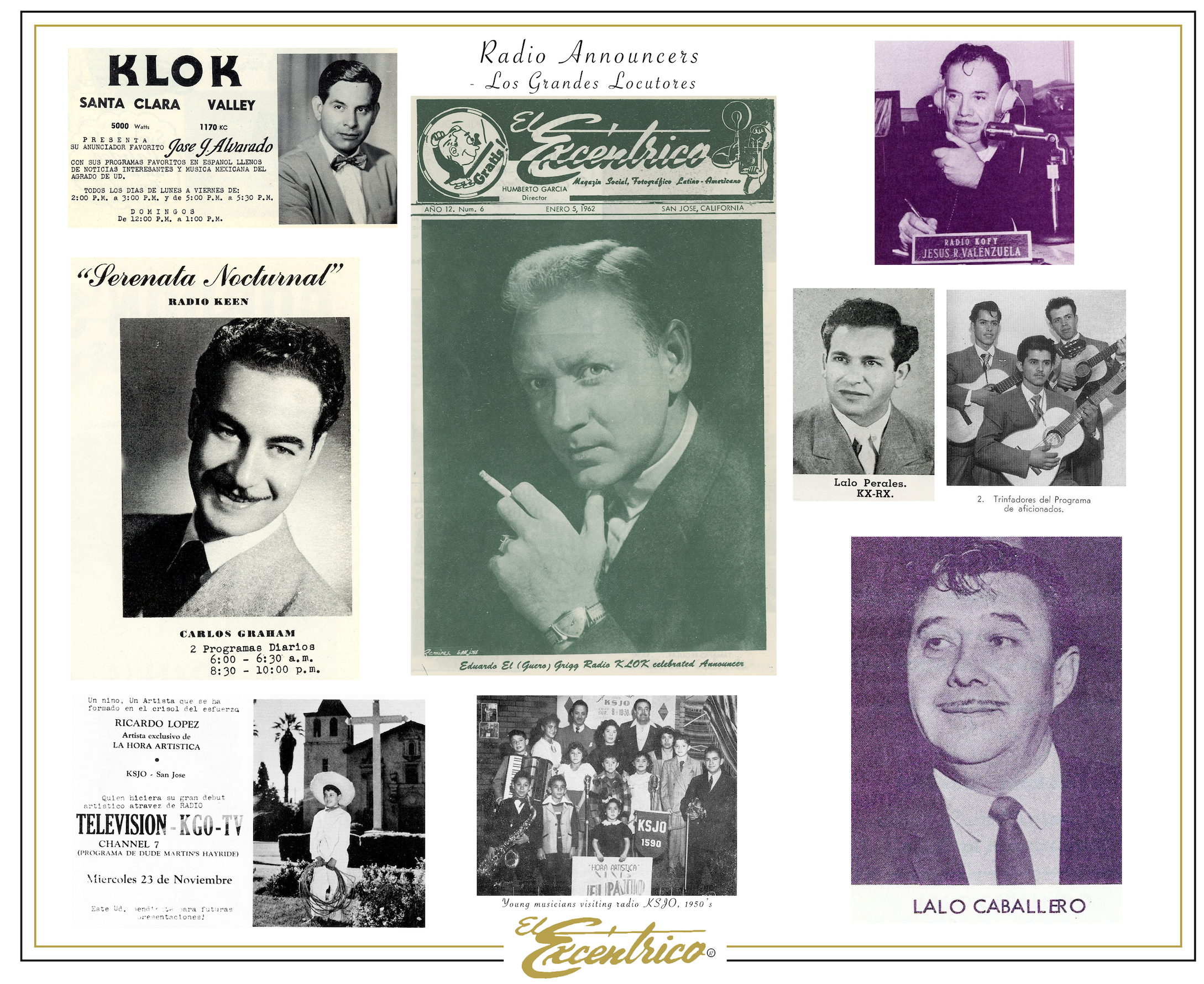
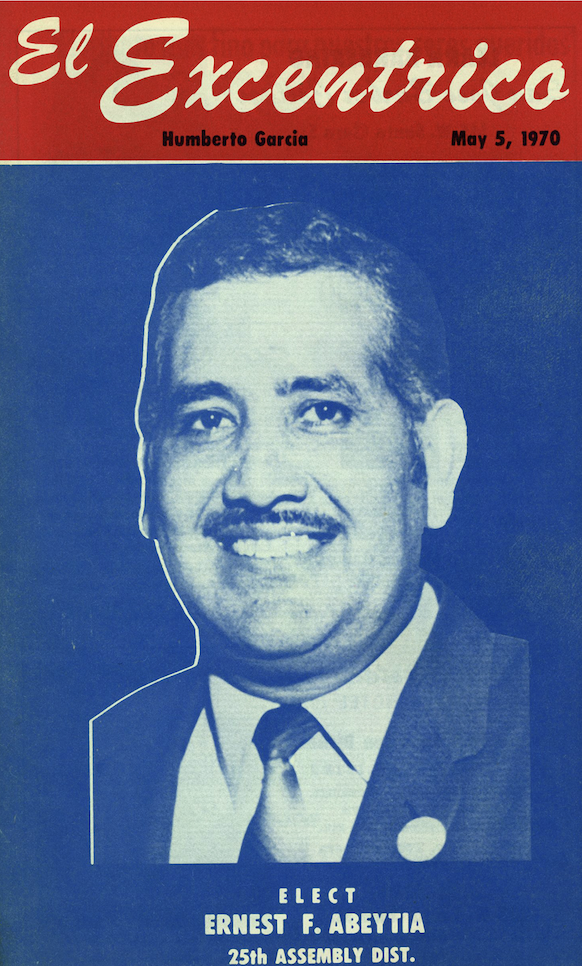
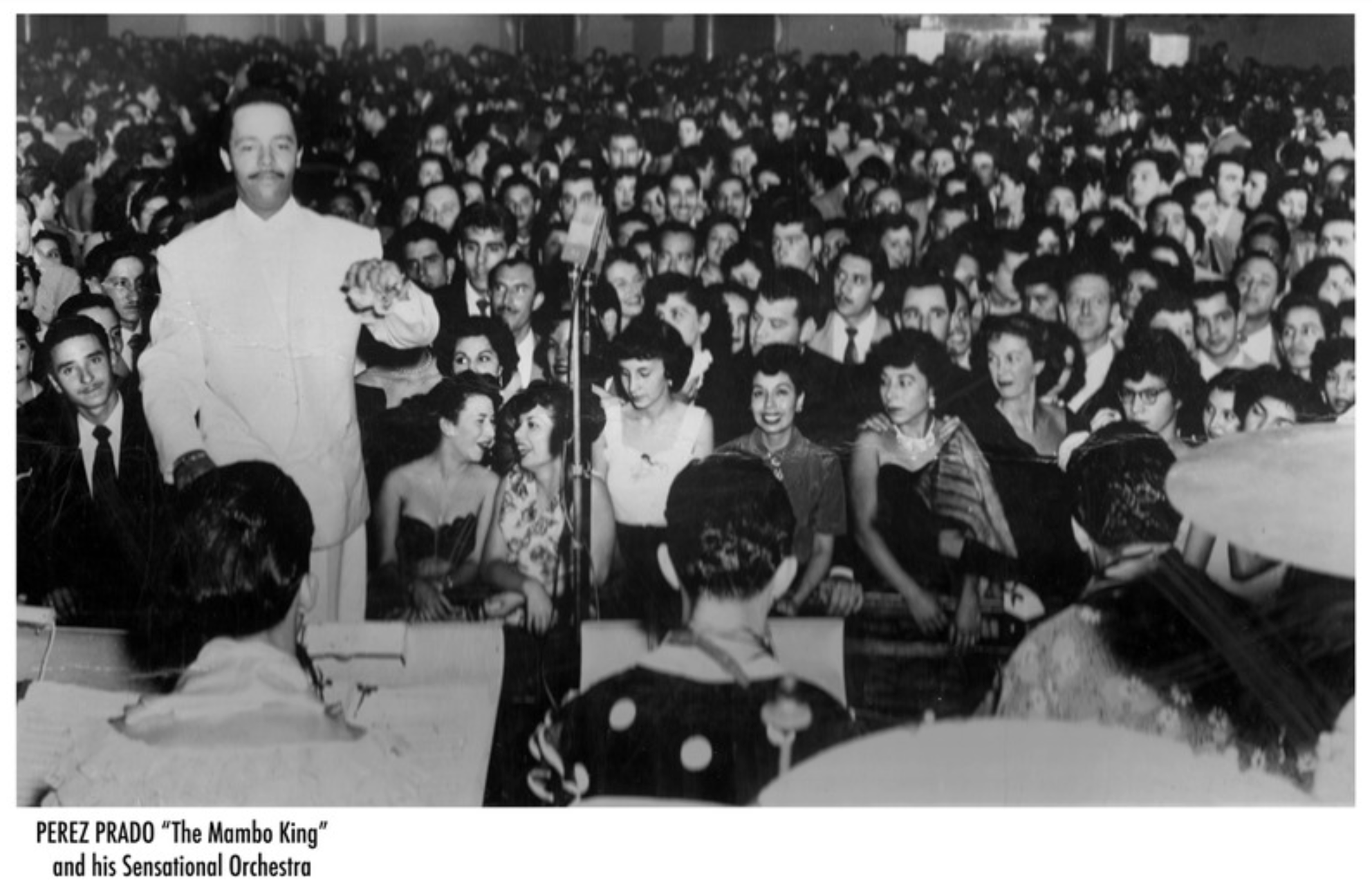
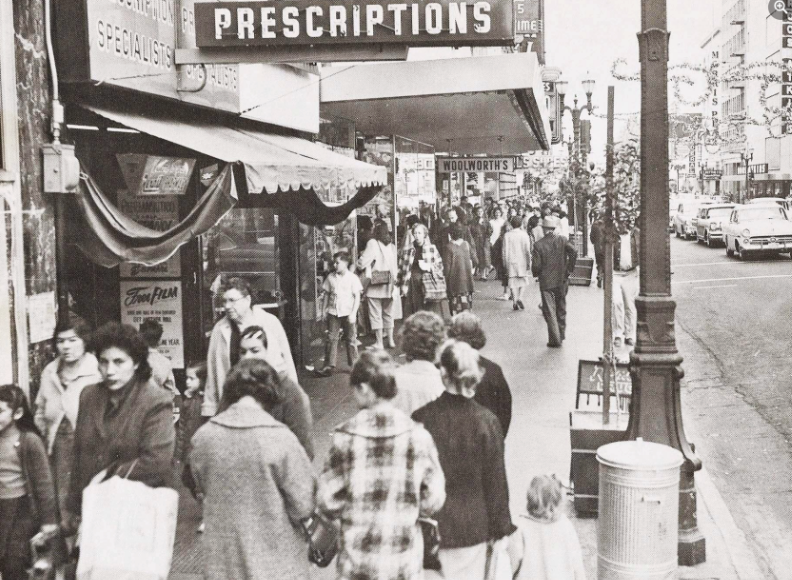
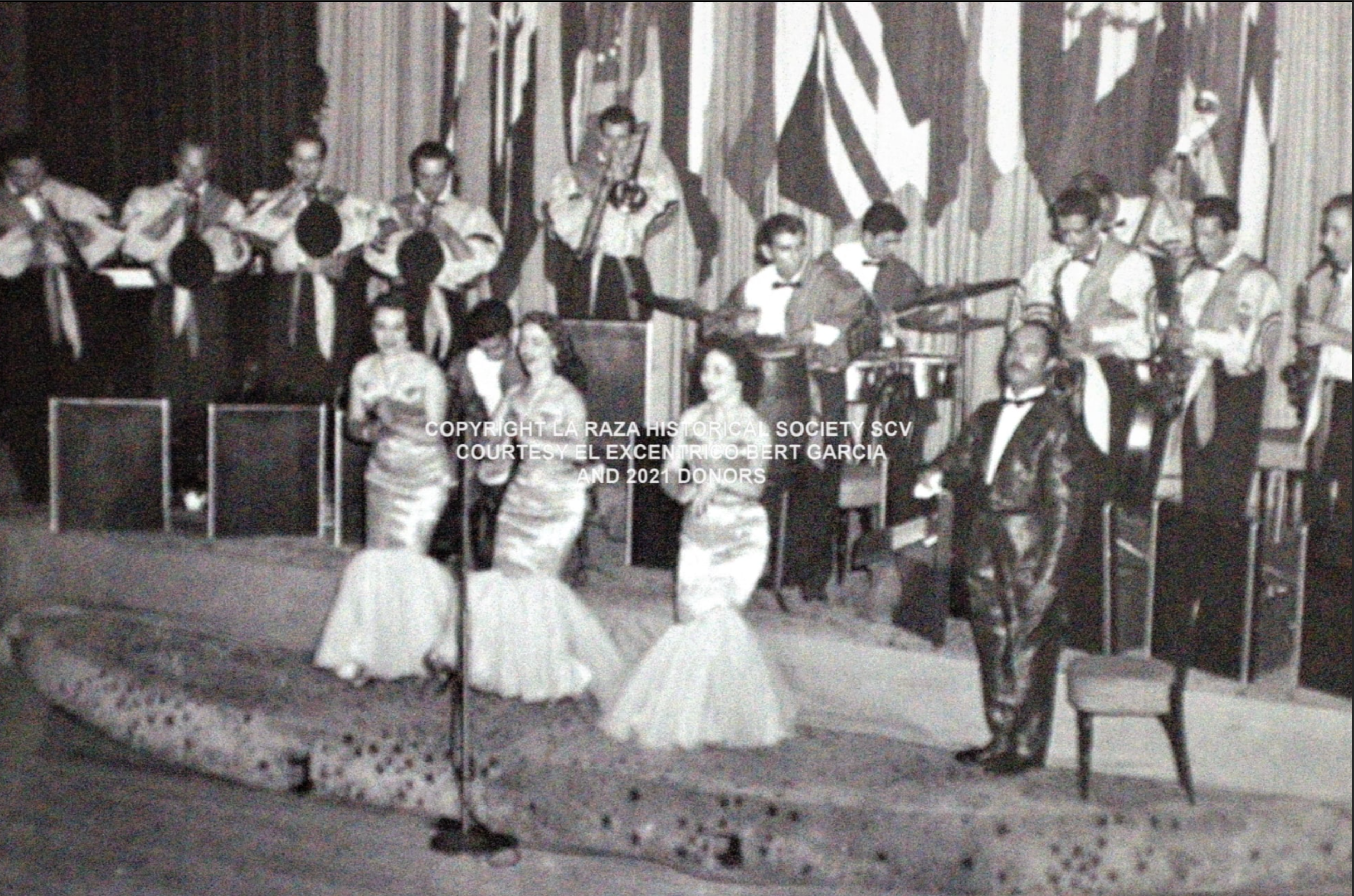
L-R Clockwise: Spanish Language Radio Announcers, State Assembly Candidate Ernest F. Abeytia, Market Street Shopping, Las Hermanas Montoya and Pérez Prado at the Palomar Ballroom (photos courtesy of El Excéntrico Magazine, MLK/SJSU Library, and La Raza Historical Society of Silicon Valley)
Chapter 5
The Rise and Fall of Los Excéntricos
We aim to improve with every edition so that it is a dignified reflection of our community.
~First edition of El Excéntrico, April 1949
***
The Palomar Ballroom. San José, California. Circa early-1950s. Dámaso Pérez Prado and his Orchestra were belting out Mambo #5, the famous smash hit that took the United States by storm. The Cuban-born bandleader from México City, who popularized the mambo dance craze, loved playing the Palomar Ballroom when he swung through San José.
His three singers, Las Hermanas Montoya, were San José natives. The club’s management treated him like royalty, and San José’s Mexican community and Mexicans from throughout the Bay Area packed the house and the dance floor.
The city built The Palomar Ballroom in 1946 on the northeast corner of Notre Dame Avenue and Carlysle Street in downtown San José, two blocks west of the present-day San Pedro Square. It was the first significant building constructed in the city after World War II.
Built for the Big Band Era, the ballroom hosted major musical acts like Ray Charles and Fats Domino. Ethnic Mexican promoters also attracted acts from México and Latin America, including Dámaso Pérez Prado and the brightest Mexican mariachi stars of the day. Historians consider it the first integrated dance hall in San José.
The building changed with the times, hosting rock and roll and rock acts, and a discotheque, from the 1960s through the late 1990s. Eventually, the last occupant of the original Palomar Ballroom building closed for good in 2002.
According to a city report, the structure was eligible for the California Register of Historic Resources and the National Register of Historic Places in part for “the building’s role in the preservation of the diverse social and cultural traditions of the Latino community in Santa Clara Valley for approximately 50 years.”
Despite the historic value of the original Palomar, the grand ballroom building was demolished in 2005 to make way for a high-rise residential development. As a consolation, the city required the developer to incorporate visual displays of the building’s history. It recommended that the Historic Landmarks Commission obtain information “from conducting oral histories with members of the Chicano community.”
The high-rise development, however, was some 50 years into the unknown future for the revelers dancing to Dámaso Pérez Prado and his Orchestra in the Palomar Ballroom. The orchestra included up to 14 musicians playing trumpets, saxophones, trombones, a drum set, timbales, congas, and a stand-up bass.
The energetic music filled the high-ceilinged, cavernous room. Women dressed in evening gowns, cocktail dresses, high-heeled shoes, and white or cream-colored elbow-length gloves. Men wore neatly pressed dark suits, crisp white dress shirts, colorful ties, and shoes polished until they could see their reflections when looking down.
Couples danced the mambo cheek to cheek as they stepped back and forth, and side to side, while sensually swiveling their hips to intoxicating rhythms. Gentlemen flipped open shiny lighters to light cigarettes for themselves and their dates. Cigarette smoke hovered just slightly above the dance floor. With cocktails in hand, those not dancing chatted, laughed, and enjoyed a lovely evening out on the town.
San José’s Mexican American middle class had arrived.
***
Most ethnic Mexicans still labored in backbreaking agricultural work. Although shunned from front-office work and government jobs, Mexican Americans began to find employment opportunities in the fast-growing valley. As La Colonia expanded and its residents remained unwelcome in other parts of town, ethnic Mexican entrepreneurs emerged to provide daily services.
The community included doctors, lawyers, hair salons, barbers, photo studios, grocers, auto shops, tax preparers, clothing shops, and much more. When Ford Motor Company opened an assembly plant in the neighboring town of Milpitas in 1955, ethnic Mexicans sought out those potentially well-paying union jobs.
With resilience and perseverance, ethnic Mexicans responded to the stinging rejection of the powers that be by developing La Colonia into a self-sufficient community that thrived with businesses of their own. The establishments lining Market Street sold American goods and Mexican imports. The Balconades, the Rainbow Ballroom, and the Majestic competed with the Palomar to host local talent and major musical acts from México.
Radio programs featured personalities that read the news in Spanish and played the latest popular Latin music, and three theaters showed first-run movies from México. Ethnic Mexicans from throughout the Bay Area went to La Colonia for shopping and entertainment. The Market Street corridor was a vibrant and bustling example of ethnic Mexican entrepreneurship, work ethic, and family-centered community.
The community also had its own press outlets. Perhaps the most influential of these was El Excéntrico, a small 5 ½ by 8 ¾-inch magazine that published 30 to 40 pages each month. The magazine’s employees distributed it to businesses in La Colonia, east San José, and, ultimately, across the greater Bay Area. The magazine shared local news, culture, fashion trends, politics, and society gossip in English and Spanish.
Beginning in the early 1950s, Mexican Americans had sought to participate in politics to ensure that local government met community needs and addressed concerns. The Community Services Organization, a grassroots advocacy group based in Los Angeles, organized in Sal Si Puedes and La Colonia to register voters. The organization sought to replicate its success in electing the first Mexican American to the Los Angeles City Council in 1947.
Three years later, a grocery store owner named Charles Esparza and attorney Manny Gomez filed their intent to run for the San José City Council. On the East Side, reports indicated that Republican poll watchers harassed voters by questioning their citizenship and legal voter registration cards. Mainstream candidates soundly defeated Esparza and Gomez in the April primary election.
Despite the efforts of the Mexican American middle class to gain access to the public decision-making table, subsequent public policy actions by the San José City Council during the 1960s and 1970s would literally cause the “demolition” of La Colonia and its dynamic business district.
Hundreds of ethnic Mexican families were displaced to make room for San José’s first urban renewal project. The Park Center Plaza, 3.8 million square feet of commercial and office space (directly across the street from the present-day Plaza de César Chávez), broke ground in July 1968.
Other buildings quickly followed. The main library on San Carlos Street in 1970 and the Center for Performing Arts in 1972. Major San José cultural venues like the Tech Museum of Innovation and the Children’s Discovery Museum, both valuable community assets, sit on the ashes of a once-thriving ethnic Mexican community.
Through it all, Mexican Americans endured like the ever-present avena barbata swaying in the howling winds of a winter storm. When the wind and rain stopped, San José’s ethnic Mexican community stood tall like the slender wild oak that covered the east foothills, ready to face the last two decades of the 20th century.
***
Note: Mexican Heritage Plaza: A Symbol of Resilience and Perseverance is coming SOON!
 ESEReport.com
So what happened to Sal si Puedes on the Eastside of San Jose?
Although it has experienced many changes since the 1950s, the neighborhood is still there.