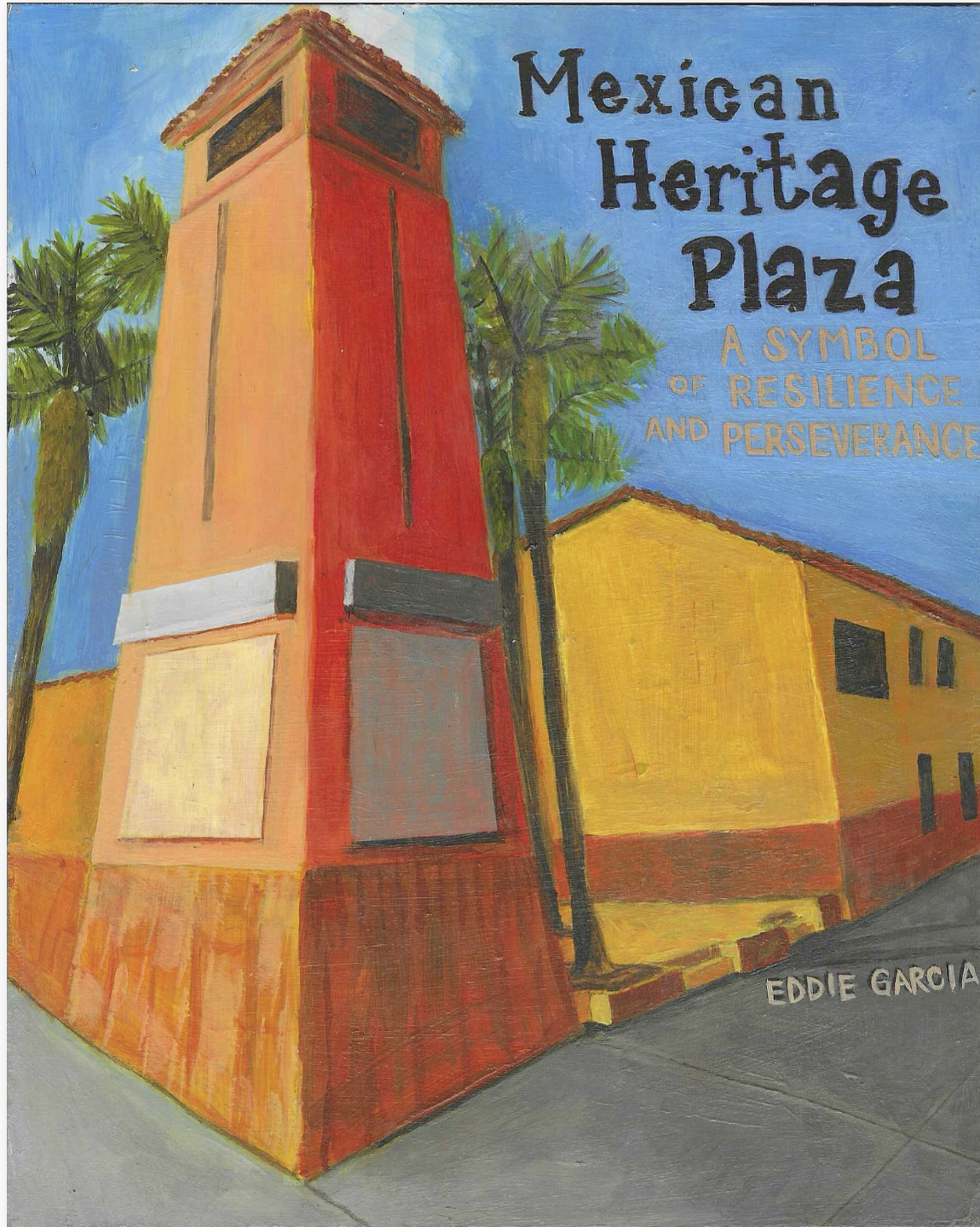
My new book is titled Mexican Heritage Plaza: A Symbol of Resilience and Perseverance. La Raza Historical Society Publications is scheduled to release the book in Spring 2026. The prologue is reprinted below.
***
Prologue
September 9, 1999, was a beautiful day in San José, California. A large crowd gathered for the dedication of the Mexican Heritage Plaza, the city’s most ambitious neighborhood cultural arts project. Although the first day of autumn was less than two weeks away, clear skies, a light breeze, and a comfortably warm 74 degrees blanketed the plaza. There was a sense of excitement, accomplishment, and relief that this day had finally come. It was as if the gods conspired to make a perfect day for the much-anticipated consecration of a living and breathing monument to the city’s Mexican origins.
When the 1,000 or so people settled into their seats, Santa Clara County Supervisor Blanca Alvarado stood and walked up the few steps onto the stage to address the gathering. The audience included San José’s political class, community activists, neighborhood leaders, and other guests. When she approached the podium, Alvarado opened her comments with equal parts passion and eloquence:
“To be here with you at this official dedication is to stand in awe and wonder at what we have accomplished in the spirit of community. To stand here is to feel free at last from the stinging rejection that so many of us have felt for being Mexican-American. To be able to speak our language and to experience our cultura in its many forms is to acclaim our right to be.”
With that opening flourish, Alvarado brought to life recognition of the city’s Mexican roots, which white Americans had dismissed since their arrival in the late 1840s.
***
The first human beings to occupy the land that is now San José, California, were the Ohlone people. They descended from nomads who migrated across a land bridge that connected modern-day Asia to North America in search of food and game about 15,000 to 30,000 years ago. Archeologists believe that descendants of those wanderers settled in what is now the Santa Clara Valley 4,000 to 10,000 years ago.
In January 1777, Franciscan friars established the first European settlement in the valley by founding Mission Santa Clara de Asis. Eleven months later, a group of settlers representing the Spanish king founded El Pueblo de San José de Guadalupe just east of the river that dissected the two communities. Although they settled on the eastern bank of the Guadalupe River as subjects of Spain and under the orders of the Spanish government, all 66 people who established the camp were born in modern-day Mexico. Contrary to assertions by 20th-century San José historians and those who claim to be descendants of the settlers, members of the 1777 group were most likely not culturally Spanish. They were ethnically Mexican.
Since its birth as a European-style civil settlement, San José has been a community with a rich Mexican history. From its founding in 1777 to 1822, the town was a colony of the Spanish Crown. The Mexican Empire and its successive governments ruled the people of San José from 1822 until the United States acquired the pueblo as spoils of war in 1848. With the influx of Americans traveling to California in search of fame and fortune during the Gold Rush of 1849, San José began its slow ascent as an industrial city. First, with quicksilver mining in the Almaden Hills, and later, with the robust canning business tied to the agricultural boom that created the Valley of Heart’s Delight.
During that time, Mexicans worked the mines, cultivated grain and vegetables in the fields, and harvested the fruit trees that blanketed the valley floor and hillsides. Civic leaders and 20th-century San José chroniclers have spent nearly two centuries trying to erase that history. Through the 20th century, the handful of scribes who wrote about San José’s history ignored the ethnic Mexican experience. While historians, professional and otherwise, erased ethnic Mexicans from published historical works, the Mexican community of San José continued to thrive.
Beginning in the early 1950s, ethnic Mexicans unsuccessfully attempted to establish a cultural center to celebrate the city’s Mexican birthright. Proposals from the 1950s, 1960s, and 1970s faced institutional roadblocks, financial challenges, and community divisions. Ultimately, none of these projects progressed beyond the idea phase. Despite efforts by generations of San José’s ruling class to marginalize the contributions of ethnic Mexicans to the city’s development, a group of Mexican American civic leaders overcame seemingly impossible odds in the 1990s to build a state-of-the-art Mexican cultural center that would become a symbol of Mexican American resilience and perseverance.
 ESEReport.com
Eddie: Very well written, and from San José’s pre-history to the time of settlement is a nice timeline. You properly emphasize the efforts of so many previous historians to ignore or purposely minimize the presence of the ethnically Mexican settlers, making scant mention of that population and the many contributions to the evolution of our city by its MexIcan-American residents.
Thank you, Don Fernando Zazueta!
Eddie, what an incredible way to honor the history of the Mexican Heritage Plaza and the community leaders who fought to make it a reality is truly powerful. I can’t wait to read your new book, now more than ever.
“To stand here is to feel free at last from the stinging rejection that so many of us have felt for being Mexican-American. To be able to speak our language and to experience our cultura in its many forms is to acclaim our right to be.” Love it!!!