


To stand here is to feel free at last from the stinging rejection that so many of us have felt for being Mexican-American. To be able to speak our language and to experience our cultura in its many forms is to acclaim our right to be.
~Honorable Blanca Alvarado, Santa Clara County Supervisor, September 9, 1999
* * *
It’s been some time since I’ve written on this blog, 141 days to be precise. Here’s the scoop. I’m working on my second book. It’s not a sequel to Summer in the Waiting Room and it’s not about my personal life. I’m doing historical research and writing about the Mexican American experience in San Jose, California. The story doesn’t paint a rosy picture.
Society’s current view that Mexicans are hard working people is a recent phenomenon. Less than a generation ago, the majority of the population used the adjectives “dirty” and “lazy” to describe Mexicans. My family’s experience and research on my book, however, indicate that the words “resilience” and “perseverance” more accurately portray Mexicans and Mexican Americans.
The racist policies of the current presidential administration are nothing new. When California became part of the United States in 1850, the largest landowner in San Jose was a Mexican American rancher named Antonio Chaboya. By 1863, he lost 90% of his land as a result of the California Land Act of 1851. It’s a fascinating story that I’ll describe in my upcoming book. Chaboya’s fate was shared by many ranchers throughout Santa Clara Valley during the same era. The story of Mexican Americans in San Jose is littered with similar tales of exploitation in its 175 year history as an American city.
Despite those kinds of setbacks, the Mexican American community in San Jose has survived and thrived. From the 1950s to the mid-1970s, downtown San Jose was the epicenter of the Bay Area’s largest Mexican American business district. The City ultimately demolished it to redevelop the city center. With resilience and perseverance, Mexican Americans in San Jose recovered from the destruction of their thriving downtown business district to secure places of influence in the community today.
I’ll keep readers posted on the book’s progress. There’ll be more information in the months to come.
I stepped away from my book project this weekend to work with Cohort 15 of the Latino Leadership Alliance (LLA) Leadership Academy. The Academy is an eight-month leadership program that engages, mentors, and mobilizes the next generation of Latino and Latina civic leaders. Last weekend’s Academy workshops focused on politics and local government. The sessions were held in conjunction with the Bay Area Latino Elected and Appointed Officials (BALEO) Leadership Summit in Napa, California. I was also a presenter at the Summit.
The attempt to take mental leave of my book project was in vain. The weekend in Napa was a powerful and uplifting demonstration of Latino resilience and perseverance. All around me I was reminded of the struggles and triumphs found in my research.
Friday morning began with a LLA Leadership Academy seminar on how local government works and the importance of Latinos engaging in the political process. With the BALEO summit in session at the same time, the LLA Academy cohort had the benefit of engaging with a panel of Latino and Latina elected officials from Mountain View, Morgan Hill, San Jose, and Santa Clara. The politicians shared experiences about the challenges and opportunities of serving in political office.
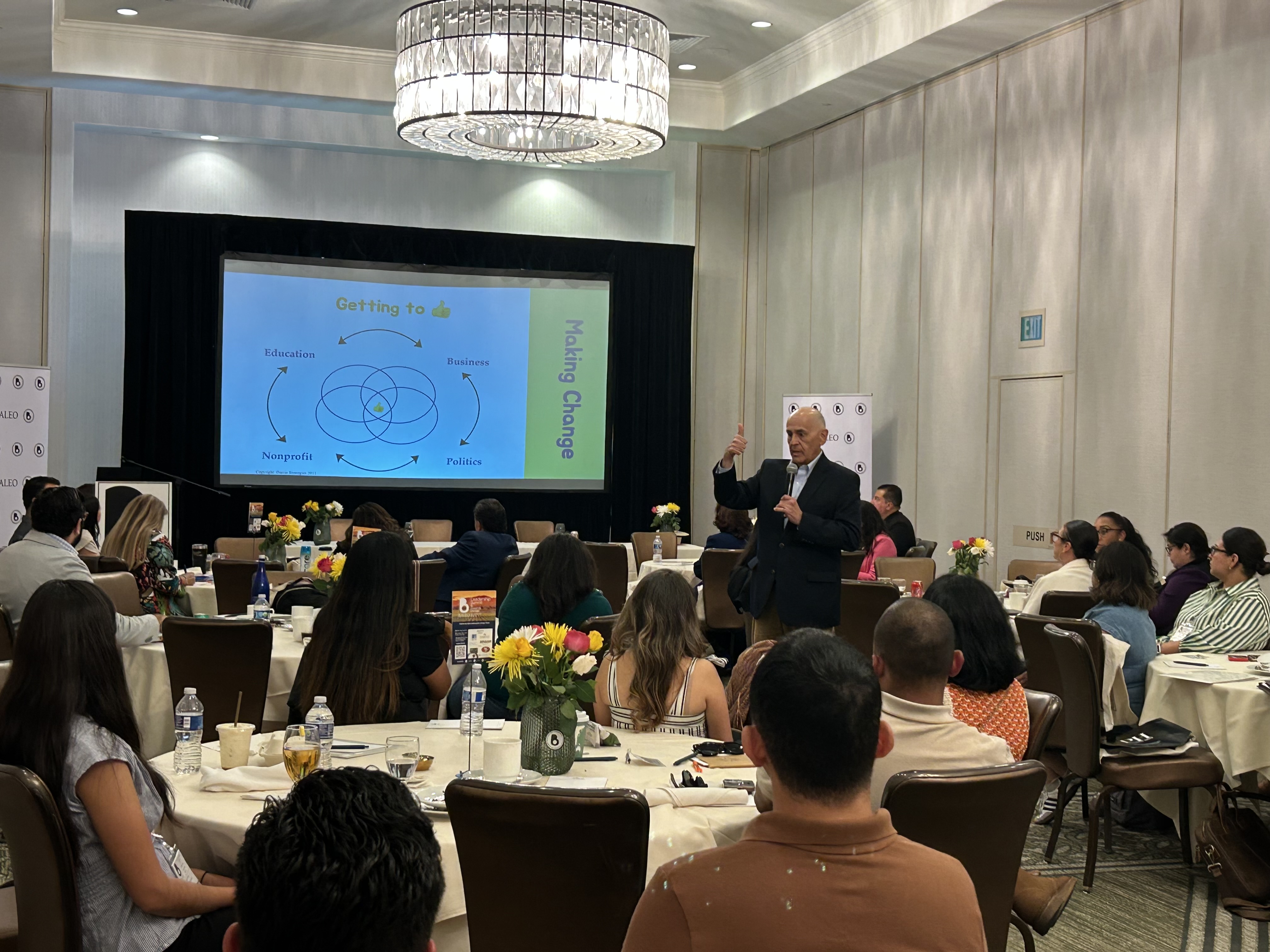
That afternoon, I presented a community leadership model to a room full of elected county supervisors, city council members, and school board trustees who represent communities from Napa to the Central Valley. The best part of the afternoon was the Q&A and exchange of ideas. Many in the room were the first Latino or Latina ever elected in their jurisdictions. With resilience and perseverance, they each have had to overcome inherent biases to bring fresh perspectives to solving problems in their respective communities. Their work inspires me.
Saturday was a day of celebration. As a conference speaker, I was invited to join BALEO and corporate leaders in a suite at the Bottle Rock La Onda Festival in Napa. The festival attracts major musical acts from Mexico and Latin America on two giant stages in a large park. More than 40,000 people attended this amazing event. After spending time networking and thanking our hosts, Sandra and I ventured out into the festival to listen to music.
We meandered our way through the crowd to get a closer look at Pepe Aguilar before his set began. Pepe is the scion of the Aguilar musical family. His father Antonio was fondly known as El Charro de México (Mexico’s Cowboy). I grew up listening to Antonio Aguilar. Pepe is just as famous as his legendary father, and, in my humble opinion, a better singer. Pepe’s daughter Angela, a rising star in her own right, performed at La Onda the next day. By the time Angela reaches her father’s age in about 30 years, the Aguilar Family will be on top of the Mexican music world for over 100 years! But, I digress . . .
There was exciting anticipation in the air as Pepe Aguilar’s mariachi stepped onto the stage and the crowd roared when the musicians started playing Son de La Negra, the traditional mariachi “walk up song.” The mariachi seamlessly transitioned into El Cihualteco (The Man from Cihuatlán), a classic son jalisciense from the Mexican state of Jalisco. Pepe’s magical voice mesmerized the throng as he sang about a man from a small Mexican village. Although the sweltering late afternoon sun was hot, I felt chills, proud of my Mexican heritage, as goosebumps popped up on my arms.
The mariachi’s first notes of Se Me Olvidó Otra Vez, written by the late Juan Gabriel, perhaps Mexico’s most famous and prolific singer/songwriter, sent thousands of people into a frenzy. It seemed like everyone in the crowd, young and old, sang along with Pepe, feeling the pain and suffering of every word from the song about unrequited love. More chills. More pride. More goosebumps.
In the faces of the masses singing each lyric, I could see the pain and suffering of the ranchers who lost their land to unscrupulous lawyers and squatters during the 1800s. I could see the sadness of the families that lost their homes in downtown San Jose to make room for the city’s new gleaming buildings. As people were singing, I couldn’t help but believe that all of us in that crowd were in one way or another sons and daughters of those exploited Mexican ranchers and downtown families.
As it turned out, one of the most popular Mexican music groups was denied entry into the United States and canceled its appearance at La Onda. From the stage, as a first generation American born in San Antonio, Texas, with dual Mexican-American citizenship, Pepe Aguilar fearlessly talked about the current presidential administration’s exploitation of our people to the delight of the audience. Hope was the order of the day.
As an encore, Pepe Aguilar sang his rendition of Un Puño de Tierra, a song his father made famous. It’s an upbeat ranchera song about living life to the fullest.
On the day that I die,
I won’t take anything with me.
You must live life to the fullest
for it ends too soon.
Of all that happens in this world,
All that’s left are the memories.
When I die, all I’ll take
is a fistful of dirt.
The pain and suffering in the faces of the crowd gave way to happiness as people danced away with joyful abandon. Pepe had it right. Whether life gives you rocks or all the riches in the world, you can’t take it with you. That’s the spirit of resilience and perseverance in the face of exploitation and persecution.
RIFF Magazine, a major online music publication, wrote in its post-festival analysis about La Onda, “It wasn’t just about the music, but about persistence and pride.” Damn right! The Mexican American and Latino community in the United States will weather the latest storm. Organizations like BALEO and LLA will continue to organize and grow an influential footprint. We’ll be stronger than ever.
As comedian George Lopez likes to say, “we ain’t going nowheres!”
 ESEReport.com