Monthly Archives: November 2023

Love is the Answer

With Sandra in the ICU after LVAD surgery – November 7, 2018

The following excerpt is from pages 258-260 of Summer in the Waiting Room: Faith • Hope • Love

_________

But the greatest of these is love. ~ Saint Paul’s First Letter to the Corinthians 13:13

* * *

My spiritual journey has been amazing! Every day, I travel to intellectual and mystical places that help me understand the power of God, the Creator, or whatever one believes to be a higher power. I understand a little more about the ways of the universe and better appreciate life in this world. With each step on the path, I uncover new revelations that become more profound as I meander along.

Saint Paul the Apostle has been a major influence on that spiritual journey. Faith and hope entered my consciousness in the first two parts of this book. The experience in the ICU strengthened my belief that accepting what we can’t control and managing what we can are the first steps toward finding inner peace. The third part explores where love fits in. Saint Paul wrote in the language of his era. The ancient Greek word he used for love is agape. The word is generally characterized as meaning the giving of oneself for the sake of others regardless of the circumstance. Throughout my spiritual journey, I’ve contemplated deeply on the existence of agape. Is it even possible? Can human beings truly give of themselves without conditions? I believe so, and I believe that Sandra is a perfect example of that kind of love.

Love means different things to different people. Some people believe that love is necessary for life. Others associate it with giving to others and practicing unselfish acts. The word is often used when describing someone’s fondness for a sports team, food, a book, a movie, music, etc. British author and Christian philosopher C.S. Lewis tried to make sense of it all in a groundbreaking book he published in 1960. In The Four Loves, Lewis sheds light on these concepts and describes four categories of love: storge (affection), philia (friendship), eros (romance), and agape (God’s love).

Affection is the kind of love between parents and their children, siblings, and other blood relations. This is one of the strongest forms of love that most of us are blessed to experience. Since it’s bound together by bloodlines and relatives, Lewis believes that 90 percent of a person’s happiness is related to affection. For that same reason, suffering and pain caused by family friction is disproportionately intense. Friendship is driven by choice. Sharing things in common brings people together as friends. These commonalities and circumstances of meeting seem to happen by coincidence. But with God in control, nothing happens by chance. According to Lewis, “Friendship is the instrument by which God reveals to each of us the beauties in others.” Eros is tricky. Anyone who has been “in love” knows that to be true. When we think of romantic love, warm and fuzzy feelings of happiness, butterflies in the stomach, and hugs and smooches come to mind.

Agape is the most powerful form of love. This is the kind of love God has for humanity. There are no strings attached. For Christians, the Passion Story illustrates how love can change the world. God allowed Jesus to be tortured and humiliated on the road to his crucifixion. The Passion Story shines a light on God’s message about giving of oneself for the sake of others. Throughout the summer of 2010, Sandra demonstrated agape in all its glory. She slept on a cot by my bedside for over one hundred days to make sure she was available to make decisions to help the doctors care for me. Her unwavering commitment to my health continued for another ten years as my damaged heart grew weaker and eventually left us with more life-and-death decisions to make. It’s such a cliche to say that I live for Sandra and the girls. But it’s true. I give of myself and sacrifice much to continue the fight to stay healthy for them. The statement “For richer or poorer, in sickness and in health, till death do us part” is embedded deeply in our souls.

My health problems didn’t disappear when I walked through the front door of our house on September 21, 2010. The heart attack that led to the summer in the waiting room left me with a severe case of congestive heart failure, also known as CHF or heart failure. For eight years, I managed the disease with a strict diet, disciplined medication regimen, and regular exercise. My heart eventually reached the end of its usefulness. On November 6, 2018, doctors implanted a mechanical pump called a left ventricular assist device into my heart. On April 16, 2020, a heart transplant gave me a new life. Transplants aren’t a cure. Other complications take the place of heart failure. In five short essays, Part 3 of this book tells the story of the decade after coming home on September 21, 2010.

I don’t know what obstacles lurk in the shadows of my new heart. Making difficult decisions about how to keep it healthy is my new reality. When clouds of uncertainty start gathering and force me to make hard choices, I turn to the lessons of my spiritual journey. No matter what happens, I know that love is the answer.

***

On Thursday, November 9, 2023 from 6:00 to 7:00 pm, I will share more stories from my book at the Stanford Bookstore. Join me and my heart transplant surgeon for an evening of faith, hope, love, and signing books!

RSVP at this link:

God’s Birthday Gift

Walking it off after surgery – November 12, 2018

The following excerpt is from pages 271-275 of Summer in the Waiting Room: Faith • Hope • Love

_________

November 6, 2018, my fifty-fifth birthday, was a day filled with hope and excitement. The night before, Monsignor Francisco Rios joined me, my family, and a few friends in a hospital room at Kaiser Santa Clara Medical Center. He led prayers for a successful open-heart surgery the next morning. The thirty or so people who crowded the room sang “Las Mañanitas,” the traditional Mexican birthday song.

In the morning, the surgical and cardiovascular ICU teams sang “Happy Birthday” before wheeling my gurney into the operating room to implant a mechanical pump called a left ventricular assist device (LVAD). The procedure is straightforward. A surgeon cuts an incision in the chest, saws through the chest bone, opens the rib cage, inserts the titanium device into the lower heart, wires the chest bone together, and closes the incision. The operation typically takes four to six hours, barring any complications.

Kaiser Santa Clara Medical Center established the LVAD program in 2017. The hospital hired Dr. Richard Ha, the surgeon who participated in creating the program at Stanford. While there, he successfully implanted 250 LVADs. After more than a year of planning and assembling a team, Dr. Ha performed the first LVAD operation at Kaiser about a month before my surgery. I was the second patient at Santa Clara to undergo the procedure.

Doctors were concerned about the condition of my heart. For eight years, the right side had been compensating for the damaged left side. The transplant evaluation confirmed that the right ventricle, which pumps blood into the lungs, was getting weaker. This causes elevated pressure in the arteries that carry blood to the lungs. The condition, called pulmonary hypertension, could be fatal during and after surgery.

In the months prior to the operation, doctors prescribed medication to relieve the pressure caused by pulmonary hypertension. This strategy worked until the weeks before surgery. During this time, I increased my activity level in a sort of “nesting” way. I wanted to make sure that my personal and professional affairs were in order before undergoing a major procedure.

When I checked into the hospital on November 2 to prepare for surgery, the lead LVAD doctor approved the use of intravenous milrinone, a short-term drug that helps the heart beat stronger and decreases pressure in the arteries that pump blood into the lungs. With that stress relieved, Sandra and I spent the next three days learning about the LVAD and postoperative care. The plan included up to two weeks in the ICU and another couple of weeks in the cardiac unit of the hospital.

After the festive singing of “Happy Birthday” on the morning of the procedure, the surgeon led an entourage of doctors, physician assistants, nurses, and support staff into the operating room at 8:00 a.m. sharp. Sandra, the girls, and a waiting room filled with family and friends anxiously settled into what was sure to be a long morning and early afternoon.

Just before noon, a physician assistant came out to inform Sandra that everything was going well. The surgeon had successfully implanted the LVAD and was preparing to begin the chest cavity closure process. The waiting room erupted in cheers and a round of hugs. With the nightmare of 2010 still lurking beneath the surface of everyone’s memory, relief and gratitude filled the space.

For the next couple of hours, there was a relaxed mood in the waiting room. After getting a quick bite to eat, family and friends settled down in anticipation of the surgeon confirming that the procedure was complete. The room grew tense and concerned as the hours began to tick by. Finally, the physician assistant emerged from the waiting room with additional news. This time the news wasn’t so good.

The physician assistant reported that complications had delayed completing the procedure. The surgeon and his team were diligently working on resolving the issues that prevented them from finishing. Once an update was available, a report from the operating room would be forthcoming. Everyone sat in stunned silence with the ghosts of 2010 swirling around the room. Prayers and whispered voices replaced the animated chatter and joking of three hours earlier.

Later in the evening, Dr. Ha provided a briefing to Sandra and the girls. Although he looked concerned, he still showed the same confidence we had become accustomed to. As feared, the right side of my heart reacted negatively to the procedure. This may have caused inflammation of the lungs. My lungs were too swollen to close the rib cage and complete the procedure. Also, the heart had grown so weak that any contact with the heart tissue caused it to bleed into the chest cavity.

The good news was that the LVAD was working. With that in mind, Dr. Ha’s strategy was to leave my chest cavity open until the right side of the heart pumped efficiently enough to decrease the swelling in the lungs. He also inserted three tubes into the chest cavity to drain the blood that was pooling around the heart and lungs from the internal bleeding. After answering a blizzard of questions from Sandra, the surgeon returned to the operating room.

When Sandra and the girls were allowed to see me in the ICU, they found me in a deep sleep from the sedative medication. I had a breathing tube inserted in my throat and three tubes draining blood into three canisters sitting on the floor next to the bed. The gap in my chest was held open by a clamp-like device. A skin-colored mesh dressing covered the eight-inch-by-five-inch opening. Sandra and the girls could see blood flowing and my heart pumping through the sterile mesh.

For the next four days, I remained in this condition as the surgical team ushered me from the ICU into and out of the operating room. On the second day, my heartbeat raced to unsafe levels as it struggled to find a rhythm. Doctors administered many electrical shocks to pace my heart. During one of those incidents, I was in the hallway being transported to the operating room when family and friends heard a doctor shout, “Clear!” My body convulsed from yet another shock.

Finally, on November 11, Dr. Ha emerged from the operating room with a wide grin to announce to Sandra that the internal bleeding had stopped, and my lungs were no longer swollen. The procedure to close the opening in my chest had been successful. As Sandra listened to the surgeon, she could see and hear his team in the background near the operating room doors joyously clapping, hugging, and high-fiving each other.

The dedicated surgical team had remained in the hospital throughout the five-day ordeal. The surgeon who came to Kaiser Santa Clara Medical Center from Stanford to start a state-of-the-art LVAD program kept vigil outside my ICU room the entire time. There was little doubt of his commitment and dedication. His determination literally saved my life.

Some people mentioned to Sandra that I must have some sort of strong and amazing will to live. It had to come from deep in my soul, they reasoned. Nothing else could explain the vigorous fight I put up while heavily sedated and unconscious. At first glance, that reasoning makes sense. It’s one thing to be conscious with the ability to make the decisions to do what it takes to survive. It’s another when no conscious control exists.

That’s where faith comes in. Sandra and I relied on our unconditional faith in God to provide answers to my unconscious will to live. We went into the week with hope and the comfort of knowing that the outcome would be in God’s hands. As it turned out, another hopeless medical crisis ended in a miracle. I’m comforted that God will determine when it’s my time to leave this world. That week, my faith journey reached new heights.

With God’s grace, a talented surgical team, and a supportive community of family and friends, my life was extended yet again. At that moment, I was still in critical condition. The following days would surely be difficult but hopeful. November 11 ended the same way the previous five days had. The waiting room gathered in a prayer circle to thank God.

***

On November 9, 2023 from 6:00 to 7:00 pm, I will share more stories from my book at the Stanford Bookstore. Join me and my heart transplant surgeon for an evening of faith, hope, love, and signing books!

RSVP at this link:
https://www.eventbrite.com/…/an-evening-wauthor-eddie…

Oh Shit!

Code Blue

The following excerpt is from pages 124-126 of Summer in the Waiting Room: Faith • Hope • Love

_________

By the early morning of June 18, the clot closed off the blood flow to the heart’s lower-left chamber, causing my heart to pump furiously in its efforts to deliver oxygenated blood to the body. Within seconds of the artery closing, my heart raced to 280 beats per minute. It was alarmingly above the average heart rate of 65 beats. In less than a minute, I went into cardiac arrest.

Cardiac arrest is a medical way of saying that the heart stops beating. Without blood circulation and delivery of oxygen to the body and brain, the patient loses consciousness. If cardiac arrest goes untreated for more than five minutes, lack of oxygen could cause death or, if the patient survives, severe brain damage. The best chance of survival requires immediate cardiopulmonary resuscitation (CPR) and the use of an automated external defibrillator (AED). The AED uses electronic paddles to shock the heart so it can start beating and return to a normal heart rate. Unless someone nearby is trained in CPR and an AED is readily available, the chances of survival for someone who suffers cardiac arrest are remote.

I was fortunate to be in the hospital ICU when my heart suddenly stopped beating. My memory of that episode is brief but harrowing. The entire scene was hazy and chaotic as doctors and nurses appeared to be moving in fast motion, then slow motion, as they worked to save my life. It seemed like one minute, I was watching the NBA finals with my boss and the next minute, I was sitting up in bed violently screaming for help because I couldn’t catch my breath. According to the medical record, I repeatedly shouted, “I can’t get enough air.”

A short and slender pulmonary doctor in his late sixties with thinning gray hair and a trimmed white beard was trying to calm me down. He instructed me to relax so he could help me. Fear of dying entered my mind for the first time as doctors and nurses hovered over me. They looked concerned and even scared themselves. As the doctor urged me to relax, I noticed a nurse standing calmly at the foot of the bed with a soothing smile, talking to me in a soft but audible voice that could be heard above the bedlam. She calmly said that everything was going to be OK, and I would be fine. The nurse looked exactly like my late sister Patty. Warmth and comfort came over me as the madness around me disappeared, and I peacefully fell asleep.

God entered the fray and intervened to calm me as my life hung in the balance. On the morning of June 18, my sister Patty was in the ICU as His messenger of hope. My medical condition was dire. I was in the right place at the right time. If I was anywhere else other than a hospital, I wouldn’t have survived.

At the moment I thought I had fallen asleep, my heart had actually come to a complete stop after racing to that stratospheric 280 beats per minute. The medical team immediately went into action to get my heart beating again. Nurses started CPR as technicians quickly prepared the AED paddles needed to shock my heart back to life. Seconds were rapidly ticking away as the heart monitor standing behind the bed stopped beeping with the familiar peaks and valleys of LED lines bouncing across the screen. In an instant, the monitor emitted a steady, high-pitched sound with a solid flat line, indicating that the heart was no longer beating.

With AED paddles securely in place on my chest, the doctor prepared to activate the shock waves that would send electronic signals to reactivate my heart. In most cases, doctors need to send several signals to the heart to restore a normal heartbeat. When the doctor administered the first shock, my back arched, my chest heaved forward, I sat up, and the heart monitor began beeping again. The procedure worked. God wasn’t ready to take me.

Two months later, a nurse walked into my hospital room with a wide grin and joy in her eyes. She’d heard that I was still in the hospital, so she came to see me to share an anecdote about the hectic morning of June 18. She recounted how she was on duty in the ICU and rushed to my room after hearing the public address system announce a “code blue,” indicating that an emergency life-or-death situation was unfolding. With a broad smile, she remembered how the doctor shocked me with the AED paddles, and I instantly sat up with a grimace on my face. With eyes wide open, I shouted, “Oh shit!”

She said that everyone stopped what they were doing, and for a few seconds, the room became quiet and still. With the deadpan delivery of a stand-up comedian, the doctor said, “I think we have a heartbeat.” The room erupted in relieved laughter.

***

On November 9, 2023 from 6:00 to 7:00 pm, I will share more stories from my book at the Stanford Bookstore. Join me and my heart transplant surgeon for an evening of faith, hope, love, and signing books!

RSVP at this link:
https://www.facebook.com/events/656597839920085?acontext=%7B%22event_action_history%22%3A%5B%7B%22mechanism%22%3A%22your_upcoming_events_unit%22%2C%22surface%22%3A%22bookmark%22%7D%5D%2C%22ref_notif_type%22%3Anull%7D

Con El Favor De Dios (God Willing)

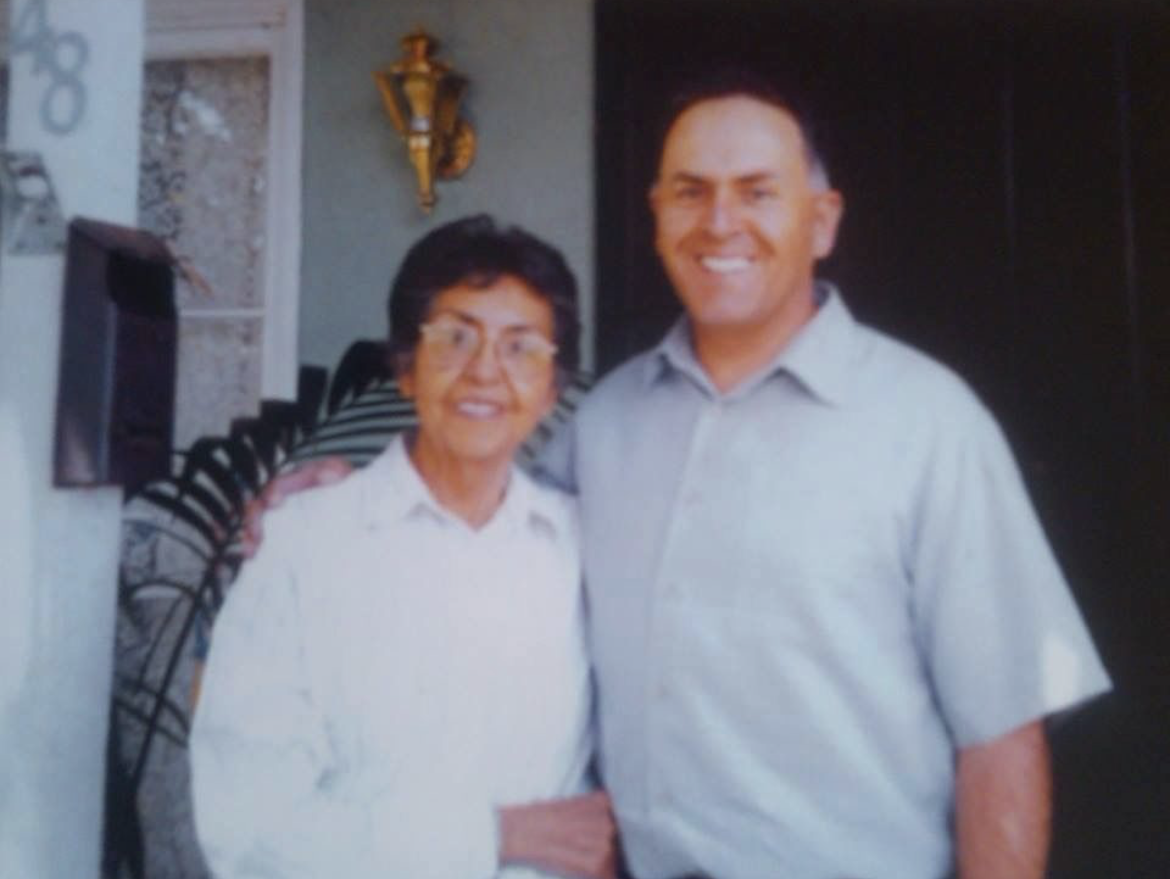
With Mom on the porch of 48 Viewmont Avenue – 1996

The following excerpt is from pages 1-4 of Summer in the Waiting Room: Faith • Hope • Love

_________

Now faith is confidence in what we hope for and assurance about what we do not see. ~ Saint Paul’s Letter to the Hebrews 11:1

* * *

My story is about youthful promise, unfulfilled potential, bad decisions, and crippling failure. What comes next is a frenetic quest to vanquish failure demons and short-lived vindication. A life-changing heart attack and heart failure trigger an exploration of faith. In the end, my spiritual journey, shaped by faith, hope, and love, leads to a remarkable recovery and long-lasting redemption.

There’s a supernatural higher power that mysteriously controls the world around us. Life does its own thing despite futile efforts to manage it to our benefit. No matter how hard we try to unravel mysterious phenomena with science, there are some things that can’t be explained. That’s when we turn to religion, spirituality, and mysticism to find answers. Mahatma Gandhi’s grandson once told a friend that his grandfather said, “Religion is like a mother. However good your friend’s mother may be, you cannot forsake your own.” In honor of the profound influence my mother had on me, I refer to God throughout this book as that higher power.

Wholehearted confidence in God is at the core of faith, inner peace, and happiness. Unfortunately, like most worthwhile endeavors, devotion to unconditional belief is easier said than done. I’ve spent more than a decade reading, learning, and thinking about how to apply the concepts of acceptance, gratitude, and reliance on the divine in my day-to-day life. While the literature opened my eyes, I could’ve looked no further than my mom’s life to find answers. She was a model of faith, even though I didn’t fully understand the impact of her words and actions.

When I was a kid, she taught us to say, “Thank you, God, and thank you, Mom” after breakfast, lunch, and dinner. Of course, I understood why I was thanking Mom. She cooked the meals. The reason for thanking God never really dawned on me. I thought it was a ritual like everything else about church: sitting and standing at the appropriate times, praying “Our Father,” taking Communion, and reciting responses after the priest gave a blessing. For Mom, the words had deep meaning. Through the course of any given day, you could hear her say, “Si Dios quiere” (God willing), “gracias a Dios” (thank God), and “Dios te bendiga” (God bless you). These expressions of devotion were part of every discussion she had with someone. They weren’t mere clichés to her. She was patient, understanding, and thoughtful no matter the situation, good or bad. Mom was a woman who put herself in God’s hands.

As I grew older and more financially secure, I started to notice the beautiful simplicity of her life. I found time to visit her in the morning on the way to work almost every Friday. I loved to see her eyes brighten and her smile broaden when she opened the door. A warm hug greeted me before she escorted me to the kitchen to fix a plate of papas (fried potatoes), two over-easy eggs, a cup of coffee, and warm tortillas. Mom loved to hear about my week and shared news about my brothers and sisters. Her children and grandchildren were her prized “possessions.” When my siblings and I bought “nice” homes and filled them with “nice things” (her words), she beamed with pride. When she passed away, she had the same round kitchen table, simple living room furniture, basic dinette, and plain bedroom set that I remember as a boy. She appreciated every bit of it. I never heard her yearn for more or complain about what she didn’t have.

Mom genuinely believed that to live a happy and fulfilling life, one has to be truly thankful for all that God has provided. My guess is that she had a happy and fulfilling life. The struggles of living and the heartbreak of losing loved ones didn’t deter her from being grateful. She didn’t know her father. She grieved when she lost my grandma, dad, and an older sister. She wasn’t surrounded with “nice things.” She never visited the places she dreamed about. Nevertheless, she was truly thankful for what she had and appreciated every day of life God gave to her.

Faith is a powerful ride-or-die partner to have by your side, especially while riding the roller coaster we call life. I’ve been on quite a ride myself, most of it without the guardrails of faith and gratitude. The highs and lows and twists and turns of my story resemble a wild ride on the Giant Dipper, a whitewashed wooden 1920s-era roller coaster with bright red tracks that dominates the Santa Cruz Beach Boardwalk. When I was a kid, we used to simply call it “The Roller Coaster.” Getting on The Roller Coaster was my all-time favorite thing to do every time my family went to Santa Cruz, which is about a forty-five-minute drive from where I grew up.

The Giant Dipper is a thrilling experience. Without warning, the coaster swooshes away from the starting point and quickly vanishes into a tunnel. Adrenalin shoots through your body while riders hoot, holler, and scream with nervous excitement. The train speeds through a pitch-black curvy tunnel to a low point before emerging from the darkness and begins slowly climbing to the first peak with the classic clicking sound of a roller coaster laboring upward. Once at the top, the train slowly scales the peak and screams down the other side of the tracks in a free fall as it rushes toward the ground. After scaling a couple of smaller hills and valleys, the train rapidly rises up into the sky to reach the top before it violently curves downward to its left, speeding through a deep, scary drop.

For forty-six years, my life followed the path of The Roller Coaster. I grew up in a working-class east San Jose neighborhood in the protective cocoon of my parents. After high school, I ventured away from the neighborhood to attend San Jose State University. Being outside the bubble was exciting and a little intimidating. I eventually flunked out of college and chose a lifestyle fueled by alcohol, dead-end jobs, and the next party. The ensuing undisciplined mayhem was like the Giant Dipper’s wild downward ride through the dark tunnel. Slowly, I put my life back together. I married a wonderful woman, returned to and graduated from college, worked my way up the corporate ladder, and served in public office. My wife, Sandra, and I built a family and a stable life.

On June 7, 2010, we were approaching our twentieth wedding anniversary, our two daughters were healthy and happy, and I had achieved success in my career. It felt like being on top of the world. But like the Giant Dipper’s next move after reaching its climactic bend, my life would soon make an abrupt and furious downward turn and plummet toward its lowest depths. That summer, I embarked on a quest to understand faith the way my mom understood it.

***

On November 9, 2023 from 6:00 to 7:00 pm, I will share more stories from my book at the Stanford Bookstore. Join me and my heart transplant surgeon for an evening of faith, hope, love, and signing books!

RSVP at this link:

https://www.facebook.com/events/656597839920085?acontext=%7B%22event_action_history%22%3A%5B%7B%22mechanism%22%3A%22your_upcoming_events_unit%22%2C%22surface%22%3A%22bookmark%22%7D%5D%2C%22ref_notif_type%22%3Anull%7D